

Design & industry
Corian Nature in Motion 2026: buy the travertine-inspired form, not only the color
The new collection brings layered stone-inspired visuals and richer neutrals into a surface family that can be proposed for shaped and vertical elements. Review the complete form and its pattern transitions before treating it as a continuous stone effect.
Corian Design’s Nature in Motion introduction is useful to a kitchen buyer when the brief includes more than choosing a flat countertop color. A layered stone-inspired appearance might extend into an upright surface, a built-up edge or a shaped feature. The decision is whether that particular appearance still works once it becomes the proposed form. A compelling flat sample does not establish the result at a corner, junction or curve.
DuPont’s announcement dated 2026-04-21 introduces Nature in Motion across Corian Solid Surface and Corian Quartz, with travertine-inspired aesthetics central to the launch. It discusses shaped, integrated and vertical solid-surface applications. Those possibilities still require a project-specific proposal.
Reading note: DuPont: Corian Nature in Motion introduction, April21,2026.
Start with the material that carries the chosen design
The release spans distinct material types. Keep the actual product family beside the selected color in the proposal. A buyer drawn to an integrated-looking solid-surface assembly should not assume that a coordinated quartz option provides the same construction possibilities. A shared collection story is not an interchangeable fabrication specification.
Ask what the household wants to be continuous: the color, the visual pattern, the physical form or the cleaning route. These can be different objectives. A joined assembly may feel coherent while showing an interruption in its veins. A visually quiet field may make a joint less prominent without making the assembly a single uncut piece.
The solid-surface palette offers more than a single pale stone look
The official collection page lists Travertine Roma, Travertine Firenze, Vasto Greige, Vasto Laguna, Artista Drift, Artista Mocha and City Roast as its new solid-surface colors. These names identify candidates, not equivalent constructions or a guarantee that every decorative detail can be fabricated alike.
Reading note: Corian: Nature in Motion,2026 new solid-surface colors.
View the actual candidates at the scale of the intended use. A pale layered appearance on a broad counter may read differently when reduced to a narrow front edge. A deeper neutral may provide the desired contrast without making the whole kitchen dark. The room’s existing cabinet area, rather than the novelty of a color name, should determine how much of it is appropriate.
If the project is attracted specifically to the travertine idea, ask what part of that idea matters. It might be a warm background, visible strata or a restrained stone reference. A buyer wanting the actual natural stone has a different brief from one who wants its layered visual in an identified solid-surface product.
A new visual does not erase the behavior of a patterned assembly
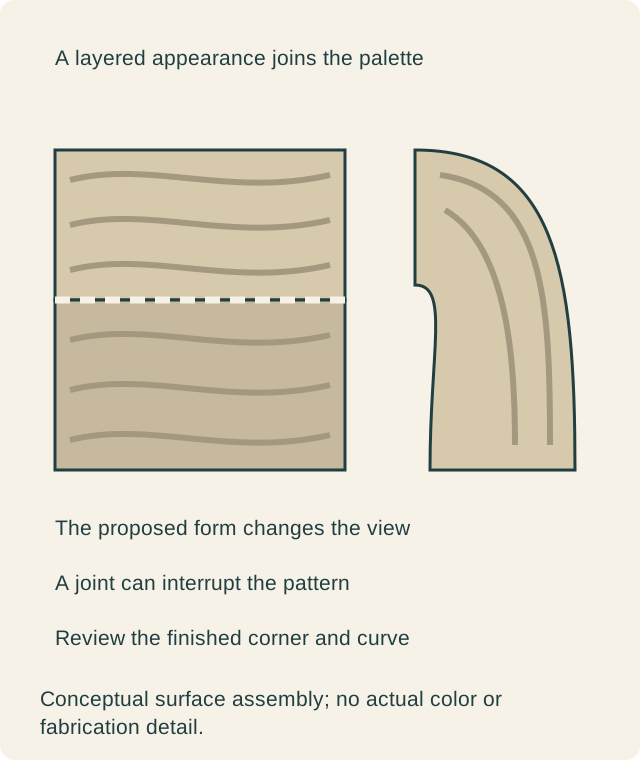
Corian’s veined-aesthetics bulletin explains that joints can interrupt pattern, cutting into a sheet changes the visible pattern, and forming limits depend on the color. This existing technical guidance is a reason to review the actual detail, not proof that every new design behaves identically.
Reading note: Corian Solid Surface: Veined Aesthetics fabrication bulletin.
The purchase should therefore include a useful example of the proposed edge and transition. If a provider describes a continuous-looking feature, ask to see what remains visible where parts meet. The answer can be perfectly acceptable without being invisible. The buyer needs an expectation based on the offered construction rather than an unqualified use of the word seamless.
A vertical extension changes which part becomes important
A backsplash or island end stands in a different viewing plane from the countertop. A line that is secondary from above may become a major feature when upright. Include the view from the adjoining room or dining seat, particularly where a large vertical face remains visible most of the day.
The household might prefer the same new design on both surfaces, or a quieter adjoining material. Matching the product name is not an obligation. If the vertical piece adds too much pattern, reduce its role before fabrication rather than asking the installer to hide an intentional decorative effect after the fact.
A shaped feature needs its own visual trial
If the proposed attraction is a rounded or otherwise shaped element, compare a relevant completed example and ask the fabricator to resolve the selected product. A rendering can express the desired outline, but it cannot demonstrate what the actual chosen pattern looks like around that form.
Keep the shape’s purpose in view. A curved end may soften the visible outline of a furniture-like island; that does not automatically make it useful at every cabinet corner. It must still suit the room’s movement, adjacent doors and intended use. Selecting a new aesthetic should not turn an unnecessary shape into a requirement.
A hypothetical island chooses a simpler assembly
Imagine owners seeking a warm, layered surface for an island with a visible end. Their first concept carries the selected new solid-surface appearance across the top and down a prominent shaped return. They like the flat sample, but a relevant mockup draws their attention to the pattern transition rather than to the intended quiet outline.
In this hypothetical decision, they retain the new design on the countertop and choose a cabinet-finished end. The top keeps the layered appearance they wanted, while the cabinetry supplies the island’s form. They do not reject the material because the first detail was unconvincing; they change the assembly that asked too much of their preferred visual.
Another household may like the transition and retain the shaped proposal after review. The useful distinction is between approving the actual appearance and assuming that a new collection removes every joint or pattern limitation. Both the material and the form should have a reason to remain in the design.
Consider an integrated element as an assembly
When a provider proposes an integrated-looking component, identify exactly what is supplied and how it joins the surrounding surface. Ask for the selected model or fabricated form rather than treating integration as a universal feature of every color. Include the places that the household will see and touch during ordinary use.
The buyer does not need to prescribe the workshop’s fabrication method. It needs a clear finished result and a provider willing to identify the applicable detail. An attractive promotional example demonstrates a design direction; the project still requires confirmation for its particular product and configuration.
Keep the final selection tied to the form it approved
Record the product family, color, finish and accepted edge or shaped detail with the fabrication proposal. If the color or assembly changes, review the affected appearance again. Keep the new collection’s publication context separate from current project supply and from technical confirmation of a particular construction.
The strongest use of this release is a material and shape that work together in the actual room. Whether the result is a layered countertop with a plain cabinet end or a more integrated composition, the household should know what happens at the visible transitions before the pieces are made.
Sources & further reading
- DuPont: Corian Nature in Motion introduction, April21,2026
- Corian: Nature in Motion,2026 new solid-surface colors
- Corian Solid Surface: Veined Aesthetics fabrication bulletin