

Bath & laundry planning
Commercial multiuser basin or a row of individual washbasins?
Choose a manufactured multiuser basin assembly when its defined layout and component system fit the commercial room and the operator can support its actual service and replacement arrangements. Choose independent basins when their separately coordinated positions and replacement boundaries better serve the project. Compare complete handwashing stations, including support and the cabinet or enclosure scope, rather than treating either option as a sink shape alone.
Choose a manufactured multiuser basin assembly when its defined layout and component system fit the commercial room and the operator can support its actual service and replacement arrangements. Choose independent basins when their separately coordinated positions and replacement boundaries better serve the project. Compare complete handwashing stations, including support and the cabinet or enclosure scope, rather than treating either option as a sink shape alone.
Decide what the project is buying as one unit
Bradley documents a one-piece multiuser lavatory with specified faucet and soap component options. This is a manufactured assembly, distinct from individually selected bowls in a fabricated counter.
Reading note: Bradley: manufactured multiuser lavatory system.
Identify the selected basin, supports, enclosure if applicable, controls and other equipment in the actual offer. A product family can allow options without approving every combination. The purchasing schedule should show the exact choices and which parts are supplied by each party.
For individual basins, define the counter, cutouts, mounting and interfaces with each fixture. Separate purchasing can provide flexibility, but someone still needs responsibility for the whole line. A field-coordinated arrangement is not complete merely because every individual bowl has been chosen.
Keep the same user task in both proposals
Plan the actual washing positions with the intended faucets, soap and hand drying. Show where people approach and leave and where any personal belongings are expected to rest. Compare the room's required use with the appropriate project review; nominal station count does not establish a functioning layout or compliance.
Include the operating team's chosen drying and waste arrangements in both. Do not compare a manufactured basin with soap and drying against individual bowls that omit those functions. The purchase should end at the same usable handwashing result before installation scope or cost is assessed.
Show support and service without inventing storage
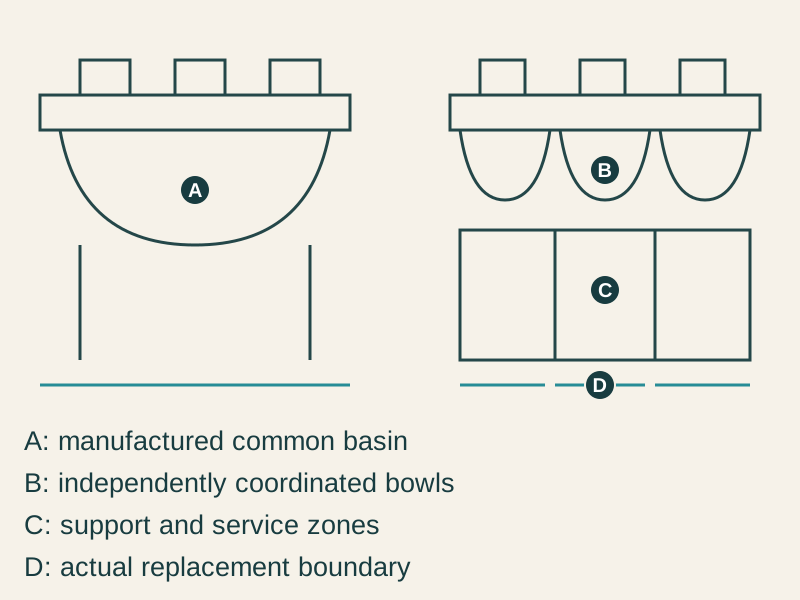
- A
- A: manufactured common basin
- B
- B: independently coordinated bowls
- C
- C: support and service zones
- D
- D: actual replacement boundary
Establish which parts below the basin provide support or equipment access and which, if any, are actual storage. An enclosed front should not automatically appear in the cabinet schedule as a supply cabinet. Obtain sections and the documented open condition for the selected assembly.
For the independent line, review the complete underside with cabinet partitions and access. A counter containing separate bowls may offer a different storage arrangement, but it still needs proof of usable compartments. The proposal should identify where reserve consumables will be kept instead of assuming they fit somewhere behind a front.
Separate component attention from basin replacement
Ask the service provider to describe the actual tasks: attending a control, replenishing a dispenser and replacing a basin are different operations. Identify shared and independent components from the selected system documents and project arrangement. Do not infer that all positions must close for every task, or that all independent bowls can always remain in use beside work.
Then compare replacement boundaries. A one-piece basin is one physical replacement item even when it serves several washing positions. Independent bowls have different potential boundaries, but the real counter and mounting arrangement determine whether one can be replaced without affecting its neighbors. Have that scenario reviewed rather than treating modularity as an automatic operational guarantee.
Work through an operator's priority
Imagine a commercial operator whose priority is replacing one damaged bowl while limiting the work to a defined section of the counter line. The reviewed individual-basin proposal provides a documented replacement method for that section. This is a hypothetical procurement example, not a service promise for a manufacturer's products.
The manufactured proposal provides a clear complete system, but replacement of its one-piece basin involves the larger physical item. The operator compares the actual handling, surrounding finish work and planned availability during that operation with the independent proposal. The project team identifies the resulting responsibilities for both.
The operator chooses individual basins because the confirmed replacement boundary matters more here than buying a factory-defined common basin. Another operator may prefer the manufactured arrangement when its installation and service plan suit the building. Neither choice should be justified by an unverified promise of reduced downtime or fewer maintenance visits.
Compare completed construction and procurement
Include support, top or basin, controls, soap, drying, enclosures, adjacent storage and installation work in the relevant scopes. The lists need not have identical component names, but they should reach equivalent working results. Keep applicable project reviews with the responsible professionals rather than treating a catalog claim as approval of the room.
Use actual quotations and lead information for the selected configurations. A larger one-piece item and several independent parts can create different receiving and sequencing tasks; neither establishes a universal cost advantage. Identify who checks the components before the surrounding millwork or finish is fixed.
Keep the operating team in the final review
Have staff review the documented refill and access tasks with the ordinary room contents represented. A bin or supply cart should not block the agreed access position. Record who maintains the model and parts information so a future replacement is ordered for the installed system.
Choose the manufactured unit when the whole system provides the desired arrangement with understood responsibilities. Choose the individual line when its actual flexibility and replacement boundaries are useful and fully coordinated. The cabinet order should reflect real storage and construction, while the operator receives a handwashing line whose everyday and exceptional tasks have both been considered.
Sources & further reading
- Bradley: manufactured multiuser lavatory system