

Design & industry
CNC 2026 cabinets: drawer interiors and door system options
The new guide needs to be read as a set of specific combinations. Compare the paired Woodbourne+ interiors and drawer boxes, then place the counter-supported and reeded options only in the collections the guide identifies.
CNC’s new-product guide is useful when read as a set of complete combinations rather than a menu from which every feature can be added to any cabinet. Its interior options can carry different drawer constructions, while particular concealing doors and decorative inserts belong to named parts of the offer. The buyer should decide which combination actually serves the room before treating the whole guide as one interchangeable product family.
CNC’s public resource library identifies the new-product guide with a May update. That is a document-version reference, not evidence that every item first went on sale that month or that the guide establishes current project supply.
Reading note: CNC: public resource listing,May2026NewProductGuide update.
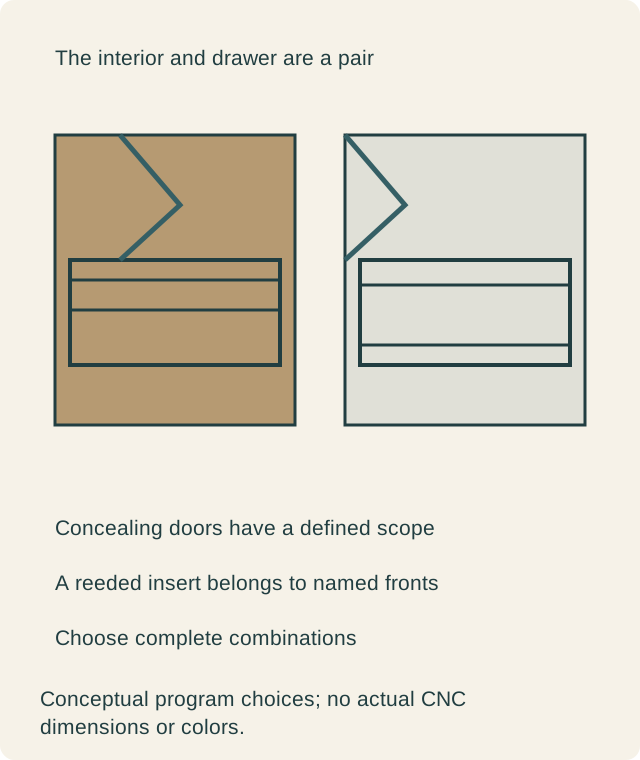
The guide pairs Woodbourne+ maple-finish interiors with wood dovetail drawers and white-satin interiors with double-wall metal drawers. Counter-supported bi-fold and pivot/slide options are limited to Broadway/Milano; reeded inserts to Newport/Versailles. These are specific product combinations.
Reading note: CNC:2026NewProductGuide,publicPDF.
An interior color choice may also choose the drawer
Someone choosing a cabinet interior may initially be thinking only about the background behind stored objects. Here, the documented pairings make the drawer type part of that selection. Compare both the open cabinet and open drawer, rather than signing off on an interior chip and assuming the rest remains unchanged.
The relevant preference can be visual or practical. A buyer may like the continuity of a wood drawer with a wood-looking interior, or the different expression of a metal box with the other proposal. Neither preference should be converted into an unsupported claim that one is universally stronger or has more usable space.
Ask to see the actual proposed drawer with the objects it will hold. The inside space, containment and organizer relationship belong to that complete drawer. A familiar outside cabinet width cannot tell the household whether its existing insert will fit either option.
Keep the pairing intact when comparing quotations
If competing offers show the same door but different interiors, check whether they also change the drawer construction. The difference is not necessarily a hidden defect or a simple price adjustment. It can be an actual product choice that the buyer needs to see and name.
The final selection should preserve the chosen pairing. If the provider proposes a different drawer with the preferred interior, ask it to identify the actual offered configuration instead of assuming the guide allows the swap. A plausible combination assembled from separate photographs is not the same as a quoted cabinet.
The concealing cabinet needs a place on the countertop
The guide’s counter-supported door systems should be evaluated in the room position they are intended to occupy. Decide what becomes hidden and what remains accessible when the doors are put away. The countertop area inside the opening has to serve the household’s task, not simply create an attractive closed elevation.
Include the nearby cabinet and working area in the trial. A concealing cabinet can be appealing for an occasional preparation or serving zone, but the family should consider whether it will normally be open or closed. If it remains open throughout everyday cooking, judge that open arrangement as seriously as the promotional closed view.
Do not transfer the option to a different collection by appearance alone. The specified fronts and supporting cabinet proposal need to come from the actual offered system. If another line is preferred elsewhere in the room, treat the junction as a deliberate mixed proposal, with its visible differences reviewed.
A reeded insert changes one part of the front
The decorative option offers a different way to introduce texture from covering the entire kitchen with it. Ask which doors and drawer fronts in the actual proposal receive the insert, then view them beside the plain members of the selected family. The pattern should have a place in the elevation rather than appearing wherever a spare front happened to fit.
A limited accent may be enough if the countertop or floor already has movement. Another room may want a stronger repeated rhythm. The guide’s availability boundary remains relevant in either case; liking the effect does not make it an add-on for every unrelated door shape.
A hypothetical kitchen prioritizes the drawer pairing
Imagine owners attracted to a cabinet front and choosing between the documented interiors. They initially prefer the lighter-looking interior from a small sample. A complete drawer demonstration then makes them realize that their favorite organizer and the visual character they want are better represented by the other actual pairing.
In this hypothetical case, they select the interior-and-drawer combination they have tested, even though the first chip was their initial favorite. They do not demand an undocumented mixture of the two. The door and room palette remain attractive, while the inside now reflects a conscious everyday-use decision.
Their separate concealing cabinet is selected from its identified collection and shown in the intended countertop location. They keep a simple nearby front rather than assuming that the reeded insert from another family can be transferred to it. The kitchen can combine different ideas without pretending the whole guide is one universal component system.
New doors and new cabinet forms can be different decisions
The guide contains both visual and cabinet-format choices. A new color or front can interest a buyer without requiring a different storage arrangement. A useful cabinet form can justify a change even when its appearance is quieter than the most conspicuous new sample.
Keep the task clear enough to explain why each selected item is present. If a front is chosen for its texture, show where that texture appears. If a cabinet is chosen to conceal a particular activity, show the activity in the open position. This gives the release a concrete role beyond its newness.
Use the guide version without making it the whole order
Record the guide reference alongside the provider’s exact current product selection. A document can establish what was presented in a program without confirming every present-day combination or supply term. Ask the provider to identify any differences between the guide example and the actual quotation.
The completed order should name the selected collection, front, interior, drawer pairing and relevant cabinet system. Keep a representative completed sample and the room’s arrangement together. The purchase is ready when the owner knows what changes inside the drawer and which parts of the new offer actually belong to the selected cabinets.
Sources & further reading
- CNC: public resource listing,May2026NewProductGuide update
- CNC:2026NewProductGuide,publicPDF