Wet cabinet packaging calls for a documented receiving decision, not an automatic assumption that the cabinets are ruined or that drying the outside will make them ready to install. Identify the affected packages, describe the moisture you can observe and contact the supplier and delivery organizer promptly. Ask how to inspect and protect the contents while preserving the arrival record. The decision depends on the actual exposure and product condition, much of which may still be unknown at the curb.
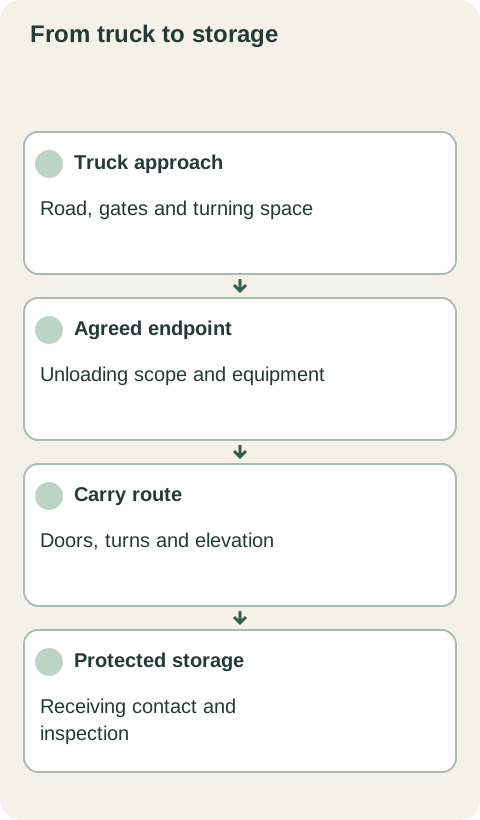
Diagram Identify where moisture is observed and coordinate protection and inspection. This diagram is not evidence that a wet cabinet is usable.
Distinguish current wetness from an old-looking mark
Describe what you see when the shipment arrives: visible droplets, damp or softened packaging, a stain, water beneath the load or moisture inside wrapping where observable. Identify the area and package label. A stain alone does not tell you when the moisture occurred, and rain during delivery does not prove the full history of exposure.
Record the arrival conditions and any known events without guessing a duration. If only the outer wrap is visibly wet, say that; if moisture is visible on a carton beneath it, record that separately. Do not turn an accessible outside view into a claim that the internal protection or cabinet surfaces have already been checked.
Prevent more exposure while arranging the assessment
Tell the delivery team about the observed condition and coordinate an appropriate protected receiving location and handling response. Keep wet packages identifiable apart from unaffected packages. Avoid letting the need to preserve evidence become a reason to leave the load exposed to continuing rain or standing water while everyone waits for a remote reply.
KraftMaid's care guidance cautions against persistent moisture exposure and emphasizes dry cabinet surfaces. That explains why additional exposure matters, but it does not provide a test for accepting wet freight or a drying schedule for a shipped cabinet. Obtain handling and inspection directions for the actual product instead of treating ordinary cleaning advice as a restoration procedure.
Ask for an inspection that reaches the relevant layers
Provide package identity, arrival photographs and the extent of observed wetness to the supplier. Ask who should inspect the outer carton, internal packing and cabinet, and how the findings should be reported. If inspection is arranged, retain the relationship between those layers so an observation about the wrapping is not later mistaken for an observation about the wood or finish.
Record visible changes found on the product, such as an altered edge profile, lifted surface or discoloration, without assigning a diagnosis from appearance alone. State which areas remain unexamined. A dry-looking face cannot establish the condition of concealed edges or the back of the cabinet, and a surface that later dries does not by itself resolve the original exposure question.
Compare different wet-packaging situations carefully
Imagine water droplets on exterior wrapping, with the underlying package not yet inspected. Compare that with a carton whose lower section is wet and visibly soft after sitting over a wet pallet area. Both need accurate reporting, but describing them simply as “wet delivery” hides information that may change the handling response and inspection priority.
Report each affected package and its actual condition rather than assigning the same status to the whole order. Ask the supplier what can proceed, what should remain pending and whether any further review is needed before installation. Do not use a guessed air-drying period, a heat source or improvised refinishing to convert a pending cabinet into an approved one.
Keep the decision tied to the inspected item
Retain arrival records and relevant packaging information while following the agreed protection instructions. If the packaging cannot remain in its original arrangement during protection or inspection, document the change and keep labels traceable. The record should explain what was observed first and what was found after opening, without suggesting that the later condition is the condition in which the load arrived.
Before the affected cabinet is installed, obtain a clear next step from the responsible supplier or project professional based on the actual findings. This may require additional inspection, a product-specific handling instruction or a replacement decision; none should be presumed from the appearance of the carton alone. Share the status with the installer so a package marked for review does not disappear into the installation sequence before that decision is made. Name the person responsible for communicating that decision; a customer-service conversation does not automatically reach the installation team.
Pure White
Cream White
Light Warm Gray
Gray
Navy
Black
Oak Tone
Dark Walnut Tone
Design study These finish studies are design references, not a list of currently orderable colors. Screens and lighting change the appearance; compare a physical sample before choosing.See all finish options →
The sample shows the door frame, a separate center panel, the face frame and the cabinet box. Each component has its own place in this Shaker construction.
Shaker construction: door frame, center panel, face frame and cabinet box. The cutaway helps locate these parts; confirm each material in the specifications for the selected cabinet.
01 / Door frame
The Shaker door has rails and stiles around a separate center panel. The frame and center panel are different components; confirm their materials in the specifications for the selected cabinet.
02 / Face frame
The face frame surrounds the opening at the front of the cabinet box and sits behind the doors. The face frame, door frame and cabinet box are separate parts.
03 / Cabinet box
The sample exposes the cabinet sides, interior surfaces and layered edges. The image does not establish the wood species or material specification of a selected cabinet.