Buying a cabinet tambour door: slats alone are not a working system
A tambour front needs a compatible travel track, return arrangement and, where required, a brake or balancing mechanism. Compare the same completed assembly and cabinet preparation.
Order a tambour cabinet front as a defined system, not simply an area of decorative slats. The linked profiles must travel through matching guides and park in the intended return arrangement. A package that supplies the visible curtain may still omit the parts and machining that make it operate. This matters when comparing a component quote with a ready-to-install assembly.
The track changes the fabrication work
REHAU distinguishes recessed CLASSIC tracks from surface-mounted TOP tracks in its RAUVOLET range. The TOP description explicitly describes cutting to length and screwing down without milling. This creates different cabinet-preparation scopes even before the decorative front is selected. A recessed-track quotation and a surface-mounted quotation are not equivalent if the necessary groove machining is missing from the former.
The color-line/decor-line specification also lists distinct profile thicknesses: E23 and E9 are 8 mm, while E4 and SE26 are 12 mm. That is a concrete reason not to treat all slat curtains as interchangeable. The system specification must match the selected profile with its guides and accessories. Thickness is not a quality ranking, and matching it alone does not prove that an unrelated track will work.
The manufacturer separately describes brakes that slow movement, balancing mechanisms and cassette assemblies. Those functions are not synonyms. A brake description does not by itself establish counterbalancing, and a vertical mechanism is not automatically the equipment for a horizontally travelling front. REHAU’s C-box range packages a preassembled return mechanism, but the applicable assembly still needs its specified rails and accessories.
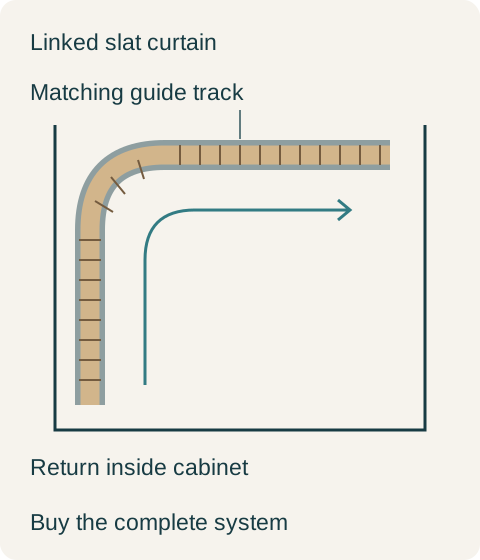
Diagram Conceptual side section showing a linked curtain turning into the cabinet. The return path is illustrative, not a prescribed radius or a drawing of a particular REHAU kit.
A finished cabinet favors a compatible surface track
In a hypothetical retrofit, the cabinet interior is finished and has no routed track channels. A shop confirms a compatible horizontal TOP-based system and demonstrates its complete travel in a representative assembly. The buyer selects that package with the curtain, tracks, return parts, handle and fixing work included. A lower component-only offer for a recessed arrangement is declined because its price excludes the cabinet machining and assembly work it would need.
This choice does not make recessed tracks inferior. For new cabinets manufactured with the required channels, that route may be a deliberate part of the original design. The comparison changes when the cabinet is already finished. Price the preparation actually required at that stage, rather than treating work omitted from one offer as a material saving.
Separate profile stock from a configured set
The REHAU product program allows different movement directions and lists their respective systems. A slat profile name therefore does not define the opening direction, return path or complete accessory list. For trade procurement, a useful order identifies the curtain profile and the chosen system configuration together. Loose stock intended for workshop fabrication is a different delivery from a configured assembly.
Keep the assembly drawing, cabinet preparation and parts list attached to the quotation, including what the fabricator supplies. Approve travel and the closed front using the same configuration that will be delivered. A complete system comparison prevents a decorative material allowance from being mistaken for a functioning cabinet door; it does not rely on a promised installation shortcut for an unspecified kit.
Pure White
Cream White
Light Warm Gray
Gray
Navy
Black
Oak Tone
Dark Walnut Tone
Design study These finish studies are design references, not a list of currently orderable colors. Screens and lighting change the appearance; compare a physical sample before choosing.See all finish options →
Hinged, lift-up and pocket fronts move the obstruction to different places. Compare the full opening sequence, parked front, usable interior and the appliance’s actual operating location.
Compare the actual countertop products, heat-source routine and fabrication proposal. A fired porcelain slab and resin-bound quartz are different materials, but neither label replaces a complete kitchen specification.
The sample shows the door frame, a separate center panel, the face frame and the cabinet box. Each component has its own place in this Shaker construction.
Shaker construction: door frame, center panel, face frame and cabinet box. The cutaway helps locate these parts; confirm each material in the specifications for the selected cabinet.
01 / Door frame
The Shaker door has rails and stiles around a separate center panel. The frame and center panel are different components; confirm their materials in the specifications for the selected cabinet.
02 / Face frame
The face frame surrounds the opening at the front of the cabinet box and sits behind the doors. The face frame, door frame and cabinet box are separate parts.
03 / Cabinet box
The sample exposes the cabinet sides, interior surfaces and layered edges. The image does not establish the wood species or material specification of a selected cabinet.