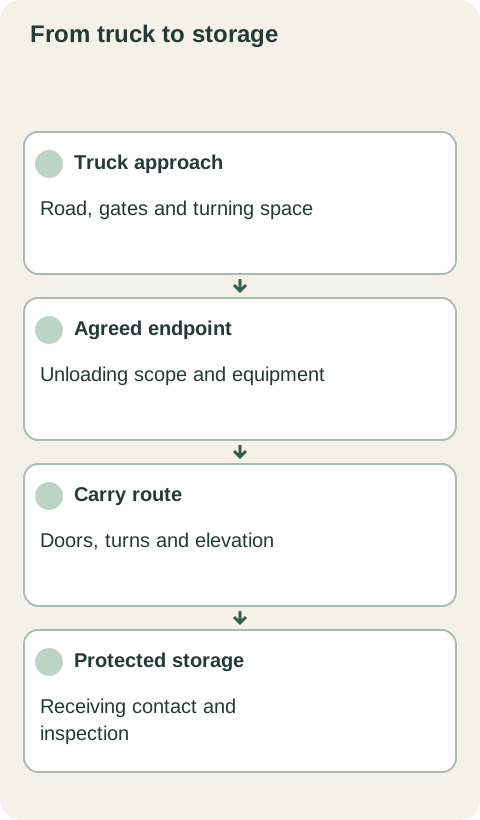
Before choosing whether to receive damaged cabinet freight or leave it with the carrier, consult the instructions for that order and contact the responsible supplier or delivery organizer with the observed condition. Establish the affected items, what handling can safely proceed and what will happen next. Neither an automatic refusal nor an automatic acceptance is a complete plan. The choice needs to fit the actual shipment and remain connected to its follow-up arrangement.
Diagram A receiving decision needs an item-specific instruction and a recorded next location; this diagram does not decide whether a load should be accepted or refused.
Obtain the receiving directions before arrival
Ask the supplier how visible damage should be handled at delivery, who can answer a question during the appointment and what record the receiving person should keep. Have the current instructions available on site. A process remembered from a previous furniture order may belong to a different supplier, carrier or service and should not silently become the rule for this shipment.
Published directions illustrate the difference. Advanced Cabinet Systems' receiving document directs refusal for externally damaged containers. HomeCabinets gives a receive-and-document direction for its Estes LTL deliveries. These are supplier-specific examples, not instructions to transfer to your order. Confirm the actual arrangement rather than choosing whichever general advice sounds more reassuring.
Describe the condition and scope before requesting a decision
Identify the shipment and affected packages, with accessible photographs and concise observations. Distinguish damaged packaging, exposed product damage, an unstable load and a quantity discrepancy. State what has not been inspected. A decision based on a torn outer flap needs different information from one involving a visibly collapsed load, even when both are described casually as shipping damage.
If the load or handling situation appears unsafe, stop the affected activity and have the responsible delivery team address it. The receiving decision should not require the buyer to climb onto equipment or attempt a risky movement to obtain better proof. Explain the observation limits and ask how the team can safely assess the relevant condition.
Clarify whether the decision concerns an item or the whole shipment
If only part of the order is affected, ask whether the supplier and carrier can support a documented partial handoff. Do not assume packages can be separated merely because the buyer wants the unaffected items. The arrangement must identify what stays with whom, and the handling must be supported for the actual load configuration.
Keep the status of the remaining order explicit. Retaining an affected carton at the site, leaving it with the carrier or completing a partial delivery creates different next tasks. Ask whether another collection, inspection or delivery will be needed, who coordinates it and what changes to timing or quoted services should be expected. Do not let the decision end at a word entered on a screen.
Compare the available paths using the same facts
Imagine a cabinet shipment has a damaged labeled carton while the other packages appear intact. The receiver sends the supplier the carton identity and visible condition. The supplier needs to say whether its process supports receipt for review, a different handoff or another action, and how the affected product should be protected or retained. An instruction to “deal with it later” leaves those practical tasks unspecified.
If different people give conflicting directions, relay the exact conflict to the delivery organizer and supplier so they can resolve a single instruction for this shipment. Record who provided the final direction and the time of that communication. Avoid treating the driver's informal comment, a generic webpage and the project's current instruction as though they automatically say the same thing.
Record what happened and keep the next action assigned
Document the observed condition through the receiving process and preserve the final handoff record. Identify which packages were received, which remained elsewhere and what follow-up was agreed. Keep photographs and supplier communication tied to those identities. A record that says only “refused” or “accepted” leaves the next person without the information needed to locate and resolve the affected item.
After the handoff, confirm the status of the original goods and the next contact or update. Receiving the load does not make the damaged item ready to install, and leaving it with the carrier does not by itself arrange a replacement. Continue tracking the agreed inspection, collection or corrective shipment until the actual item and project decision are accounted for.
Pure White
Cream White
Light Warm Gray
Gray
Navy
Black
Oak Tone
Dark Walnut Tone
Design study These finish studies are design references, not a list of currently orderable colors. Screens and lighting change the appearance; compare a physical sample before choosing.See all finish options →
The sample shows the door frame, a separate center panel, the face frame and the cabinet box. Each component has its own place in this Shaker construction.
Shaker construction: door frame, center panel, face frame and cabinet box. The cutaway helps locate these parts; confirm each material in the specifications for the selected cabinet.
01 / Door frame
The Shaker door has rails and stiles around a separate center panel. The frame and center panel are different components; confirm their materials in the specifications for the selected cabinet.
02 / Face frame
The face frame surrounds the opening at the front of the cabinet box and sits behind the doors. The face frame, door frame and cabinet box are separate parts.
03 / Cabinet box
The sample exposes the cabinet sides, interior surfaces and layered edges. The image does not establish the wood species or material specification of a selected cabinet.