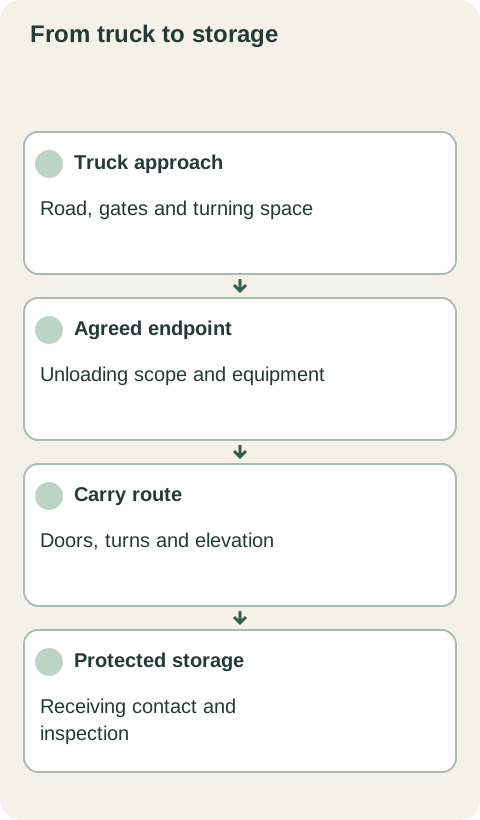
A cabinet receiving note should say which shipment or package has a discrepancy, what was actually observed and what remains unverified. Use the carrier's available recording process and retain a readable copy. The purpose is to preserve a clear account of the handoff. Broad wording such as “problems with delivery” or “not checked” does not explain an observed shortage, an incorrect label or a particular damaged surface to the people who must follow up.
Diagram A receiving note should identify its observation and scope; this illustration does not supply wording with a guaranteed outcome.
Anchor the note to the item and the document
Include or associate the shipment reference and delivery location through the form you are using. Identify the affected package by its readable label or another traceable description. If a label is missing or illegible, say so and describe the package's position or physical identity without inventing a product code to fill the gap.
Maersk Ground Freight lists the shipment reference, delivery location, condition description, photographs and a copy of the delivery receipt with notations as reporting inputs. A note is therefore most useful when it connects to the same item and images as the rest of the report. It should not become an isolated sentence that nobody can relate to a package.
Distinguish pallets, cartons, product pieces and loose packages. If you have counted cartons, describe a carton discrepancy; do not convert it into a number of missing cabinets without checking the contents or packing allocation. A mixed carton may contain several accessories, while a single product may be distributed among different packages.
When the observed count differs from the delivery document, record the actual document count and the count you verified, with their units, in the receiving process. If a portion of the load has not yet been presented or checked, identify that limitation. An accurate partial observation is better than declaring a final shortage before the count is complete, but uncertainty should not erase a discrepancy you have already confirmed.
Separate observation, inference and inspection limits
Write the visible condition in ordinary physical language: a torn lower seam, an opened carton, a bent exposed trim end or a label that differs from the expected item record. Specify whether you are describing packaging or product. Words such as “destroyed” or “fine” can overstate the conclusion when the internal condition has not been inspected.
Do not assign a cause unless you actually witnessed the relevant event, and distinguish what you saw from what someone else reported. If contents remain unexamined, state that as an inspection limit alongside the observed issue. A general reference to future inspection does not tell the reader what was visible at this handoff; the actual observation still needs to be described.
Replace vague wording with a specific example
Imagine the note says “cabinet broken,” but the receiver has only seen a split in the outer carton beside a panel label. A clearer description identifies the labeled panel carton, the side seam opening and the fact that the panel itself has not yet been inspected. This preserves useful information without changing a packaging observation into a product diagnosis.
For a different example, “wrong order” is too broad when the receiver sees an unexpected finish code on a particular carton. Describe that code discrepancy against the current order and keep the rest of the shipment's status separate. If later unpacking shows that the product matches despite the label, add the new finding rather than silently replacing the original observation with a rewritten history.
Check the saved note before the record moves on
Review the notation through the carrier's paper or electronic process and obtain a copy or confirmation of the saved record. Check any prefilled condition description too, and raise wording that conflicts with your observation before the record is finalized. If a short field cannot hold the necessary description, ask the organizer how to associate the additional details and photographs with that shipment. Keep your account consistent across the receipt, supplier message and image labels without deleting relevant differences in timing.
If you cannot enter or verify the intended note, tell the delivery organizer and supplier promptly and retain your contemporaneous observations. Ask what further report is required; a receiving note alone may not complete the supplier's issue-handling process. Preserve later corrections as additional dated information and identify who provided them. Clear wording helps the parties investigate the actual discrepancy, but it does not itself decide the cause, remedy or outcome.
Pure White
Cream White
Light Warm Gray
Gray
Navy
Black
Oak Tone
Dark Walnut Tone
Design study These finish studies are design references, not a list of currently orderable colors. Screens and lighting change the appearance; compare a physical sample before choosing.See all finish options →
The sample shows the door frame, a separate center panel, the face frame and the cabinet box. Each component has its own place in this Shaker construction.
Shaker construction: door frame, center panel, face frame and cabinet box. The cutaway helps locate these parts; confirm each material in the specifications for the selected cabinet.
01 / Door frame
The Shaker door has rails and stiles around a separate center panel. The frame and center panel are different components; confirm their materials in the specifications for the selected cabinet.
02 / Face frame
The face frame surrounds the opening at the front of the cabinet box and sits behind the doors. The face frame, door frame and cabinet box are separate parts.
03 / Cabinet box
The sample exposes the cabinet sides, interior surfaces and layered edges. The image does not establish the wood species or material specification of a selected cabinet.