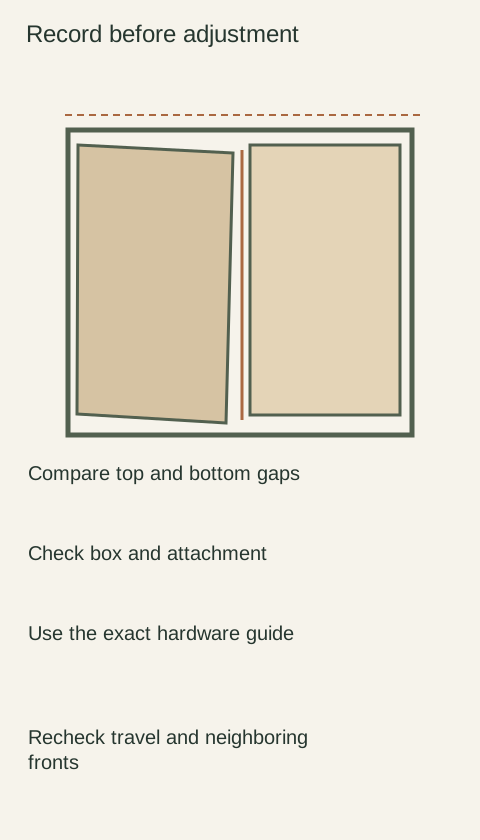
A useful cabinet punch list identifies the exact affected component, not just the room and a general complaint. Give each issue a stable reference, connect it to the installed location and order information, and collect the views needed to distinguish the part. This allows a supplier or installer to review the request without guessing which of several similar doors, panels or hardware pieces is involved.
Diagram Use an identified location and a specific observation. A diagram or photograph alone does not establish whether adjustment or replacement is appropriate.
Describe the observation before choosing the remedy
Record what is visible or what happens during ordinary use, with the location and the date observed. Distinguish a damaged surface, a missing component and an operating concern. Avoid calling every issue a replacement request before the responsible person has reviewed it; an adjustment question and an incorrectly supplied part require different follow-up information.
Use consistent location names that match the project documents. If several identical cabinets appear in the same room, add a marked overview photograph or drawing reference. Keep the issue identifier unchanged when more details are added. Otherwise a revised description may look like a new problem, while the original remains on another person's list.
Connect the component to the actual product record
Record the cabinet or order-line identity, then identify the affected component within it. KraftMaid's owner guide recommends retaining product-label information including product identity, door style and finish. Such records are useful references, but another supplier may use different labels or require additional information for a replacement inquiry.
Do not substitute a cabinet's nominal width for a measured door size, or a finish nickname for the documented selection. Preserve original codes and add plain-language descriptions beside them. If the identity is unknown, say what has been checked and what remains uncertain. A plausible product name can send a request toward the wrong part more quickly than an openly incomplete record.
Photograph identity, location and the specific concern
Include an overview that locates the component and a closer view that shows the issue clearly. Add a readable label or relevant hardware marking when it is accessible without dismantling or unsafe access. Keep the photographs connected to the issue reference so a close-up cannot be mistaken for another door that happens to have the same finish.
State the viewing direction when describing left, right, front or back. For a replacement inquiry, note which face is finished and where existing holes or fittings are located when relevant. Do not reverse photographs or rely on a cropped picture that removes orientation. Measurements should follow the supplier's requested method, with units stated and unclear readings flagged rather than guessed.
Confirm what the proposed replacement includes
Imagine a punch-list entry says scratched drawer, but the affected piece is only the drawer front. A supplier needs to know whether the request concerns that front, the box, the slide or an assembled combination. If the proposed replacement is a front only, confirm how existing hardware and any required preparation will be handled instead of assuming every pictured component will arrive with it.
Review the proposed part against the record before accepting it as the solution. Check style, finish, orientation, preparation and the quantity actually affected. If several issues involve a shared product, preserve their separate location links while consolidating the supply request where appropriate. This keeps an efficient order from obscuring which installed pieces still need attention.
Close the item after the result is checked
Track the request, the supplier's response, any replacement reference and the work still required on site. A response acknowledging the issue is not a shipment, and arrival of a part is not completion of its installation. Keep those events distinct so a project coordinator can see the next action without rebuilding the story from emails.
When the work is complete, check the original concern at the identified location and record the result. Preserve an unresolved note if the replacement does not fit or the operating problem remains. The punch list does not establish fault or promise a particular remedy; it gives the people resolving the issue enough precise information to make and verify the next decision.
Pure White
Cream White
Light Warm Gray
Gray
Navy
Black
Oak Tone
Dark Walnut Tone
Design study These finish studies are design references, not a list of currently orderable colors. Screens and lighting change the appearance; compare a physical sample before choosing.See all finish options →
Translate the design into identifiable products, details and responsibilities. A useful handoff lets another professional price and build the intended arrangement without reconstructing private conversations.
The sample shows the door frame, a separate center panel, the face frame and the cabinet box. Each component has its own place in this Shaker construction.
Shaker construction: door frame, center panel, face frame and cabinet box. The cutaway helps locate these parts; confirm each material in the specifications for the selected cabinet.
01 / Door frame
The Shaker door has rails and stiles around a separate center panel. The frame and center panel are different components; confirm their materials in the specifications for the selected cabinet.
02 / Face frame
The face frame surrounds the opening at the front of the cabinet box and sits behind the doors. The face frame, door frame and cabinet box are separate parts.
03 / Cabinet box
The sample exposes the cabinet sides, interior surfaces and layered edges. The image does not establish the wood species or material specification of a selected cabinet.