

For professionals
One cabinet project, several inquiries: connect the people without mixing their quotes
A homeowner, designer and contractor can contact the same cabinet seller about one job. Keep project identity separate from contact identity, confirm who is buying and approving, and avoid treating each conversation as another kitchen order.
Count the project before counting another sale
A homeowner asks for kitchen cabinets, the designer sends a drawing and a contractor requests a trade quote a few days later. Those may be separate projects, or different conversations about the same room. The cabinet seller needs to find out before quoting incompatible scopes, reserving goods twice or reporting every inquiry as another kitchen likely to be sold.
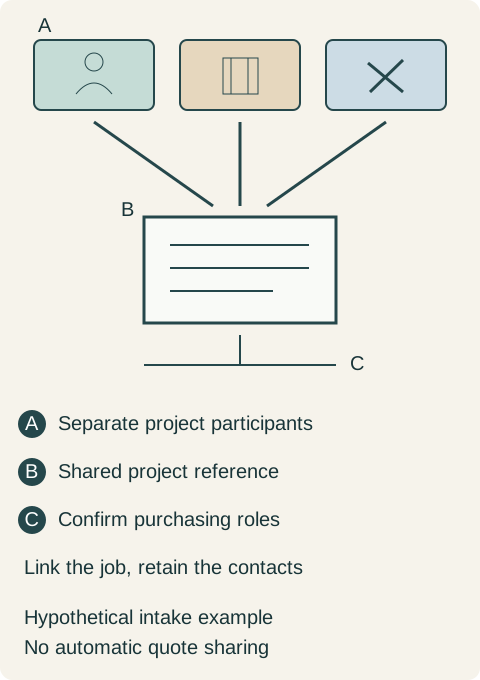
Keep each person identifiable while linking the actual job. A shared project reference should make the current room and requested scope easier to understand. It should not erase separate purchasing relationships, reveal another person's pricing or make someone an authorized approver merely because they know the address.
Contact identity and project identity answer different questions
An email address identifies a contact route. A company name can organize a professional relationship. Neither tells you how many rooms or active projects the person is discussing. A contractor may have several jobs, while several unrelated email addresses can all concern the same homeowner's kitchen.
HubSpot's documentation distinguishes contacts deduplicated by email from companies deduplicated by domain. That illustrates why record type matters. A cabinet team's project matching still requires its own review of the actual job.
Reading note: HubSpot — Deduplicate records.
Use the software or simple file system the business can maintain accurately. The essential decision is which project a conversation concerns and which role the person has there. Buying a larger database does not resolve unclear project identity, and a matching surname alone is not sufficient reason to combine records.
Confirm a likely match with a short project question
Ask whether the inquiry concerns an existing project reference, the same property and room, or a new scope. When another participant has already been introduced, ask for that known connection rather than disclosing an unknown customer's details. Keep the conversation limited to information needed to identify the work.
Addresses need context. A multiunit building can contain several independent cabinet jobs; the same house can have a kitchen and unrelated bathroom purchase. Record the unit or room and whether phases belong to one accepted package or separate purchases. Do not merge everything at a familiar location simply to make the list shorter.
Preserve uncertainty when the evidence is incomplete. Mark a possible connection for confirmation instead of silently treating it as established. Staff should be able to see why records were linked and reverse a mistaken connection without losing either person's inquiry or the history of what was sent.
Establish who selects, approves and buys
The person supplying drawings may not place the order. A homeowner can approve appearance while the contractor checks field conditions; the actual purchaser may be either party under their arrangement. Ask who is doing each task rather than assigning authority from a title such as designer or builder.
Keep the accepted scope and its approver attached to the purchasing record. If another participant requests a change, route it to the agreed decision-maker before altering the order. A revised drawing is useful information, but its arrival alone does not establish that the purchaser accepted a different product package.
Treat price access separately. Knowing that conversations concern the same room does not authorize the seller to circulate one party's private quote. Ask how quotations should be addressed and shared. Where parties request alternative purchase routes, preserve those alternatives without pretending they are several simultaneous orders.
Reconcile alternatives without deleting the useful choices
In a hypothetical intake review, 6 inquiries concern 3 jobs. For 1 job, the homeowner, designer and contractor each contacted the seller; another job has 1 contact, and the remaining job has 2. The counts describe different communication paths, not 6 cabinet orders. They are invented to show the distinction, not a usaKT.com lead report.
If the first hypothetical job has homeowner-direct and contractor-supplied alternatives, keep both scopes while marking them as alternatives for that single project. Do not sum their cabinet quantities into expected demand. Once a purchase route is accepted, identify the chosen package and keep the other proposal as history rather than another active order.
Use the same discipline for finish options and revised layouts. A different door selection can produce a useful comparison without creating a new job. Conversely, a genuinely separate purchase at the same property should keep its own scope and acceptance, even when the buyer remains the same.
Make the next response useful to the whole job
Give the person handling the inquiry enough context to answer accurately: the project reference, room, requested option, latest accepted drawing and unresolved decision. Avoid forwarding a long conversation without explaining whether its attachments are current. The goal is that the next response advances a particular project rather than restarting selection from an outdated picture.
Separate confirmed information from suggestions. A contractor may report a field condition that requires review while a designer is still testing an alternative. Preserve both roles without allowing whichever message arrived last to overwrite the accepted package. Ask for resolution where the information conflicts.
When a staff member takes over, transfer the project map as well as the contact list. That map should show who receives questions, who can approve changes and who will receive the shipment. Keep unrelated projects under a professional account separate so that a decision for one client is not applied to the next.
Review demand using projects and report contacts separately
For sales planning, distinguish unique project inquiries, active proposals, accepted purchases and individual contacts. Choose definitions the team can explain and use them consistently. Several people asking about one room can signal collaboration; it does not multiply cabinet demand. A contact who returns for a genuinely new job should not disappear inside an old record either.
Before moving an inquiry forward, resolve the room identity, the intended purchasing route and the next decision required. Link related conversations, retain separate people and preserve the scope that was actually accepted. Accurate intake helps a cabinet team quote the right job once while still serving everyone who legitimately contributes to it.
Sources & further reading
- HubSpot — Deduplicate records