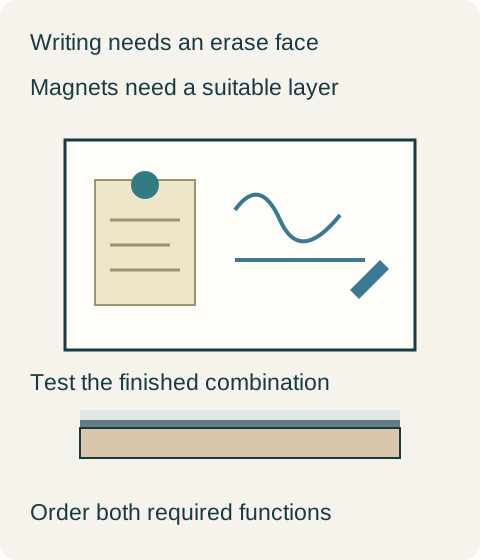
For a cabinet message panel, buy the required functions rather than a white or glossy appearance. A dry-erase surface needs to release the intended writing after use. A magnetic board needs to work with the intended magnetic accessories. Neither function follows merely from the panel’s color, sheen or metal-like appearance, and writing performance alone does not establish magnetic attachment.
The writing surface and magnetic layer are different parts
Wilsonart’s Markerboard data describes a laminate made for dry-erase use, with decorative resin-impregnated paper over a resin-impregnated kraft-paper core. Its smooth gloss finish supports erasure. The document also says the laminate is not structural and needs a suitable substrate. A sheet therefore is not yet a finished cabinet panel.
Abet describes Magnetico differently: it explicitly includes a magnetic layer as well as a writable surface, and identifies use with erasable markers and magnetic accessories. That is affirmative evidence of both functions in this named material. It does not mean every decorative laminate, ordinary glossy door or metallic finish has the same construction.
Translate the intended routine into a sample comparison. Use the specified marker and erase it by the material’s instructions, then try the intended magnets with the actual paper or accessory to be held. Evaluate the finished panel construction, not a loose magnetic backing that will later be buried under another finish. A supplier’s writing demonstration and a separate magnet demonstration should refer to the same proposed surface.
Diagram Conceptual layered message panel and separate writing/magnet functions. The diagram does not specify magnetic force, supported weight or actual laminate thickness.
Choose a combined surface for notes and reusable writing
Suppose a hypothetical pantry end panel must carry temporary paper notices and a repeatedly rewritten shopping list. The ordinary decorative sample does not provide documented writing performance, and a dry-erase-only proposal does not include the magnetic requirement. A completed magnetic/writable sample performs the agreed erase-and-note routine with the chosen accessories. The buyer selects that finished panel package and removes the appearance-only alternatives from the order. No adhesive note rail is added as an unpriced substitute for the function being purchased.
If writing is the only requirement, the comparison can reasonably end with a purpose-made markerboard instead. Paying for an unneeded magnetic layer is not automatically a useful upgrade. Conversely, a magnetic-only display surface should not be approved for repeated writing unless the selected face also has the appropriate writing and cleaning instructions.
Price the panel, substrate and finished edges together
The quote should identify the face product, supporting panel, exposed edges and attachment method. The appearance sample may be small, but the delivery is a complete cabinet component. Confirm that the finished surface and the specified accessories are the combination evaluated, especially if another coating, film or decorative overlay is proposed.
Retain the marker and care requirements with the panel specification. Permanent-marker assumptions, improvised abrasives or a different cleaner can defeat the reason for buying an erasable surface. Keep the writing area distinct from adjacent ordinary cabinet fronts so the functional finish is not mistakenly treated as a property of every matching-colored surface.
Pure White
Cream White
Light Warm Gray
Gray
Navy
Black
Oak Tone
Dark Walnut Tone
Design study These finish studies are design references, not a list of currently orderable colors. Screens and lighting change the appearance; compare a physical sample before choosing.See all finish options →
A painted door, a wood-grain side and a plywood cabinet box can belong to the same cabinet. Here is how to read those parts, what the sample photos actually show, and which details to put on a quote.
A color name does not identify a finish system. Compare the decorative surface, the core, the edge and the repair method before choosing a cabinet front.
The sample shows the door frame, a separate center panel, the face frame and the cabinet box. Each component has its own place in this Shaker construction.
Shaker construction: door frame, center panel, face frame and cabinet box. The cutaway helps locate these parts; confirm each material in the specifications for the selected cabinet.
01 / Door frame
The Shaker door has rails and stiles around a separate center panel. The frame and center panel are different components; confirm their materials in the specifications for the selected cabinet.
02 / Face frame
The face frame surrounds the opening at the front of the cabinet box and sits behind the doors. The face frame, door frame and cabinet box are separate parts.
03 / Cabinet box
The sample exposes the cabinet sides, interior surfaces and layered edges. The image does not establish the wood species or material specification of a selected cabinet.