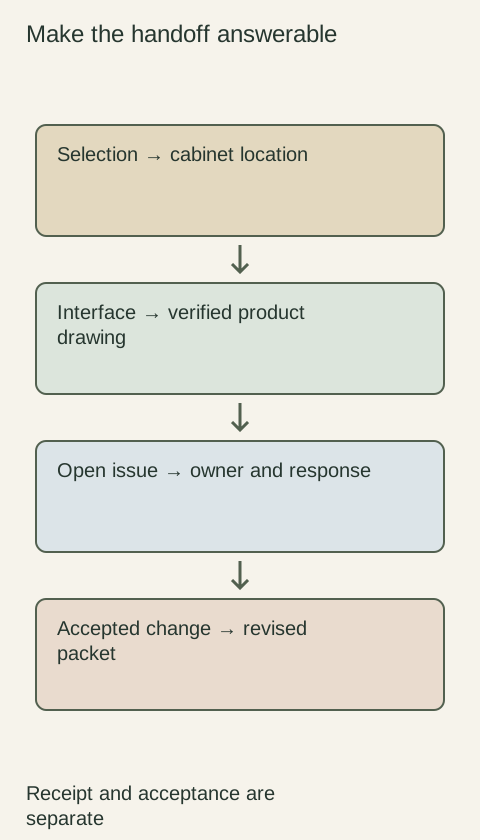
Before buying cabinets, identify the seller handling the transaction and the contact responsible for the order after payment. A website brand, product manufacturer, designer and delivery company can play different roles. Ask how those roles connect in your purchase. The goal is a usable service path: you should know who accepts the order, who records payment and who will answer a shortage or change request.
Diagram Identify who receives and acts on each order question. The diagram does not verify a business or establish a seller-manufacturer relationship.
Identify the seller on the transaction documents
Compare the storefront name with the name shown on the quote and invoice. If they differ, ask for an explanation tied to the specific purchase. A trading name and a billing name may differ, but the buyer still needs to understand the connection. Do not treat either matching names or polished branding as proof that every promised service has been arranged.
The FTC recommends retaining the company's name, website, purchase information and communications when shopping online. Use those records to make the seller and transaction identifiable. This article does not verify a particular business or determine its status; it describes the information a buyer should obtain for the actual cabinet order.
Ask whether the person helping with selections also places the order or only provides design assistance. Identify who supplies the products and who communicates changes to that supplier. A manufacturer name on a door sample does not identify the party that will invoice your purchase. Likewise, a showroom visit does not explain whether the display seller handles your final order.
Write the practical responsibilities beside each contact: selections, order acceptance, billing, shipment coordination and product questions. If a separate installer is involved, identify where its work begins. You do not need every internal department name, but you do need a clear route from the person you can reach to the person who can act on the order.
Confirm the payment connection before using instructions
Check that the invoice identifies the order and explains the payment route being offered. If the payment recipient or descriptor differs from the familiar storefront name, ask the seller to explain the relationship through an established contact. Preserve that explanation with the invoice. Do not assume that a payment screen alone identifies who will handle the cabinet order afterward.
Imagine a designer sends the approved cabinet list, but a separate seller issues the invoice and collects payment. The buyer should ask who accepts product changes and who will provide the receipt and balance record. The designer's helpful involvement does not answer those questions. Resolve the division before submitting payment rather than discovering later that each party expects the other to respond.
Try the order-service route with a real question
Before ordering, use the published contact route to ask a specific question about the proposed purchase, such as how a missing component would be reported. Look for an answer that identifies what information to send and which team handles it. A working phone number is useful, but a generic greeting alone does not demonstrate how your order issue will be managed.
Ask whether the same contact remains responsible after the sale and how to continue if that person is unavailable. If the seller uses a shared service address or case system, retain the route and reference it provides. Do not infer a promised response time unless one has actually been stated. A clear process is more informative than counting available social-media accounts.
Keep a contact record that survives handoff
Store the seller name, website, accepted quote, invoice and service route together with the order identifier. Keep the supplier and carrier contacts separately identified, so a shipping-location question does not become confused with a product-replacement request. If the seller directs you elsewhere for a particular issue, ask who remains responsible for following up on that request.
At project handoff, give the next person a short explanation of the parties and any open issue references, without sharing unnecessary payment credentials. Reconfirm changed contact or payment instructions through a known route. The result should let another person continue the purchase without guessing which logo or individual represents which responsibility, while keeping unverified assumptions about service outside the accepted order record.
Pure White
Cream White
Light Warm Gray
Gray
Navy
Black
Oak Tone
Dark Walnut Tone
Design study These finish studies are design references, not a list of currently orderable colors. Screens and lighting change the appearance; compare a physical sample before choosing.See all finish options →
The sample shows the door frame, a separate center panel, the face frame and the cabinet box. Each component has its own place in this Shaker construction.
Shaker construction: door frame, center panel, face frame and cabinet box. The cutaway helps locate these parts; confirm each material in the specifications for the selected cabinet.
01 / Door frame
The Shaker door has rails and stiles around a separate center panel. The frame and center panel are different components; confirm their materials in the specifications for the selected cabinet.
02 / Face frame
The face frame surrounds the opening at the front of the cabinet box and sits behind the doors. The face frame, door frame and cabinet box are separate parts.
03 / Cabinet box
The sample exposes the cabinet sides, interior surfaces and layered edges. The image does not establish the wood species or material specification of a selected cabinet.