

For professionals
One cabinet line or several brands: build a dealer assortment around jobs you can complete
Add another cabinet line when it solves a documented purchasing gap, not merely to increase the number of doors on display. Compare complete project coverage, operating work and product boundaries before expanding.
Add a line for a missing job, not another logo
A cabinet dealer benefits from another line when that line serves a real project need the current assortment cannot reasonably meet. More brands are not automatically more useful choices. A well-understood range that completes the jobs customers bring can be stronger than several overlapping catalogs that staff cannot quote consistently.
Begin with the projects the business wants to serve. A homeowner replacing a straightforward kitchen, a designer requiring an unusual configuration and a builder repeating accepted units may need different capabilities. Those differences should lead the assortment decision. Do not infer that every customer at a higher budget needs another brand, or that every inexpensive project must accept the same limitations.
Record the actual gap before looking at another range
Review inquiries that could not be completed and identify why. Was the issue a missing product format, finish, modification, complete project price, supply condition or lack of an appropriate service? A different cabinet line may solve some of those problems. It will not automatically solve insufficient measuring capacity or a receiving service the business never arranged.
Separate unavailable product from unexplained product. A team may lose a job because it does not understand an option already offered in its current range. Confirm that capability before assuming another supplier is necessary. Equally, do not keep forcing awkward combinations into the original line when a genuinely different product system would serve the project better.
MasterBrand's dealer information describes a portfolio spanning different styles, finishes, customization choices and price points. This illustrates how a supplier group presents breadth. It does not establish that every brand is suitable for a particular dealer, that an account is available or that their components can be mixed.
Reading note: MasterBrand — Information for Cabinet Dealers.
Compare complete kitchens across the candidate lines
Use a representative room brief with necessary exposed panels, trim, storage fittings and selected appliance relationships. Ask each candidate line to supply a coherent package. A similar-looking door does not establish equivalent cabinet configurations or the same completed price. Differences should remain visible instead of disappearing inside a broad label such as standard or premium.
Check the difficult parts of the project, not just its common base cabinets. A line that offers the required tall arrangement or finish family can add meaningful coverage. Another range that repeats the same ordinary cabinets with slightly different naming may add more maintenance work than customer choice. Evaluate actual gaps using current product information.
Keep comparisons at project level. Using one brand's box, another brand's front and an unverified panel is not evidence that either line completes the kitchen. A mixed design can be considered when its real compatibility and appearance have been resolved, but it should not conceal a missing capability in the assortment review.
Measure inquiry coverage without calling it sales
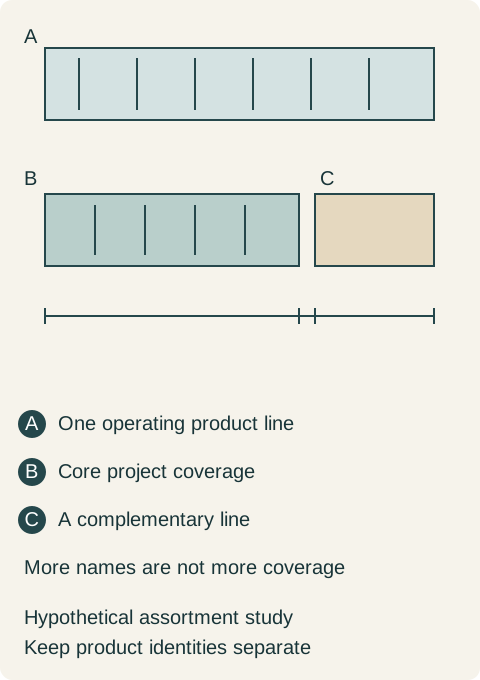
For a hypothetical review, a dealer examines 20 documented inquiries. Its current line could serve 14 as requested; 6 had unresolved product needs. A proposed complementary line appears to address 4 of those remaining briefs. That would raise potential project coverage to 18, leaving 2 unresolved. These invented counts describe a screening exercise, not completed sales, demand research or predicted conversion.
The hypothetical result still needs checking. Were those 4 requests alternatives for the same job? Did their budgets and receiving requirements actually fit? Would accepted substitutes in the current line have resolved them? If the inquiry records cannot answer those questions, the coverage estimate should remain provisional rather than becoming a sales forecast.
Keep reasons attached to the cases. A short collection of real unresolved briefs is more informative than saying customers want more variety. It also gives the prospective supplier specific questions to answer and provides a way to review later whether the added line solved the problem it was chosen for.
Include the work of maintaining another product system
Another line can mean new ordering conventions, samples, design catalogs, pricing inputs, construction options and service references. Ask who will maintain each of them. A range that only one person can quote becomes difficult to support when that person is absent. Training and recordkeeping should be part of the decision before customers are promised the new choice.
Inventory is separate from representation. Offering a line does not require pretending every item is stocked, and an available sample does not establish current supply. Decide which items, if any, deserve local stock and which remain project-specific. Keep the sales description consistent with that actual arrangement.
Avoid copying service assumptions from one supplier to another. Ordering acceptance, shipment identification and replacement procedures need their own records. A familiar parent-company name is not evidence that the new line uses an identical process. Review the actual operating conditions before rolling them into a common sales script.
Define what each line is for without building a rigid hierarchy
Give staff a practical explanation of the new line's role. It might address a particular configuration need, a coordinated whole-home finish family or a distinct construction choice. Explain that role with real product differences. Broad claims that a higher-priced range is always better, or that a lower-priced one is only for rentals, can mislead both staff and customers.
Let the project decide between suitable lines. If the original range completes the accepted kitchen at an appropriate total cost, the salesperson should be able to recommend it. The added range should earn its place when its actual capabilities matter. Offering alternatives is useful when their consequences can be explained without forcing every inquiry into a sales ladder.
A missing tall-cabinet arrangement justifies a complement
Imagine a dealer repeatedly receiving design briefs that need a particular tall-cabinet configuration. The current range serves the ordinary working cabinets well but cannot supply that accepted arrangement. Instead of adding several similar door collections, the dealer evaluates a line that can complete the difficult room as a coherent package.
The test quote includes its necessary side treatments, companion fronts and storage configuration. Staff learn the complete ordering process, keep its samples identified and describe supply on the actual terms. The original line remains available for jobs it already serves. The new line has a clear purpose without requiring unsupported claims that it is superior in every respect.
Review the decision using completed project experience after the line is genuinely in operation. Track the kinds of briefs served, quoting errors, unresolved supply questions and the work required to maintain the range. Expand, simplify or revise the assortment on that evidence. The useful result is a business that can explain and complete more suitable projects, not a showroom with more brand names.
Sources & further reading
- MasterBrand — Information for Cabinet Dealers