

For professionals
Ship cabinets straight to the job or consolidate at the dealer’s warehouse?
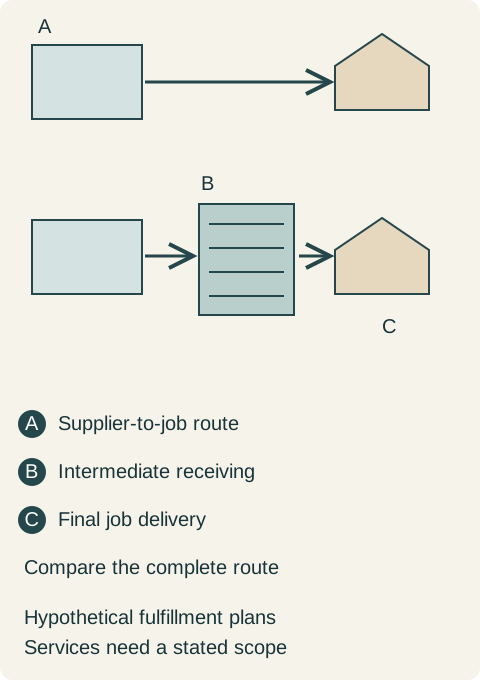
Choose the fulfillment route for the complete order. A direct shipment avoids an intermediate stop; consolidation can create a coordinated delivery, but only if receiving, inspection, storage and the final trip are actually included.
Choose the route for the whole cabinet order
Direct shipment makes sense when the job can receive the supplier's actual delivery and the order does not need an intermediate consolidation service. Routing cabinets through a dealer's warehouse can make sense when someone will receive, reconcile and coordinate the goods before the final trip. Compare those complete arrangements. A warehouse address by itself does not mean the dealer will unpack, inspect, assemble or deliver anything inside the house.
The seller, product source and shipping origin can be different businesses. Ask where this particular order will begin its trip, where each handoff occurs and who will communicate with the recipient. This is more useful than assuming that an online seller always ships directly or that a local showroom always handles the goods first.
Describe the extra stop by the work it performs
Shopify describes dropshipping as a fulfillment arrangement in which the seller passes the order to a supplier that ships to the customer. That defines the direct route; it does not establish that a cabinet supplier offers it or describe the handling services attached to a particular cabinet order.
Reading note: Shopify — What Is Dropshipping and How Does It Work?.
For consolidation, identify the actual work after arrival. Someone may only count sealed cartons. A different arrangement may reconcile individual components, photograph discrepancies or assemble selected items. State those tasks separately. If no one opens a carton, do not describe the stop as a completed product inspection. If someone opens it, establish how the contents will be protected and repacked for the next journey.
Ask how the warehouse knows which pieces belong together. A kitchen may contain cabinet boxes, separate fronts, fillers and trim arriving under different references. Consolidation is useful when the receiving record joins those references to the project. Simply placing several pallets near one another does not prove that the necessary components are complete.
Test whether the job can receive the direct alternative
Review the delivery endpoint, unloading method, vehicle access and receiving contact for the actual shipment. An appointment to receive freight at the curb is not an arrangement to carry cabinets into the kitchen. If the owner cannot perform that next step, put its labor and storage into the direct-route comparison rather than assuming it will happen for free.
The job also needs an appropriate place to retain the shipment before installation. A complete order delivered early can be harder to manage than a later coordinated arrival. On the other hand, a ready project with proper receiving support may have little reason to add another stop. The useful distinction is readiness and assigned work, rather than whether one route sounds more professional.
For separate supplier shipments, find out how many receiving events the current plan actually requires. Do not infer that several purchase lines will arrive together, or that the seller can hold every item for a common release. Use confirmed arrangements, and identify what remains unsettled before promising an installation start.
Compare all trips and handling, not the first freight line
The direct option may include several final deliveries, hired unloading, carry-in and temporary storage. The consolidation option may include inbound freight, receiving, storage, repacking, assembly if purchased, and the last delivery. Identify which charges are quoted and which are still estimates. A low inbound freight rate is not the total cost of routing the goods through a warehouse.
In a hypothetical comparison, 3 direct delivery appointments cost $180 each, totaling $540. An alternative has $220 inbound freight, $140 receiving and consolidation, and $240 final delivery: $600 altogether. The warehouse route costs $60 more in this invented example. These are teaching figures, not freight rates or a quote for any market.
That hypothetical $60 difference does not tell the buyer which arrangement is better. If the warehouse option genuinely replaces repeated receiving work the customer would otherwise buy or perform, compare that work too. If it provides only sealed-carton storage, do not assign it the value of an inspection or assembly service that was never included. Use equivalent endpoints before choosing.
Keep discrepancies connected to the handoff where they were observed
Record who receives the goods at each stop and what that person checks. Preserve the supplier's product identification and the relationship between the inbound and final shipment. If an issue is found at the warehouse, record it there and communicate through the agreed order contact rather than letting an unresolved cabinet quietly travel to the job.
The extra handling stage also needs a clear condition record. Note what was opened, what was repacked and what remained sealed. That helps the project describe observations accurately; it does not determine a carrier's responsibility or extend a supplier's claim period. Obtain the applicable reporting requirements for the actual transactions before relying on an intermediate stop.
If a customer finds a problem after final delivery, the sales contact should be able to trace the component without making the customer guess which warehouse or freight company last touched it. Establish the communication route in advance. Passing the customer between businesses is not a fulfillment plan.
A consolidation service has to earn its extra step
Imagine a remodeler ordering cabinets and matching finishing pieces through different supply arrangements. The homeowner is away during ordinary receiving hours, and the interior carrying crew is available only for a coordinated delivery. The first proposal sends every shipment straight to the house because that appears to avoid warehouse charges.
The remodeler compares a second arrangement in which a named receiver accepts the shipments, reconciles the project list and reports shortages before scheduling the final trip. The quoted last delivery includes the agreed unloading and carrying work. The plan also identifies what happens if a necessary finishing piece has not arrived. With those tasks assigned, the intermediate stop solves a real coordination problem.
Another project can reach the opposite decision. If the job is ready, the full order ships together and a receiving crew can handle the supplier's endpoint, a warehouse stop may add handling without useful work. Keep that option available rather than treating consolidation as automatically better.
Tell the buyer what the chosen route actually includes
Before release, describe origin, handoffs, receiving tasks, storage, final endpoint and the contact for discrepancies in the project's purchase records. Give the final receiver the correct component list. If the arrangement changes, review the extra work and costs before presenting the new route as equivalent.
The objective is a complete, understood path from the supplier to usable goods at the project. Whether the seller calls it direct shipping, local distribution or consolidation matters less than knowing who performs each necessary step and which quoted services the customer is buying.
Sources & further reading
- Shopify — What Is Dropshipping and How Does It Work?