A cabinet finish can be within its unopened shelf life while a mixed batch is already outside its permitted use window. For a catalyzed coating, the stock-container date and the time of mixing answer different questions. A production plan that carries mixed material into a later shift must address the batch clock, not merely show that the original container was recently purchased.
A named product shows why the clocks differ
Gemini’s posted August 2016 Clear Platinum sheet lists 20-minute induction, 24-hour pot life at 77°F in a sealed container, and 18-month unopened shelf life at 77°F in a cool, dry area. These are conditions for that documented product, not a general cabinet-finish timetable.
Induction is the specified interval before the prepared material is used. Pot life concerns the usable mixed material; shelf life concerns the stored product under its stated conditions. Once a batch has been activated, an unopened-container allowance cannot be substituted for its mixed-batch limit. Putting a lid on the batch does not make it unopened stock again.
This is a manufacturing scheduling question for the professional finishing operation. It is separate from waiting for an applied coating to dry or cure. A cabinet buyer needs the agreed finish system and a credible production scope, while the applicator owns product identification, preparation, conditions and batch control. A generic promise of a durable catalyzed finish does not explain how a delayed coating run will be handled.
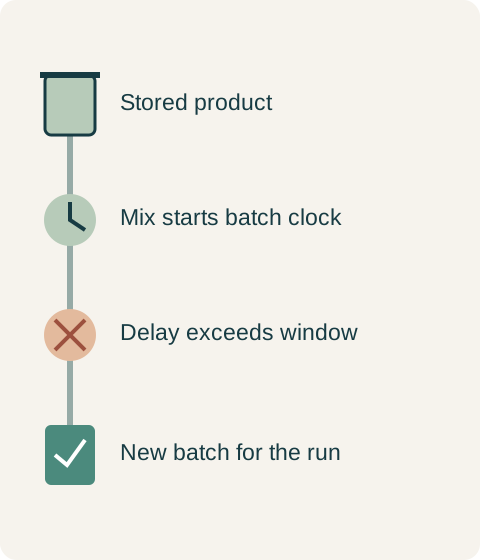
Teaching example Hypothetical production sequence. The diagram distinguishes material states; it gives no mixing ratio, equipment settings or application recipe.
A delayed coating run may need a fresh batch
Suppose a hypothetical shop using the cited timing conditions activates a batch on Monday at 08:00. The next cabinet run is moved to Tuesday at 09:00, an elapsed 25 hours. Even assuming the stated storage conditions were maintained, that planned use is beyond the documented pot-life window. The shop removes the old mix from the run and uses a newly prepared batch, completing its required induction before application. The buyer retains the specified finish instead of accepting an unapproved change merely to use up old material.
In this hypothetical schedule, the new batch is prepared for the revised run rather than all remaining material being activated in advance. The completion plan includes the necessary preparation time. It does not treat the expired batch as usable because it still pours, or claim that adding unused coating resets its age. Any recovery procedure would need explicit support for that product; none is assumed here.
The quotation should allow for the actual production sequence
A shop quoting a staged order should account for batch preparation and interrupted runs in its own manufacturing plan. That does not require the buyer to receive a chemical mixing recipe. It requires a clear answer about which specified finish will be applied to each group of components and whether a schedule change also changes the delivered system.
The cited sheet is a dated example for reading technical terms. The applicator must use the applicable information for the actual supplied coating and conditions. The decision method remains useful across products: keep stored stock, activated material and coated components as distinct states, and schedule each against the requirement that actually applies to it.
Pure White
Cream White
Light Warm Gray
Gray
Navy
Black
Oak Tone
Dark Walnut Tone
Design study These finish studies are design references, not a list of currently orderable colors. Screens and lighting change the appearance; compare a physical sample before choosing.See all finish options →
A color name does not identify a finish system. Compare the decorative surface, the core, the edge and the repair method before choosing a cabinet front.
The sample shows the door frame, a separate center panel, the face frame and the cabinet box. Each component has its own place in this Shaker construction.
Shaker construction: door frame, center panel, face frame and cabinet box. The cutaway helps locate these parts; confirm each material in the specifications for the selected cabinet.
01 / Door frame
The Shaker door has rails and stiles around a separate center panel. The frame and center panel are different components; confirm their materials in the specifications for the selected cabinet.
02 / Face frame
The face frame surrounds the opening at the front of the cabinet box and sits behind the doors. The face frame, door frame and cabinet box are separate parts.
03 / Cabinet box
The sample exposes the cabinet sides, interior surfaces and layered edges. The image does not establish the wood species or material specification of a selected cabinet.