Is a built-in vacuum drawer worth giving up kitchen storage?
Compare the sealing method and the installation separately. A chamber must accommodate the package inside it; a countertop edge sealer needs support for the bag outside. Then decide whether the regular task deserves a permanent appliance position.
A built-in vacuum drawer deserves cabinet space when vacuum sealing is an established kitchen task, the intended packages suit that chamber, and the fixed location improves the whole packing routine. It is harder to justify when it is selected merely to complete an appliance stack or to replace a countertop machine that already has a convenient working and storage home. Compare the method of sealing before comparing the fronts.
Built-in and chamber describe different things
Anova distinguishes chamber sealers, which remove air from the chamber including the pouch, from edge sealers, which draw air directly from the bag. This is a difference in the sealing mechanism.
A chamber sealer can sit on a countertop as well as be built into cabinetry. A built-in drawer is therefore not the only way to buy a chamber process. Keep the comparisons separate: which mechanism supports the intended packages, and which installation suits the kitchen? Otherwise a countertop chamber machine can disappear from the comparison even when it is a reasonable alternative.
Likewise, the drawer's external width does not describe the package it can receive. The appliance includes its housing and equipment as well as the working chamber. An edge machine's sealing-bar width also does not describe every package dimension, since the bagged contents remain outside it. Compare the manufacturer's actual package limits and arrangement, not the apparent size of the front.
The package has to suit the working geometry
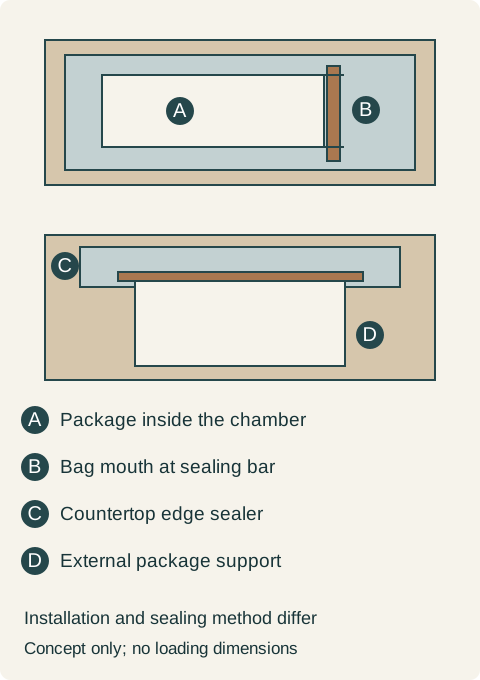
Miele's cited instructions place the bag in the chamber with its mouth across the sealing bar. They also require full drawer extension and room to open the glass lid, and prohibit using that lid or drawer as a work surface.
For the buying decision, examine the typical filled package, not just an empty bag folded flat. The contents, the bag mouth and the lid all have to occupy their intended positions. An unusually long package that works with a supported edge-sealing arrangement should not be assumed to fit within a chamber merely because the drawer front looks wide. Changing the portion shape or using a different package is a changed routine, not extra chamber capacity.
The edge-sealing alternative needs a suitable supported position for the bag outside the machine. Include that footprint with the machine itself when assigning countertop space. Do not count only the narrow appliance body and leave the actual package over the edge of the worktop. Use the selected equipment's instructions for the working arrangement; this comparison does not supply a loading method.
Teaching example Conceptual plans with lids omitted. Above, the bag sits inside a chamber with its mouth at the sealing bar. Below, an edge sealer meets the bag mouth while the package rests outside the machine. Shapes do not establish usable capacity, approved loading or cabinet dimensions.
Reserve a packing station, not only an appliance opening
Whether the machine is fixed or movable, identify where packages are filled, where unused bags are kept and where completed packages go next. Those surfaces and storage positions are part of the task. A built-in machine can clear its own body off the counter while the preparation work still needs counter space.
Place the open drawer and lid within that sequence. A convenient appliance height is not enough if opening it blocks the supplies used for every package. Conversely, a countertop machine can be practical when it has a defined operating area and an easy storage route after the task. Being movable is useful only if the user is actually willing and able to perform that transfer.
Consider how a regular group of packages moves through the station. Avoid a layout that repeatedly requires closing the appliance to reach bags or moving completed items back onto the filling area. This is a furniture allocation question. Package handling and any subsequent food storage must follow the applicable instructions rather than being inferred from the machine's location.
Identify what storage is really retained
Miele describes a separate storage compartment in its EVS 7670 for items such as vacuum bags or steam-oven pans. That feature is specific to the offered appliance, not a reason to count every vacuum chamber as an ordinary drawer.
Read the actual compartment arrangement before subtracting the appliance from the cabinet inventory. Some supplies may have a provided home; the rest still need space elsewhere. Do not allocate utensils to an area that only looks empty in a photograph of the open machine. Compare the permitted storage with the actual contents of the furniture drawer being replaced.
For a countertop option, identify both the stored-machine location and the operating area. If the machine will remain on the counter, accept that occupied surface honestly. If it will be put away, keep its required stored configuration and the retrieval path in the plan. An unspecified appliance garage is not a complete answer, especially when the machine must move out to operate.
An established packing routine earns the built-in position
Consider a hypothetical household that already seals a regular group of modest packages. The proposed drawer's documented chamber arrangement accepts those packages, and the household does not depend on a long external-bag format. Its main annoyance with the current countertop setup is repeatedly clearing and restoring the machine's working location.
The revised kitchen gives the built-in drawer a fixed position beside the existing filling counter. The selected unit's permitted storage compartment takes the compatible spare bags; the adjacent dry drawer holds the remaining small supplies. Utensils displaced by the appliance move into an already allocated utensil drawer. The household accepts that loss of general-purpose storage and keeps the filling counter available during the task.
It chooses the built-in proposal after rehearsing the open drawer, lid and supply access. The decision does not assume that the drawer replaces all countertop preparation or that sealed packages remain in the appliance. The benefit purchased is a fixed, ready working location for an existing routine, with the package geometry and the displaced storage both resolved.
A household that seals only occasionally may instead keep a suitable countertop machine and the general-purpose drawer. Someone needing a chamber process but not a built-in installation can compare a countertop chamber model. These are distinct, useful outcomes; they should not be erased by a choice between matching appliance fronts.
Compare the complete cost and installation
Price the actual appliance, its installation and the cabinet changes together. Include any compatible consumables and accessories needed for the chosen use. Do not assume existing bags or containers transfer between mechanisms or manufacturers solely because both products use the words vacuum sealing.
Have the exact built-in arrangement checked with any appliance above it and with its required electrical and service provisions. A drawer-shaped opening is not evidence that an ordinary storage drawer can simply be exchanged for a powered appliance. For the countertop route, select a permitted operating setup rather than installing a portable machine into an improvised enclosure.
The final purchase should state the intended package arrangement, chosen mechanism, fixed or movable location and remaining storage. That makes the value of the appliance understandable in everyday use. A matching front is a design preference; the cabinet space is justified by the task it actually completes.
Pure White
Cream White
Light Warm Gray
Gray
Navy
Black
Oak Tone
Dark Walnut Tone
Design study These finish studies are design references, not a list of currently orderable colors. Screens and lighting change the appearance; compare a physical sample before choosing.See all finish options →
Hinged, lift-up and pocket fronts move the obstruction to different places. Compare the full opening sequence, parked front, usable interior and the appliance’s actual operating location.
Compare locations by the vessels leaving the drawer, their intended destination and the people using that area. A matching appliance stack is only part of the decision.
The sample shows the door frame, a separate center panel, the face frame and the cabinet box. Each component has its own place in this Shaker construction.
Shaker construction: door frame, center panel, face frame and cabinet box. The cutaway helps locate these parts; confirm each material in the specifications for the selected cabinet.
01 / Door frame
The Shaker door has rails and stiles around a separate center panel. The frame and center panel are different components; confirm their materials in the specifications for the selected cabinet.
02 / Face frame
The face frame surrounds the opening at the front of the cabinet box and sits behind the doors. The face frame, door frame and cabinet box are separate parts.
03 / Cabinet box
The sample exposes the cabinet sides, interior surfaces and layered edges. The image does not establish the wood species or material specification of a selected cabinet.