Birch or maple cabinets? Compare the actual wood, door construction and finish
Maple is not a complete specification. Separate hard maple from soft maple, compare the same cabinet component, and identify what a higher quote changes.
Neither birch nor maple is an automatic winner for a cabinet purchase. First establish what the names describe: a solid door frame, a veneered center panel, a cabinet-box face or a complete construction. Then identify the maple category and compare the same door style and finish. A species preference becomes useful only when it is attached to the part you will receive and the appearance or performance you want.
Maple needs a more precise identity
The American Hardwood Information Center lists hard maple as sugar and black maple, while its soft-maple profile includes red and silver maple. Its birch profile concerns yellow birch. These distinctions matter when a quote says only maple or birch. Soft maple is not a softwood classification or a declaration that the material is unsuitable for cabinets; the HMA profile includes cabinetry among its uses.
A veneer name also does not identify every layer beneath it. Columbia Forest Products lists birch, hard maple and silver maple as separate decorative veneer options. When comparing door offers, record the frame wood, center-panel face and core separately. A solid hard-maple frame around a veneered panel is a different description from an all-solid panel, even if both are sold under the same species heading.
For a visible wood finish, examine the actual proposed range of grain and natural tone, not just the lightest sample. HMA describes pale sapwood and darker heartwood in these species. That does not promise that all pale wood will match, or that a particular species name buys a uniformly pale door. Color selection must be an explicit part of the order if it matters across an uninterrupted run of fronts.
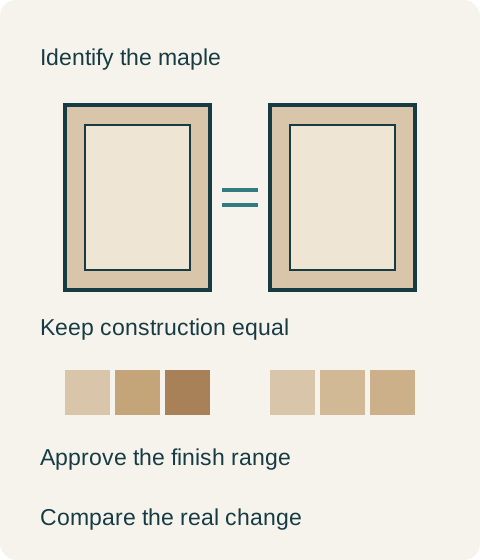
Teaching example Conceptual comparison of two door packages. Matching outlines hold the component constant; sample strips represent an approved range, not measured species colors or usaKT products.
Compare the species in the same finished application
Consider a hypothetical homeowner choosing clear-finished doors. The birch offer and hard-maple offer have the same frame-and-panel construction, dimensions, hardware scope and finishing system. The birch sample set includes a broader natural color range that the homeowner likes. The higher hard-maple quote includes a narrower approved color selection. The buyer chooses birch and records acceptance of its sample range, because uniform pale color was not a requirement. This saves the difference shown on that actual hypothetical quote without claiming birch is always cheaper or maple never justifies an upgrade.
Now change the requirement in that hypothetical comparison: a nearly continuous pale appearance becomes essential, and only the submitted hard-maple package demonstrates the accepted range. The buyer selects that package and its sample limits. The premium buys the offered selection and finished result, not a universal promise that every maple cabinet is better. A different shop’s selected birch package could change the decision. The material name alone cannot price that work.
Hardness is one property of the wood
The USDA Forest Products Laboratory describes Janka testing through controlled ball indentation of wood specimens. That makes it relevant to indentation resistance under the test conditions. It does not test a complete cabinet’s joinery, door alignment, finish adhesion or hardware. Reading a higher wood-hardness figure as a higher overall cabinet-quality score changes the meaning of the measurement.
Keep solid-wood and veneered comparisons on the right basis as well. A published solid-wood hardness value does not establish the dent behavior of every thin veneer-and-core assembly carrying that name. Likewise, resistance to a dent in wood is not a measured scratch-resistance result for the coating. If a specific abuse or cleaning exposure matters, compare evidence for that finished construction rather than borrowing a number from a species chart.
What should a price difference actually buy?
For an opaque painted door, much of the natural color that motivates a clear-finish choice will be covered. The buyer should therefore compare the proposed paint-ready construction, profile quality, accepted finished sample and scope of preparation. Paying for a particular visible grain selection makes little sense if that grain is intentionally hidden, unless the selected specification has another stated purpose. This does not mean every wood or panel is interchangeable under paint.
A useful alternate quote isolates the changed item: species and selection, door construction, finish process or included components. If several change together, compare the packages as packages rather than attributing the entire difference to birch versus maple. Preserve the accepted physical samples and the exact material description with the chosen package. That is how a preference for a wood becomes a purchase that can be checked at delivery.
Pure White
Cream White
Light Warm Gray
Gray
Navy
Black
Oak Tone
Dark Walnut Tone
Design study These finish studies are design references, not a list of currently orderable colors. Screens and lighting change the appearance; compare a physical sample before choosing.See all finish options →
A painted door, a wood-grain side and a plywood cabinet box can belong to the same cabinet. Here is how to read those parts, what the sample photos actually show, and which details to put on a quote.
A ranked list can hide its comparison rules. Find the tested product, the scoring priorities and the missing conditions before applying the result to your cabinet order.
A color name does not identify a finish system. Compare the decorative surface, the core, the edge and the repair method before choosing a cabinet front.
The sample shows the door frame, a separate center panel, the face frame and the cabinet box. Each component has its own place in this Shaker construction.
Shaker construction: door frame, center panel, face frame and cabinet box. The cutaway helps locate these parts; confirm each material in the specifications for the selected cabinet.
01 / Door frame
The Shaker door has rails and stiles around a separate center panel. The frame and center panel are different components; confirm their materials in the specifications for the selected cabinet.
02 / Face frame
The face frame surrounds the opening at the front of the cabinet box and sits behind the doors. The face frame, door frame and cabinet box are separate parts.
03 / Cabinet box
The sample exposes the cabinet sides, interior surfaces and layered edges. The image does not establish the wood species or material specification of a selected cabinet.