

Bath & laundry planning
Sensor or manual bathroom faucet: choose the whole control arrangement
Choose a sensor faucet when its actual activation and temperature controls suit the room's ordinary washing tasks and the owner accepts the equipment and maintenance arrangement. Choose a manual faucet when direct control of starting, adjusting and stopping the water better serves the household. Removing a hand movement can be useful, but it does not by itself establish a more suitable basin or a simpler complete purchase.
Choose a sensor faucet when its actual activation and temperature controls suit the room's ordinary washing tasks and the owner accepts the equipment and maintenance arrangement. Choose a manual faucet when direct control of starting, adjusting and stopping the water better serves the household. Removing a hand movement can be useful, but it does not by itself establish a more suitable basin or a simpler complete purchase.
Separate starting water from selecting temperature
Sloan documents a sensor-activated battery faucet with an integrated side mixer, plus specified continuous-run and temporary-off functions. Those controls belong to that particular configuration.
Reading note: Sloan: sensor faucet with side mixer.
Identify how the actual candidate sets temperature and how the user reaches that control. A touchless start does not necessarily make temperature selection touchless. Decide whether the household wants a recurring setting, frequent changes or another supported arrangement, then test the selected product against that routine.
For the manual alternative, use the actual handle and its movement. Direct control can be practical without requiring the same motion from every faucet. A lever's position, grip and relationship to the basin matter more than a general claim that manual operation is familiar.
Demonstrate the real washing tasks
Try the ordinary hand position, movement to soap and return to water with an appropriate demonstration of the chosen faucet. The user should understand how it starts and stops during that sequence. A brief activation in an empty display is not the same as completing the room's intended task.
Include any household task that needs a different running pattern. Ask the supplier to demonstrate the documented way the candidate handles it rather than assuming every sensor model supplies the same continuous-run function. If the proposed controls do not support the task, change the candidate or the brief before buying the surrounding assembly.
Match the control arrangement to the basin
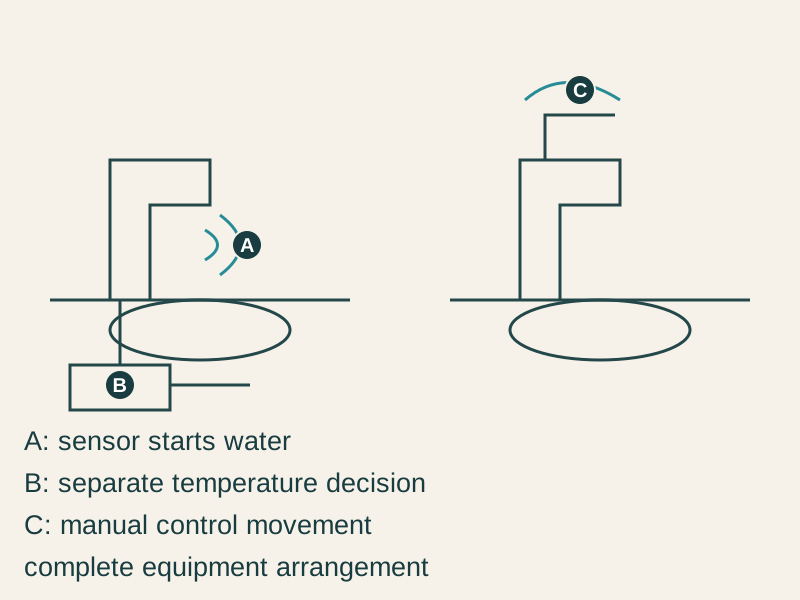
- A
- A: sensor starts water
- B
- B: separate temperature decision
- C
- C: manual control movement
Review the selected faucet, bowl and mounting position together using product information and the appropriate project review. Identify where the hands work and how the person approaches. The owner's useful demonstration should be based on a comparable complete arrangement, not only the spout from an unrelated sink display.
Keep the washing area and dry preparation surface in the same review. A control that technically operates can still be awkward beside the ordinary grooming kit. The goal is an understood routine at this basin, rather than winning a comparison by describing a technology in isolation.
Buy the complete equipment configuration
Identify the power arrangement, valve and control components actually required by the sensor candidate. Have installation and access coordinated with the project. For the manual version, identify its own mounting bodies and connections as carefully. Compare complete configurations instead of a sensor spout price against an installed manual faucet.
Bring the accepted equipment arrangement into the vanity interior before assigning storage. The occupied equipment zone is not a shelf for other belongings. Ordinary attention and eventual replacement need defined access, but that is part of implementing the chosen architecture; it should not replace deciding whether the owner likes using the faucet in the first place.
Compare a household that changes the choice
Imagine a bathroom where ordinary use is brief handwashing and the owner wants fewer control steps during that task. The sensor candidate provides an understood temperature arrangement and its demonstrated operating modes cover the room's named tasks. This is a hypothetical purchase example.
The owner uses the relevant demonstration, reviews the installation and agrees who handles the documented equipment care. The cabinet interior preserves its assigned storage outside the equipment zone. The sensor proposal is selected because the complete routine works, not because it is assumed to reduce water use or improve hygiene.
If the household instead frequently wants a different running pattern that this candidate does not support conveniently, a manual proposal can be preferable. Choosing direct control is a useful response to that task, not evidence that the sensor product is defective. The shortlist should be resolved by the room's actual operations.
Make cleaning and unfamiliar use understandable
Ask how the selected system is placed in its documented condition for ordinary basin and faucet care. Include the person who will do that work. A temporary-off function, where supplied, needs to be understood; it should not be inferred from the appearance of an unmarked control.
Consider someone using the room without having seen the selection process. They should be able to find the washing position and understand any intended temperature control. If an operating step needs explanation, decide how the room's users will learn it without assuming that a product-family name communicates every function.
Keep the reason for selection with the order
Record the actual faucet configuration, operating modes demonstrated, temperature control and reviewed equipment arrangement. A different sensor version may not preserve the same controls, and a different manual handle can change reach. Recheck the affected task when the selected model changes.
Choose sensor activation when the complete operation serves the room and its ownership tasks are accepted. Choose manual operation when direct adjustment is the more practical fit. The successful purchase makes the ordinary washing sequence clear and usable while keeping the basin and vanity a coordinated assembly.
Sources & further reading
- Sloan: sensor faucet with side mixer