

Bath & laundry planning
Recess toilet-paper storage into the wall or buy a separate cabinet?
Choose a recessed assembly when the wall can accept the specified opening and support, the user can reach the actual opening, and the stored rolls can be replenished without an awkward service routine. Choose a separate cabinet when it provides usable storage without obstructing the toilet area and avoids an unjustified wall alteration. Compare completed assemblies, including the front and surrounding finish, rather than an empty niche against a finished piece of furniture.
Choose a recessed assembly when the wall can accept the specified opening and support, the user can reach the actual opening, and the stored rolls can be replenished without an awkward service routine. Choose a separate cabinet when it provides usable storage without obstructing the toilet area and avoids an unjustified wall alteration. Compare completed assemblies, including the front and surrounding finish, rather than an empty niche against a finished piece of furniture.
Decide what belongs inside the wall
A dispenser for the roll in use is different from a reserve-roll compartment. Identify whether the project needs dispensing, reserve storage or both. A niche large enough to display a decorative roll may not let a user withdraw the household's actual package or replace a spindle. A large cabinet can have the opposite problem: plenty of volume, but the next roll is behind objects unrelated to the toilet.
Bobrick's catalog distinguishes recessed tissue dispensers from surface-mounted configurations. These are different installation architectures, even when they perform a similar dispensing task.
Reading note: Bobrick: recessed and surface-mounted tissue dispensers.
For a home, identify the candidate actually being considered. A commercial dispensing mechanism is not automatically the right way to store loose household rolls. The example establishes that recessing is a complete product choice; it does not establish that every cavity should receive the cited dispenser.
Verify the wall before valuing the saved floor area
Have the proposed wall location reviewed for the complete candidate, including its body, fastening, front and installation requirements. Existing framing, services and the wall's assembly can affect feasibility. A shallow mark on a floor plan is not evidence that the whole depth is available behind the finish.
Keep any necessary wall work in the purchasing scope. Identify who determines the opening, who installs the body, and who finishes the perimeter. If a proposal is still awaiting that review, compare it as an unresolved alternative rather than crediting it with a completed storage bay. A separate cabinet should likewise have an accepted placement and its required securing arrangement.
Test the front from the seated position
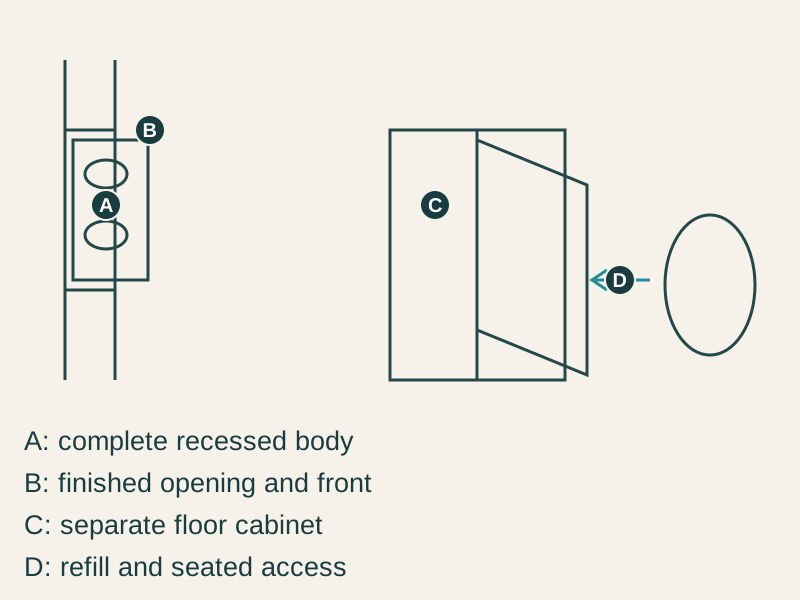
- A
- A: complete recessed body
- B
- B: finished opening and front
- C
- C: separate floor cabinet
- D
- D: refill and seated access
Mock up the visible opening or cabinet front at its proposed location and use the household's actual rolls. Test finding the next roll, getting a hand around it and bringing it out. A recessed compartment can be difficult if its edge restricts the withdrawal angle. A separate cabinet can be difficult if the door opens toward the user's knee or the contents sit too far back.
Include the normal closed state and the refill state. The cabinet door or recessed front may project into space used by another fixture. A roll that fits inside after the front is removed does not prove that ordinary replacement works with the assembly installed. Ask whether the person performing that task can operate the real closure and reach every assigned position.
Compare the whole storage result
List the items expected in a freestanding cabinet. If it also holds cleaning supplies or guest items, identify where those items go in the recessed alternative. Conversely, do not give the cabinet value for a collection of unspecified future possessions. Compare the actual inventory and its appropriate locations.
Look at floor access around the placed cabinet and the ability to reach its sides under the proposed room arrangement. Recessing can remove a piece from the floor, but its front and wall edge still require attention. Neither architecture should be described as maintenance-free merely because it looks visually simple.
Follow a concrete decision
Imagine a bathroom where a narrow floor cabinet would stand beside the toilet, but its door would open across the household's accepted approach. A reviewed wall location can accept a complete recessed reserve compartment within reach. This is a hypothetical room, not a prescribed installation location.
The owner tests the recessed opening with the actual rolls and confirms ordinary replenishment. The required wall and finish work is identified in the proposal. The recess is selected because it removes a recurring door conflict while retaining the assigned reserve supply.
If the wall review instead found an unresolved service conflict, that proposal would lose its basis. A differently placed separate cabinet could become the better purchase. The result follows from the particular opening and movement, not a general rule that recessing is more space-efficient in every bathroom.
Keep replacement responsibility visible
Retain the recessed body's identity and opening information alongside the surrounding finish records. A future front or mechanism should be checked against that installed body; a similar-looking item may not use the same opening. For a separate cabinet, preserve its identity and securing information so replacement can be evaluated against the actual room.
The recessed option is complete when wall acceptance, front operation, replenishment and finish responsibility are clear. The cabinet option is complete when its everyday movement and assigned contents fit. Buy the arrangement that makes the next roll reliably usable without borrowing space from another necessary bathroom action.
Sources & further reading
- Bobrick: recessed and surface-mounted tissue dispensers