The nearest cabinet is not automatically the best place for spare paper. A roll can fit inside while the door is difficult to open from the position where it is needed, or the remaining package can block access to plumbing. Start with the replacement task: who needs the spare, where that person is and how the roll reaches the holder. Then decide whether the vanity should carry an immediate reserve, a larger stock or neither.
Use a full replacement roll for the fit test
Measure the actual product the household buys in its new, full state. A partly used roll taken from the holder is a poor stand-in for a replacement. Include any individual wrapping or container that will remain around the reserve. Product names that suggest a large or small format do not establish the dimensions of the roll or package being stored.
Compare the whole multipack with the individual replacement unit. They perform different jobs and may need different locations. The immediate spare should be recognizable and retrievable, while the larger reserve can support occasional restocking. Do not assign the entire package to the vanity solely because bathroom paper seems to belong near the toilet.
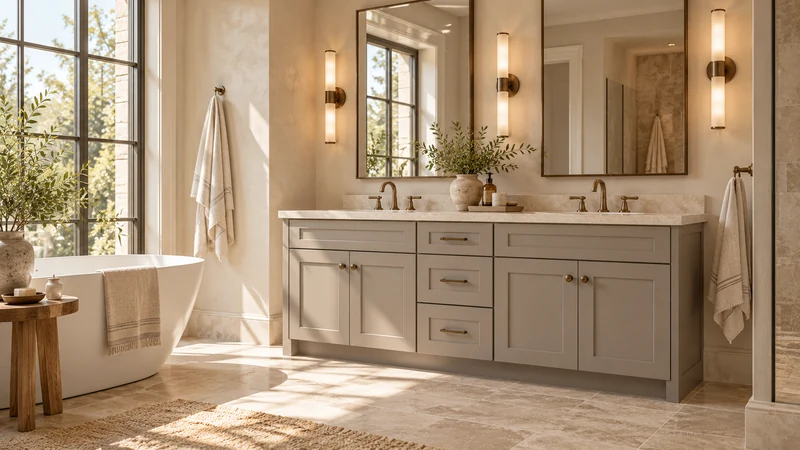
Design study Design study: cabinet-front access must be tested in the actual room; the image does not establish a toilet-side reach or an accessible paper-storage location.
Trace access from the point of need
Test the proposed spare location with the intended user in a position appropriate for the actual replacement task. Check whether the cabinet door or drawer opens far enough, whether the roll can be grasped and whether the user must move unrelated objects. The goal is a workable personal arrangement, not a claim that a particular reach or layout meets an accessibility standard.
Continue the test to the paper holder. A spare that is easy to remove from the cabinet can still be awkward to transfer or install in the holder's actual position. Include the holder's own opening or replacement method. Keep a temporary place for packaging or an empty core in mind so the task does not depend on balancing items on a narrow cabinet edge.
Compare an immediate spare with the bulk reserve
Imagine a hypothetical vanity whose door opens only partway beside the toilet. An unopened paper package fits in the cabinet, but it cannot be removed through that opening in the intended position. A full individual roll at the front can be grasped and transferred to the holder. These observations support different storage decisions for the package and the immediate spare.
The household tests a defined front location for the readily needed roll and another suitable location for the multipack. During restocking, the person approaches the cabinet from a position that permits the agreed access and places the next spare in its identified spot. This arrangement is useful only if both tasks work; the visible spare should not depend on the user reaching blindly behind pipes to retrieve it.
If no cabinet position works comfortably, evaluate another suitable location for the immediate reserve. Keeping the vanity completely free of paper stock can be a reasonable choice. Do not sacrifice a workable paper-replacement task merely to keep every bathroom supply behind matching doors. A location that the intended user can actually access is more important than a category rule.
Keep the cabinet's other functions available
Use the interior drawing to identify the basin, plumbing and the access routes already agreed for valves or service. Allocate paper only in the remaining appropriate space. A removable reserve container can help define a small zone, but its handle, lid and removal movement must also fit. It should not turn a previously clear service route into a permanent storage location.
Choose the storage position with the actual room conditions and the product's care needs in mind. Do not treat paper packed tightly around pipes as a protective filler or a way to use every void. If the available area cannot provide suitable storage without interfering with the cabinet's purpose, move the reserve elsewhere rather than expanding it through the plumbing area.
Make restocking obvious
Give the immediate spare a consistent place and a recognizable refill point. When it is taken, the person responsible for replenishment should be able to see that the position needs filling. Avoid several hidden partial packages that make the household believe a replacement is nearby when the convenient location is empty. The reserve system should be understandable without a search through the entire vanity.
Before choosing cabinet accessories, perform the full cycle with the actual roll and package: retrieve, replace at the holder, clear the temporary items and refill the spare position. Check again if the paper format or cabinet arrangement changes. The successful plan supports that cycle while preserving the vanity's other storage and service needs; it is not simply a photograph proving a package can fit inside.
Pure White
Cream White
Light Warm Gray
Gray
Navy
Black
Oak Tone
Dark Walnut Tone
Design study These finish studies are design references, not a list of currently orderable colors. Screens and lighting change the appearance; compare a physical sample before choosing.See all finish options →
Give the active routine a stable, appropriate home and keep unopened replacements in a separate cabinet reserve, rather than trying to hide every item in the same container.
Choose a defined storage location that meets the products' labels and household access requirements, then test the original containers and the complete removal-and-return task.
Arrange the equipment, current consumables and replacement parts around the actual shaving sequence, with a separate plan for any product care needed before items return to storage.
The sample shows the door frame, a separate center panel, the face frame and the cabinet box. Each component has its own place in this Shaker construction.
Shaker construction: door frame, center panel, face frame and cabinet box. The cutaway helps locate these parts; confirm each material in the specifications for the selected cabinet.
01 / Door frame
The Shaker door has rails and stiles around a separate center panel. The frame and center panel are different components; confirm their materials in the specifications for the selected cabinet.
02 / Face frame
The face frame surrounds the opening at the front of the cabinet box and sits behind the doors. The face frame, door frame and cabinet box are separate parts.
03 / Cabinet box
The sample exposes the cabinet sides, interior surfaces and layered edges. The image does not establish the wood species or material specification of a selected cabinet.