

Bath & laundry planning
Put the laundry hamper on the bathroom side or the closet side?
Locate collection where clothes actually leave the body and where someone can reliably remove the collected laundry. The bathroom side may capture clothing removed before bathing; the closet side may serve dressing and regular clothing changes better. A well-fitted hamper is still a poor purchase if its location requires a family member to enter an occupied room just to collect laundry.
Locate collection where clothes actually leave the body and where someone can reliably remove the collected laundry. The bathroom side may capture clothing removed before bathing; the closet side may serve dressing and regular clothing changes better. A well-fitted hamper is still a poor purchase if its location requires a family member to enter an occupied room just to collect laundry.
Follow removal rather than the room label
Trace an ordinary morning and evening without moving the proposed hamper into the most convenient place for each drawing. People may undress in the bathroom, dress in an adjoining closet and leave exercise clothing elsewhere. Identify the recurring source the new cabinet is intended to serve. A single hamper cannot be credited with automatic collection from every location.
Distinguish garments ready for collection from articles awaiting another care step. The project should not assume that all bathroom textiles can immediately share the selected enclosed container. Follow the household's accepted care routine and the actual accessory's use instructions. If an item needs another destination first, show that place instead of concealing it in the hamper allowance.
Define who empties it and from which room
The person who drops clothing is not necessarily the person who takes it to laundry. Test the collection route under normal occupancy. An ensuite bathroom can be unavailable while someone bathes; a dressing room can be unavailable while another person changes. The route should reflect privacy arrangements the household actually accepts.
Rev-A-Shelf identifies a removable cloth bag in the cited hamper accessory. A removable container creates a transfer step that can be reviewed separately from the cabinet's fixed location.
Reading note: Rev-A-Shelf: removable hamper bag.
Choose whether the container travels to the laundry, is emptied into another basket or stays with the cabinet. Each arrangement needs a practical removal motion and a place for the receiving container. Do not count an internal bag as easy to carry before the actual user has tested its supported handling arrangement and the route with an appropriate representative load.
Draw the pull-out and the person together
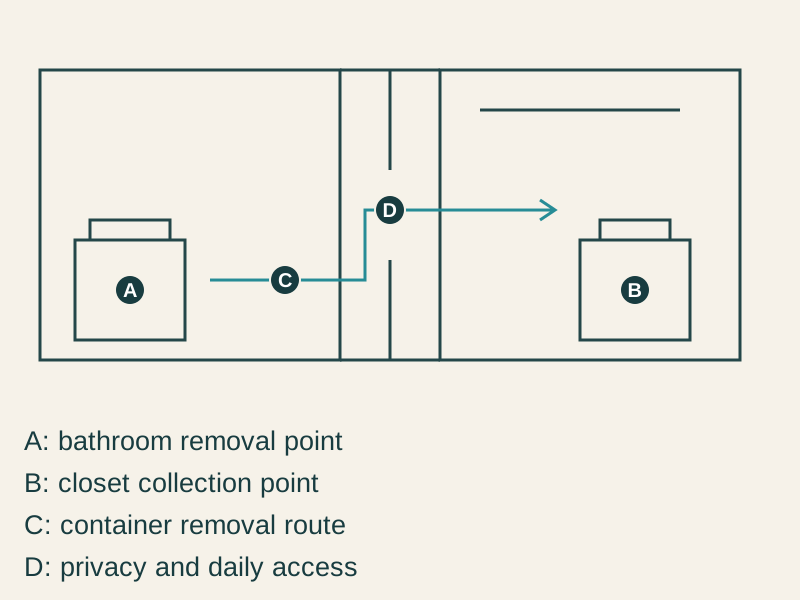
- A
- A: bathroom removal point
- B
- B: closet collection point
- C
- C: container removal route
- D
- D: privacy and daily access
Show the full open front, the user standing at it and the lift or withdrawal path. A closet aisle that accepts a closed hamper may not accept its open front while another person reaches hanging clothes. A bathroom-side opening may conflict with a shower approach or an adjacent drawer even when the cabinet itself fits.
For removable liners, check the transition from the compartment to the carrying position. Handles and attachments need to be usable with the liner actually installed. The bag must also be returned to its supported arrangement. An attractive open compartment that is inconvenient to reassemble may lead to clothing being left outside the cabinet after every collection.
Compare the storage displaced on each side
Assign the lost cabinet bay its former contents. A bathroom hamper may remove daily toiletries from reach and put them on the counter. A closet hamper may displace folded clothing or a dressing accessory. The better location is not necessarily the room with more total cabinets; it is the location where the displaced function can be handled sensibly.
Keep the same collection task in both proposals. If the bathroom version includes a removable bag but the closet version requires hand transfer into a separate basket, record that distinction. Compare complete daily operations rather than two equally sized fronts that perform different amounts of work.
Test a household decision
Imagine an adjoining bath and dressing room where clothing is removed before a shower, but laundry collection usually occurs while the bathroom is occupied. The bathroom cabinet candidate is convenient for dropping garments yet unavailable during the accepted collection window. This is a hypothetical household routine.
The closet-side candidate remains accessible and its opening does not block the planned dressing route. The owners accept carrying garments from the bath to that collection point after their established care steps. The liner can be removed, carried and returned using the accepted routine. They choose the closet side because the collection job can actually finish there.
Another household may collect only after the bathroom is free and remove nearly all clothing there. If its bathroom cabinet preserves necessary storage and opens well, that side may be preferable. Privacy and timing change the conclusion; the word ensuite does not determine it.
Decide whether a second drop point is justified
A small secondary collection arrangement can be useful when garments genuinely originate in separate locations, but it creates another container to check. Define who combines the streams and where the contents are assessed before washing. Adding another concealed bin without assigning collection can make the routine harder to observe.
Keep a missed collection visible in the planning test. What happens when the container is not returned promptly? Where can the next garments go without blocking the room? This is a household operating choice, not a promise that cabinetry changes habits. A simple agreed fallback may matter more than an additional compartment.
Before ordering, retain the selected side, full opening, container removal path, displaced storage and collection responsibility. Choose the position that connects undressing to a completed transfer while respecting how the rooms are occupied. The cabinet should support the household's real sequence from clothing removal to laundry, rather than merely conceal the point where that sequence stops.
Sources & further reading
- Rev-A-Shelf: removable hamper bag