Is a built-in clothes hamper worth giving up a vanity drawer bank?
Treat the hamper as a dedicated cabinet function that replaces other storage. Compare the laundry transfer routine and the remaining drawers before choosing the complete vanity configuration.
Choose a built-in hamper when it removes a real floor-storage problem and the remaining vanity still holds its assigned supplies. It is not free extra capacity inside an otherwise unchanged cabinet. The basket, supporting frame, front and motion need a dedicated location, and that location may be the drawer bank shown in another version of the same vanity.
Follow the clothes beyond the closed cabinet
Start with where clothing is removed, where it waits and how it reaches the laundry. Determine how often the household actually transfers it. A small hidden basket can be convenient if that interval is short; it may overflow into the room if the purchasing decision assumes a routine nobody follows.
Test the intended load using the basket or a faithful size substitute. Then consider how the contents leave. If the selected design uses a removable container, check its grip, extraction path and carrying route with a manageable load. If clothes are transferred to another basket, identify where that basket stands during the transfer. The closed-front photograph demonstrates none of these steps.
Reserve a complete bay for the mechanism
Rev-A-Shelf's top-mount hamper instructions show a sliding support frame with front and rear mounting relationships, followed by a separate door-mounting arrangement. This manufacturer example makes clear that the accessory is an installed moving assembly, not just a loose basket placed in a void.
Use the exact accessory's opening and mounting requirements with the selected cabinet construction. Keep the basin, trap and supply access outside its required space and motion. A nominal cabinet width is not a usable opening measurement. Do not assume a hamper designed for a particular construction can be inserted into any cabinet with a similar front.
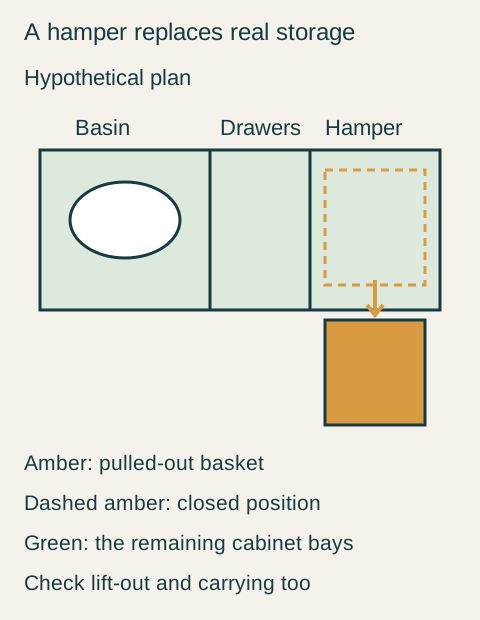
Teaching example Hypothetical vanity plan with a basin bay, drawer bank and dedicated hamper bay. The amber basket is shown pulled forward; the dashed amber outline marks its closed position. The diagram shows horizontal travel only: lift-out, carrying and the actual accessory installation require separate checks.
Compare the same vanity width with different jobs inside
For a hypothetical selection, a 60-inch assembly is divided into a 24-inch basin bay and two 18-inch side bays. One proposal uses both side bays for drawers. The other retains an 18-inch drawer bank and allocates the other 18-inch bay to a compatible hamper assembly. These are illustrative module widths, not minimum openings for the cited Rev-A-Shelf accessory.
In this example, the household's floor hamper currently occupies the approach to the room door. The actual daily toiletries fit in the remaining drawer bank, with the selected basin and plumbing separately accommodated. The extra drawer bank in the first proposal has no required assignment that justifies keeping the floor obstruction.
The household tests its ordinary laundry-transfer interval with the proposed basket. The load fits, the basket can be removed as its design intends, and the person can turn toward the door without placing it in the washing position. The owner chooses the built-in hamper version because it removes the floor basket while preserving the required daily storage. The decision does not count the hamper bay again as spare towel or toiletry capacity.
Know what would reverse that choice
If the load did not fit the household's real transfer interval, an overflow basket on the floor would defeat the reason for the purchase. If the remaining drawers could not hold the assigned supplies, the same-width hamper version would also fail. Neither problem is solved by displaying an empty basket and an empty drawer at the showroom.
Check ordinary access for cleaning the removable parts and the interior according to their care instructions. Keep the hamper's use separate from chemical storage and from access needed for basin service. Finish the order with the selected basket system, compatible cabinet interior and the storage assignment that remains around it. That turns a hidden hamper from an attractive accessory into a working part of the bathroom.
Pure White
Cream White
Light Warm Gray
Gray
Navy
Black
Oak Tone
Dark Walnut Tone
Design study These finish studies are design references, not a list of currently orderable colors. Screens and lighting change the appearance; compare a physical sample before choosing.See all finish options →
Use the same household inventory in each confirmed interior, record what fits and remains accessible, and give every displaced item a named destination before declaring a cabinet sufficient.
Choose a removable tray when lifting out a useful group improves the routine or cleaning access, and choose fixed divisions when the items are better retrieved individually from stable positions.
The sample shows the door frame, a separate center panel, the face frame and the cabinet box. Each component has its own place in this Shaker construction.
Shaker construction: door frame, center panel, face frame and cabinet box. The cutaway helps locate these parts; confirm each material in the specifications for the selected cabinet.
01 / Door frame
The Shaker door has rails and stiles around a separate center panel. The frame and center panel are different components; confirm their materials in the specifications for the selected cabinet.
02 / Face frame
The face frame surrounds the opening at the front of the cabinet box and sits behind the doors. The face frame, door frame and cabinet box are separate parts.
03 / Cabinet box
The sample exposes the cabinet sides, interior surfaces and layered edges. The image does not establish the wood species or material specification of a selected cabinet.