

Bath & laundry planning
Dressing wardrobe: pull-out pants rack or ordinary hangers?
Choose a dedicated pants rack when its actual arms, garment arrangement and outward movement improve the way you select and return trousers. Keep ordinary hangers on a fixed rail when removing a hanger with the garment, changing the mix of clothes or using the same hanging method elsewhere is more useful. Compare finished wardrobe sections with real trousers in place; an empty hardware display cannot establish usable clothing capacity.
Choose a dedicated pants rack when its actual arms, garment arrangement and outward movement improve the way you select and return trousers. Keep ordinary hangers on a fixed rail when removing a hanger with the garment, changing the mix of clothes or using the same hanging method elsewhere is more useful. Compare finished wardrobe sections with real trousers in place; an empty hardware display cannot establish usable clothing capacity.
Start with how the trousers are stored
Some people fold trousers over a hanger; others use clips and keep the legs at full length. A rack that holds folded garments changes the occupied drop and the way clothing is removed. It is not automatically a substitute for the owner's current hanging method.
Try the trousers that will actually live here, including wider legs, thicker fabric and anything normally kept in a cover. Determine whether each can be placed and removed without pulling neighboring garments along. Do not assume that every visible arm should hold several pairs or that the hardware's nominal positions all work equally well for the selected clothing.
Rev-A-Shelf lists dedicated pull-out pants-rack formats. The existence of these organizers does not establish capacity, garment-care benefits or fit in an unrelated cabinet.
Reading note: Rev-A-Shelf: pants organizer formats.
Draw the loaded mechanism inside the cabinet
Show the actual mounting, cabinet sides, door hardware and remaining usable width. Include clothing hanging from the rack, not just its frame. The lowest garment edge may determine whether a drawer or shelf below remains usable.
For ordinary hangers, draw the same trousers using the chosen hanger style. Include the motion needed to lift a hook off the rail and turn the garment out through the opening. Compare equivalent clothing arrangements rather than contrasting a densely packed rack with a loosely populated conventional rail.
Give the rack room to travel
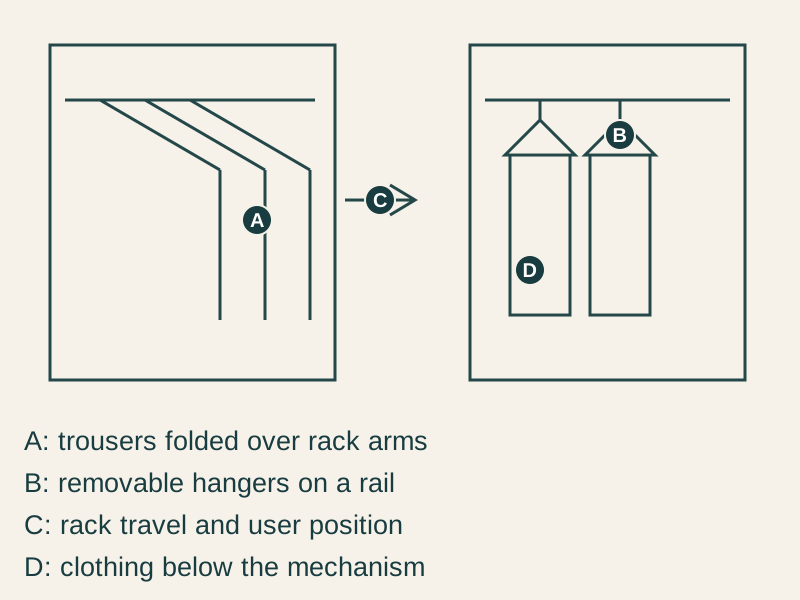
- A
- A: trousers folded over rack arms
- B
- B: removable hangers on a rail
- C
- C: rack travel and user position
- D
- D: clothing below the mechanism
Trace the fully extended position and the person's location beside or in front of it. Open the relevant wardrobe doors and nearby drawers in the intended sequence. A pull-out may bring garments forward but also occupy the standing area from which the next piece is selected.
Then try returning the last pair and closing everything. If the person must step aside, move a hamper or shut another useful drawer each time, keep those steps in the comparison. A movement can still be worthwhile, but its benefit should be visible in the complete routine rather than inferred from the word pull-out.
Compare handling, not just access to the front
A removable hanger can travel with the trousers to an outfit staging area or another closet. A rack arm generally remains part of the installed organizer; check the particular product rather than assuming otherwise. Decide whether lifting trousers off their support at the cabinet is comfortable for the user.
When returning clothing, examine how the person finds the intended position and lays or hangs the garment back. A system that makes selection easy may still require a return method the household dislikes. Keep separate storage for clothes needing care or sorting instead of using the open rack as a temporary pile.
Work through a changing wardrobe
Imagine a household whose daily trousers are normally folded over hangers, while occasional long garments share the same cabinet. A hypothetical rack proposal gives the daily trousers accessible individual positions but fixes that section to a dedicated function.
The owner tests the full daily group and its return motion, then assigns the long garments to a confirmed adjacent section. The rack is useful because the specific clothing and routine fit it. It does not earn the space merely by looking organized when empty.
If the owner's mix changes frequently between trousers, skirts and jackets, the conventional rail may be more useful. Its advantage in this case is the ability to change removable hangers and assigned clothes within the supported layout. That is a planning preference, not a claim that every rack is inflexible or every rail fits every garment.
Count the rest of the cabinet
Review the drawers and shelves displaced by the organizer and the things they would have held. A dedicated rack that eliminates a needed underwear drawer requires another real location for those items. Conversely, a rack may free a different hanging section when the actual garments are redistributed successfully.
Compare the complete proposed interiors and their real quotations, including the selected mechanism, mounting parts, cabinet preparation and doors. Avoid treating a hardware-only price as the installed alternative to a complete conventional wardrobe section.
Keep the selected clothing arrangement with the order
Record the product, mounting configuration, loaded garment drop, travel and intended clothing group. Ask how access for ordinary cleaning and future removal works in the finished cabinet. A later organizer change can affect internal holes, dividers or the space available below.
Choose the pants rack after the loaded trial shows a useful gain in selection and return. Choose hangers when their removable support and adaptable clothing mix fit the household better. The best purchase is the one whose daily handling the owner will actually keep using.
Sources & further reading
- Rev-A-Shelf: pants organizer formats