

Bath & laundry planning
Dressing storage beside the bath: pull-down garment rail or fixed high rail?
Choose a pull-down rail when the actual user can operate the specified mechanism with the intended clothes and the complete moving envelope fits the dressing room. Keep a fixed rail when the garments can be reached and returned normally or when high storage is reserved for a suitable occasional task. Bringing a rail lower can improve retrieval, but it adds a mechanism and an operating position that the wardrobe must accommodate.
Choose a pull-down rail when the actual user can operate the specified mechanism with the intended clothes and the complete moving envelope fits the dressing room. Keep a fixed rail when the garments can be reached and returned normally or when high storage is reserved for a suitable occasional task. Bringing a rail lower can improve retrieval, but it adds a mechanism and an operating position that the wardrobe must accommodate.
Test the task the upper rail will serve
Gather the garments intended for this location on their actual hangers. Distinguish daily clothes from pieces accessed only occasionally. Have the person try taking a selected item and putting it back at the proposed height without adapting their posture merely to make the drawing appear workable.
Rev-A-Shelf describes pull-down closet rods that move downward and outward, with model-specific fitting arrangements. The stored and lowered positions therefore require separate review.
Reading note: Rev-A-Shelf: pull-down closet rods.
Identify the exact mechanism rather than specifying pull-down rod as a generic allowance. Have the cabinet supplier and relevant installer review the required side construction, fixing and compatible opening using current product documents. A rail mechanism is not automatically interchangeable with a fixed rod bracket.
Draw the clothes through the movement
Include the garments and hangers, not only the empty crossbar. Clothes can project beyond the rod's narrow outline while the mechanism travels. Show the hanging group in the stored position, moving toward the person and lowered for selection. Check the actual limits and intended operation of the selected product.
Include the handle and the user's working position. A handle that can be reached is only the beginning; the person must be able to perform the complete supported lowering and return motion. Avoid judging the purchase from an unloaded demonstration if the real garment group changes the operation.
Keep lower storage and doors out of the path
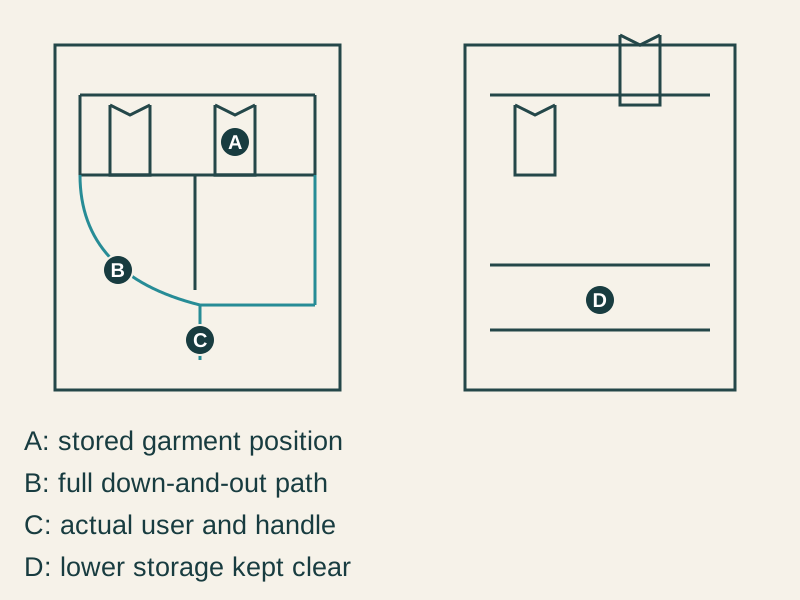
- A
- A: stored garment position
- B
- B: full down-and-out path
- C
- C: actual user and handle
- D
- D: lower storage kept clear
Compare the lowered garments with shelves, drawers and items beneath them. A usable upper rail can consume the volume originally assigned to another hanging row or a lower storage surface. Do not preserve both allowances unless the selected configuration demonstrates that they coexist.
If the wardrobe has doors, show their required open position through the entire operation. The door can expose the upper bay without clearing the moving arms or garments. Another drawer across the aisle may also occupy the lowered position. Record which ordinary states may overlap rather than drawing every component independently in its most favorable condition.
Compare the fixed-rail alternative honestly
A fixed high rail may be useful for suitable occasional clothes when the owner has an appropriate established retrieval arrangement. It can be a poor daily choice if getting dressed requires an inconvenient workaround each morning. The household should approve the real routine, not a statement that the clothes technically fit overhead.
Also consider a lower fixed rail as a separate configuration when it can provide ordinary reach. That may surrender another storage tier, but it avoids a moving mechanism. Compare the actual usable wardrobe after that change rather than assuming the only alternatives are an unreachable high rail and a pull-down system.
Work through a garment-specific choice
Imagine an owner who cannot conveniently retrieve daily shirts from the proposed fixed upper rail. A candidate pull-down mechanism can be installed in the reviewed cabinet bay, but the first drawing places a shelf inside the lowered garment area. This is a hypothetical design comparison.
The revised layout removes that shelf and gives its contents identified drawers elsewhere. The actual user tests the intended garment group through the supported operation, including return to the upper position. The doors and ordinary dressing route remain workable. The owner chooses the pull-down arrangement because daily retrieval improves without relying on an unusable lower compartment.
If the mechanism cannot be operated comfortably with the intended group, the revised wardrobe should instead compare a reachable fixed rail. A photograph of someone else using an empty mechanism cannot settle this person's purchase. The functional test belongs to the household that will use it.
Include ordinary attention and replacement
Ask how the installed mechanism is reached for the attention described in its instructions. Identify the relevant components and their relationship to surrounding panels. A built-in wardrobe should not hide a required adjustment or replacement point behind unrelated permanent construction without a reviewed solution.
Record the selected mechanism, cabinet opening and mounting arrangement with the tested garment group. A new mechanism may have different movement and fitting requirements; a new clothing allocation may change the usable lowered shape. Both are reasons to revisit the design rather than assuming that a familiar product label preserves the original result.
Keep the bath and dressing functions separate
This rail serves clothes ready for dressing storage. It is not a substitute for a drying arrangement for textiles leaving the bath. Give those items their own appropriate care destination so the wardrobe test uses the contents it will actually hold.
Choose the moving rail when complete operation, garments and room use have been demonstrated together. Choose fixed hanging when ordinary retrieval is practical and the simpler configuration serves the brief. The useful gain is a person selecting and returning clothes easily, not merely adding a second line of hanging to the cabinet elevation.
Sources & further reading
- Rev-A-Shelf: pull-down closet rods