

Construction & materials
One-off cabinet production vs. repeat orders: what to compare
A factory’s ability to sequence different components does not define every cabinet it will offer. Match the production format to the item list, permitted variations and assembly identification behind the project.
A batch-size-one cabinet line can be relevant when an order contains different component requirements, but the manufacturing description is not a promise of unlimited customization. Compare the factory’s actual offered configurations with the cabinet list first. Then investigate how variations remain connected to their intended assemblies. A repeated order and a mixed order may both fit a production program; neither becomes suitable merely because the equipment is described as automated.
Decor describes its BS1L processing cabinet components in the order needed for assembly. The same scaled program uses predefined cabinet configurations. This current example does not establish an exact launch date or universal production benefit.
Reading note: Decor Cabinets: Built for Scale and BS1L manufacturing.
Separate sequence flexibility from the product range
A line may be organized to handle different parts in sequence while the seller still offers a defined cabinet range. Those are compatible ideas. The manufacturing route describes how accepted parts move through production; the product offer determines which cabinets, materials and variations the buyer can actually select.
Ask the provider to identify the proposed configurations and any permitted changes. A computer-controlled process does not by itself confirm an unusual dimension, a special profile or a new material combination. If a proposed cabinet falls outside the offer, it remains an exception to resolve. Do not treat the machine description as approval of that cabinet.
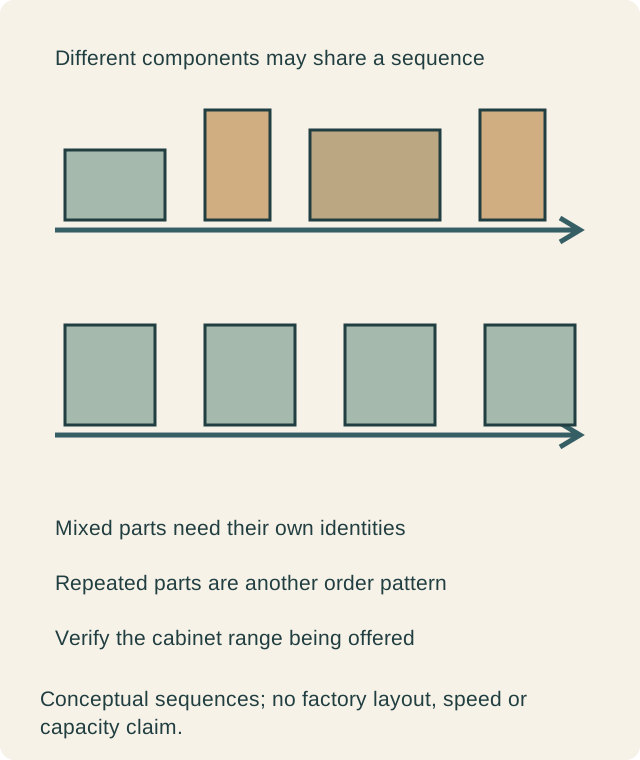
Describe the order’s variation before comparing factories
Distinguish repeated cabinets from genuinely different items. A project may contain many similar rooms while also requiring handed arrangements, distinct end conditions or revised storage groups. The provider needs to connect those differences to the actual product list. Similar appearance alone does not establish that all components can be ordered as identical parts.
Conversely, do not turn a repeated configuration into unnecessary special items. If the project accepts the same cabinet arrangement in several locations, preserve that clarity. The useful manufacturing comparison begins with the order the project really needs, rather than a sales discussion that assumes every kitchen is either entirely standard or entirely unique.
Component identity matters when unlike parts travel together
For a mixed order, ask how the supplier identifies a component’s intended assembly and its final project location. The factory’s internal sequence and the room’s cabinet labels do not have to be identical systems, but the provider should be able to connect them. A part arriving with an unexplained code is not yet useful information to the team assembling or installing it.
This is a question about traceability, not a requirement that a homeowner inspect a factory database. The cabinet provider should own the connection. If a component needs replacement, the request should identify the intended item and its current specification. Calling it the small panel from the automated line is not a sufficiently specific service description.
A revision changes information before it changes a physical part
When the project changes a cabinet after a proposal is prepared, ask which item descriptions and dependent components are affected. Do not assume a digital production route makes every revision trivial. The actual consequences depend on the product, the current order status and what work has already occurred.
Equally, do not assume a factory cannot handle a permitted variation merely because it produces at scale. Have the provider explain the actual offer and the revised scope. The comparison should preserve the project’s needed configuration while respecting the defined production program. Automation is background to that discussion, rather than a substitute for its answer.
A hypothetical repeated project keeps its exception visible
Imagine a buyer planning several kitchens with the same accepted cabinet group and a separate room with a different end condition. The first proposal treats everything as the repeated group because its elevations look similar. The buyer asks the provider to identify the changed room separately and confirm whether the required parts are offered within the chosen program.
In this hypothetical case, the provider can supply the variation and connects its components to the appropriate assembly and room. The repeated group remains unchanged. The buyer accepts the program because the actual list is supported, not because a line can produce unrelated shapes in an impressive demonstration. The exception is part of the order rather than an installer’s later improvisation.
If the variation were outside the program, the buyer would need a different proposed configuration or a clearly coordinated alternative supply scope. The line’s sequencing ability would not remove that limit. Another factory using a different route might still deliver the complete accepted list. The result turns on product capability and responsibility for the assemblies, not on the most advanced-sounding equipment.
Assembly sequence does not promise delivery sequence
The order in which components are prepared for assembly is not automatically the order in which completed cabinets will reach the project. Keep manufacturing explanation separate from the actual supply arrangement. Ask the provider how the completed order will be identified and supplied for the agreed project plan.
For example, a room priority does not become a confirmed shipment instruction merely because the factory can sequence components. Any proposed supply arrangement needs an explicit response from the provider. Likewise, a sequence description does not establish installation readiness, storage conditions or a particular completion date. Evaluate those matters from the actual project offer.
Quality still belongs to the finished product
Review representative finished cabinets and the applicable product information. If the seller makes performance or consistency claims, ask what supports them for the offered line. An automated route can describe a manufacturing method without proving every joint, finish or assembled result meets the buyer’s requirements.
The same standard should apply to a provider emphasizing manual production. A process identity is useful when it explains the proposed result; it is insufficient when it replaces that result. Compare actual construction, accepted appearance, scope and service. Do not assign universal price, lead-time or quality rankings to either production label.
Retain the accepted configuration list, the permitted variations and the provider’s way of connecting parts to assemblies. This makes the manufacturing discussion useful beyond a factory tour. Batch-size-one becomes a relevant purchasing consideration when the order’s real differences are supported and identifiable, while repeated items remain clear and the complete cabinets meet the agreed project requirements.
Sources & further reading
- Decor Cabinets: Built for Scale and BS1L manufacturing