

Buying cabinets
Batch-cooking kitchen: buy more freezer space or a better preparation and packing area?
Separate the space occupied by finished portions from the surfaces needed to make them. Test the existing freezer, active containers and return-to-cabinet routine before choosing where to spend the remodel budget.
Find the constraint before buying the larger appliance
Buy extra freezer capacity when the intended finished collection cannot be accommodated in a permitted, usable arrangement after accounting for the foods already stored. Buy better preparation and packing space when the cold-storage arrangement works but the ordinary session repeatedly runs out of clear working positions. Some kitchens need both, but one investment should not be credited with fixing the other problem.
Start with the batch the household actually wants to repeat. Name the cooking vessels, portion containers, lids, labels or other supplies it uses. Keep food-handling requirements separate from the furniture exercise. The trials here use clean empty containers and task outlines to compare space; they do not prescribe cooling, freezing or storage procedures.
Count finished containers with the retained frozen foods present
Do not begin with the freezer emptied for a photograph. Identify the regular frozen groups that will remain, then place representative container shapes into the selected product's supported storage arrangement. Preserve required access and loading provisions.
A nominal appliance capacity does not show whether the chosen covered dish passes through a drawer opening or whether a particular group can be retrieved. Include the closures and any projecting edges. If the proposed change is smaller portions or different containers, record that as a changed routine, not as extra freezer space.
Rubbermaid lists the covered Brilliance food-storage containers for freezer use. That designation is product-specific; it does not establish that an arbitrary container or any transition between appliances is suitable.
Reading note: Rubbermaid — Brilliance food-storage set, freezer-use designation.
Use containers whose intended use matches the actual routine and follow their instructions. The cabinet decision should use those selected shapes, rather than an attractive organizing bin with no confirmed role in the food plan.
Distinguish stored quantity from the size of one session
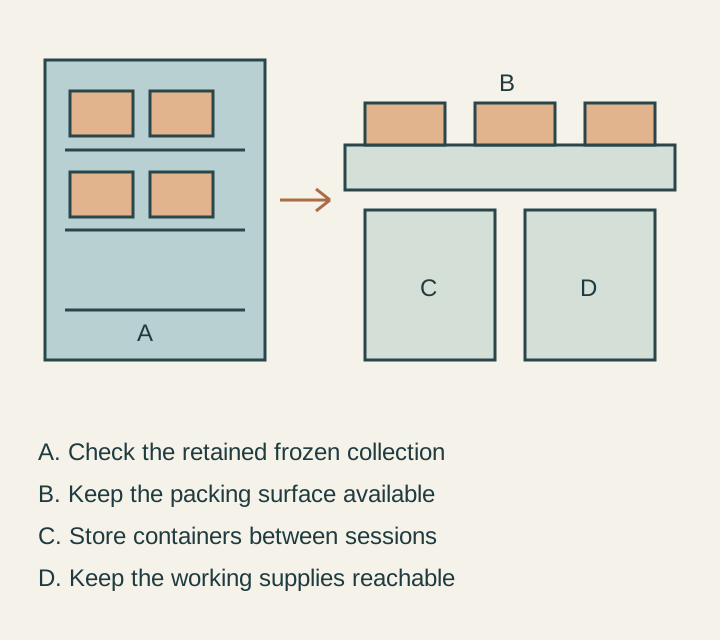
The freezer can contain portions from earlier sessions when another batch arrives. Record the expected remaining collection rather than assuming the whole previous batch has disappeared. Also identify whether different people remove portions independently; an arrangement should remain understandable when the original cook is not present.
Conversely, a desire to cook more at once does not prove a need to keep more total meals. The household may use the new portions while reducing another reserve. That is a changed allocation worth checking before adding an appliance and its room footprint.
Separate the capacity to store the accepted collection from any product-specific restrictions on loading new food. Container fit alone does not establish freezing throughput. Use the actual appliance and relevant food directions for that part of the routine.
Now lay out the working session
Keep the actual board, bowls, cooking vessels and packing supplies visible in the dry trial. Show which objects are present together. A container needs its own position while being filled and closed, even if it nests neatly in a drawer afterward.
Follow the next action. Can the person reach lids without moving a row of containers? Does the tool drawer open while the work is spread out? Is the proposed packing surface also the place where another person prepares the current meal?
Sequential work may solve a surface conflict if the household accepts the actual reset. Do not count a surface twice simply because one drawing shows chopping and another shows packing. Name what is removed, where it goes and when that change happens.
A numerical exercise exposes the wrong purchase
For a hypothetical geometry comparison, the checked existing freezer arrangement accepts 24 identical selected containers, with 8 positions reserved for the retained collection. That leaves 24 − 8 = 16 positions. A proposed batch uses 12, leaving 16 − 12 = 4 positions. These invented inputs describe space, not a freezer rating or a food-loading recommendation.
In the same hypothetical dry trial, the packing surface accepts 4 open empty containers with their working lid arrangement. Preparing the 12-container batch through that footprint requires 12 ÷ 4 = 3 successive groups, if that sequence is otherwise appropriate and accepted. This is a furniture exercise, not a timing or food-handling procedure.
The exercise identifies room for the planned stored group but a deliberate working-sequence question. A bigger freezer would not give the hands a clearer place to fill containers. The owner can choose to retain the sequence or change the working surface; either is more precise than assuming cold capacity is the missing investment.
Follow the empty containers home
As meals are used, containers and lids return through cleaning to dry storage under their care instructions. Check the drawer when the clean collection is back, not only while most of it is occupied elsewhere. A batch routine can need both filled-container space and empty-container cabinet space at different stages.
Give matching lids an understandable position. Retain the containers used for ordinary leftovers too. If the new batch collection replaces old pieces, make that decision before sizing the drawers rather than counting both indefinitely by habit.
Include any infrequent large vessel without letting it crowd the daily packing group. The best surface improvement can be lost if every session starts by searching distant cupboards for the same lid or label supply.
Compare complete renovation alternatives
An extra freezer proposal includes a permitted location, connections, operating and service space, and the dry storage displaced there. A working-area proposal includes the actual cabinets, top, usable contents and any equipment arrangement changed to obtain that surface.
Price both at that finished scope. If adding a tall cold-storage position removes the very counter needed to prepare the planned batches, show that conflict before buying. If expanding the packing area uses a cabinet that stored containers, give those containers a checked replacement location.
Neither choice has a universal financial payback. Use the household's actual goals and quotations rather than presumed savings from larger quantities. More room to buy food is not the same as a manageable routine for making and using meals.
A household spends on the working area
In the hypothetical project, the stored-container exercise passes in the existing freezer. The repeated difficulty is that the packing footprint competes with current dinner preparation. The owners compare keeping successive groups with creating a dedicated clear section of counter.
They choose the counter arrangement, with nearby dry storage for the complete returned container collection and lids. They retain the freezer, accept its verified storage arrangement and avoid a tall appliance position that would have removed part of the new work surface.
Another household whose finished collection does not fit after a genuine review may buy extra frozen storage instead. Keep the stored state, working state and returned-container state together. That complete cycle makes the next cabinet or appliance purchase answer the constraint that actually exists.
Sources & further reading
- Rubbermaid — Brilliance food-storage set, freezer-use designation