Back-painted glass or acrylic glass-look cabinet fronts?
Real glass inserts and acrylic-faced boards can create opaque reflective fronts. Compare the visible frame, edge, back and complete door rather than treating the glass look as one material.
Choose a back-painted glass front when you want the actual glass finish and accept the proposed frame and glazing construction. Choose an acrylic glass-look front when you prefer its complete board-and-edge treatment. Similar color and reflectivity do not make these interchangeable doors. Start with the whole front: an opaque reflective appearance can be delivered by different materials, and the border seen around that surface may matter as much as the broad face.
A glass front can have a visible metal frame
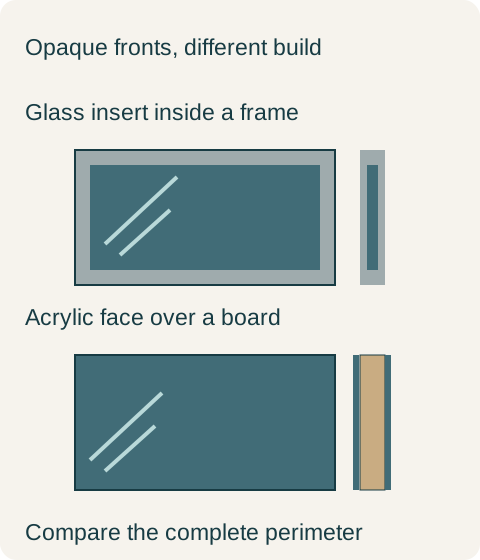
Kitchen Craft lists back-painted glass inserts specifically for aluminum-framed cabinet doors, with gloss and matte variants. This is a real glass-in-frame example, rather than an assertion that every opaque glass front uses the same construction.
REHAU describes RAUVISIO crystal cabinet boards as acrylic laminate and a balancing backer bonded to MDF, with matching edge treatment on fabricated doors. The glass appearance belongs to an acrylic-faced assembly, not a sheet of mineral glass.
These constructions offer different ways of finishing the perimeter. Compare an actual corner and the edge near the handle, not just a small face sample. A narrow metal border can be an intentional part of the room, while an edged board can continue the face color around a different outline. Neither detail should be hidden until installation. The question is which complete front you like beside the adjoining drawers, exposed cabinet end and nearby appliance, rather than which face looks closest in an isolated photograph.
Diagram Conceptual full-front and edge comparison: glass held within a visible frame versus an acrylic-faced board. Not a fabrication detail, a universal glass-door construction or an assertion of equal material thickness.
One family chooses the uninterrupted color treatment
In a hypothetical kitchen, the owners compare a dark back-painted glass insert in a contrasting aluminum frame with a similarly dark acrylic-faced slab front. They like both face samples but do not want the frame to outline each door. After seeing full-size finished alternatives, they choose the acrylic-faced package and accept its edge appearance. They also order the matching treatment proposed for the exposed end. They have selected the desired composition, not established that acrylic is universally better than glass.
The rejected glass option could be the better choice for someone who wants that frame rhythm. A metal border repeated across the cabinet run can relate to shelving or appliance details. Conversely, a different glass system might conceal its supporting detail. Do not generalize from one displayed frame to every glass-front offer. The useful next comparison is the specific assembly that produces the desired perimeter, including the open-door view, rather than searching for a material name that supposedly guarantees a frameless result.
Open the door before approving the package
The back face and the visible edge change the experience when the cabinet opens. With a glass insert, understand which surface faces the room and what is seen from inside the frame. With an acrylic-faced board, examine the back treatment and how it meets the edge. These are not hidden academic details: the person standing beside an open door sees them routinely. A glossy room-facing sample cannot establish the appearance of the rear face, nor can a front elevation show every perimeter junction.
Evaluate the working sample as a complete door. The hinge and handle arrangement must belong to that assembly, with its actual size and weight. Do not apply a surface-material weight comparison directly to a finished door: a frame, core, backer and fittings are also present. A material brochure can describe its own surface without proving that a different supplier’s complete door will be lighter, easier to operate or suitable for the hardware already in the kitchen.
A later color change is a different job from repainting wood
Buying a colored reflective face does not establish that it can later be treated like a painted wood door. For each proposal, determine whether a damaged or unwanted appearance leads to replacing an insert, renewing a component in the workshop or ordering a complete front. The answer depends on the assembled product and the offered service. Do not assume that household paint, abrasive polishing or an unspecified adhesive will preserve the selected glass or acrylic effect.
This matters especially when the proposal mixes surfaces. A buyer might want opaque reflective doors but plainer drawers or side panels. Review that combination as a deliberate design, rather than expecting every supplier to have an identical companion part in every material. If the sample set includes only the door face, the price comparison still lacks information about the pieces needed to complete the room. Compare the finished scope, including any visible frame, handles, ends and fabrication, before assigning the entire difference to glass versus acrylic.
Order the appearance with its material identity
Keep the approved full-door sample information, frame or edge description and companion-part treatment together. A replacement should reproduce that assembly, not merely repeat the color word. The hypothetical owners select the acrylic-faced doors because the completed perimeter fits their design. A purchaser who prefers the glass-and-metal composition can make an equally clear choice, provided the quotation names the actual materials and the complete front shown.
Pure White
Cream White
Light Warm Gray
Gray
Navy
Black
Oak Tone
Dark Walnut Tone
Design study These finish studies are design references, not a list of currently orderable colors. Screens and lighting change the appearance; compare a physical sample before choosing.See all finish options →
Compare the actual countertop products, heat-source routine and fabrication proposal. A fired porcelain slab and resin-bound quartz are different materials, but neither label replaces a complete kitchen specification.
The sample shows the door frame, a separate center panel, the face frame and the cabinet box. Each component has its own place in this Shaker construction.
Shaker construction: door frame, center panel, face frame and cabinet box. The cutaway helps locate these parts; confirm each material in the specifications for the selected cabinet.
01 / Door frame
The Shaker door has rails and stiles around a separate center panel. The frame and center panel are different components; confirm their materials in the specifications for the selected cabinet.
02 / Face frame
The face frame surrounds the opening at the front of the cabinet box and sits behind the doors. The face frame, door frame and cabinet box are separate parts.
03 / Cabinet box
The sample exposes the cabinet sides, interior surfaces and layered edges. The image does not establish the wood species or material specification of a selected cabinet.