An acrylic decorative mirror can be supplied in more than one panel construction. Before comparing its price or weight with glass, identify whether the offer covers a thin decorative sheet, a core-backed panel or a finished cabinet front. These are different purchases. A surface-material comparison cannot by itself predict the mass or fabrication needs of the completed door.
The mirror face can stay the same while the backing changes
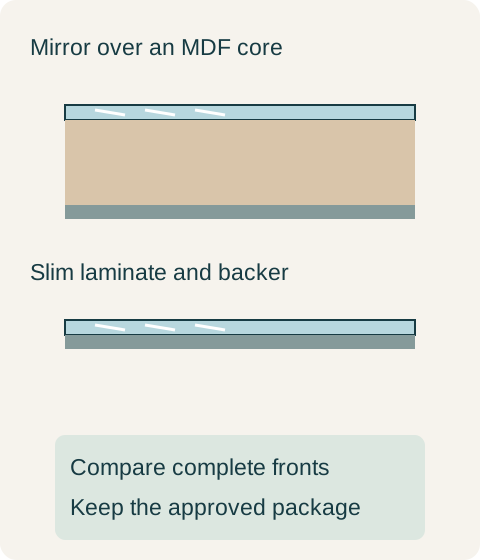
REHAU identifies RAUVISIO crystal mirror as an acrylic polymer material that can be processed with woodworking machinery. Its program distinguishes a pressed panel with an MDF core and balancing backer from a slim panel made by pressing the mirror laminate directly to the balancing backer. The cited nominal panel thicknesses are 19 mm and 4 mm respectively. These are specific program constructions, not universal acrylic-mirror thicknesses.
The construction difference explains why the sheet price is incomplete. The thin option omits the MDF core found in the pressed version; it does not thereby become an interchangeable door blank. If the project needs a supported face, the receiving support, bonding, reverse construction and edge completion remain part of the fabrication scope. Those additions can change the finished dimensions and weight.
Similarly, a claim that the mirror material is lighter than glass compares materials under the stated conditions. It should not be turned into a percentage reduction for an MDF-backed cabinet door. Compare completed fronts with their actual layers and dimensions. The operating assembly must then be reviewed for that front, rather than keeping an old assumption based on a much thinner decorative sheet.
Teaching example Conceptual sections of different mirror-panel constructions. Thicknesses are not drawn to scale; no door weight, optical tolerance or safety rating is implied.
Buy the finished mirrored front, not the less expensive sheet alone
Suppose a hypothetical order calls for an MDF-backed mirrored cabinet front, including its finished edges and reverse. An alternate quote supplies only the slim decorative panel. The buyer selects the complete front package after accepting its actual construction and appearance. The slim-sheet offer is excluded from the like-for-like price comparison because it leaves the supporting and completion work out of scope.
In that hypothetical order, the slim material could still serve a separately designed decorative lining, but it is not substituted for the door. Assigning it to another purpose would require a separate component definition. This prevents a visually similar sheet from arriving as if the cabinet shop had already manufactured, balanced and finished the required front.
Reflection quality belongs in the completed sample
Review the mirror at the viewing position and on the representative finished construction. The face appearance, edge transition and reverse should be visible together. A loose sample establishes the material look, while a finished sample shows how that look survives the chosen fabrication. It is not necessary to invent a universal distortion tolerance to notice and approve the actual result.
Keep the exact material and panel construction, finished dimensions, edges and reverse in the accepted order. Use the finished component weight where weight is needed, and retain the applicable care instructions. The word acrylic does not authorize ordinary glass-cleaning products, scratch removal methods or safety-glazing uses. The resolved choice is a specified decorative cabinet component, with the thin sheet and the complete front no longer priced as equivalents.
Pure White
Cream White
Light Warm Gray
Gray
Navy
Black
Oak Tone
Dark Walnut Tone
Design study These finish studies are design references, not a list of currently orderable colors. Screens and lighting change the appearance; compare a physical sample before choosing.See all finish options →
A painted door, a wood-grain side and a plywood cabinet box can belong to the same cabinet. Here is how to read those parts, what the sample photos actually show, and which details to put on a quote.
The sample shows the door frame, a separate center panel, the face frame and the cabinet box. Each component has its own place in this Shaker construction.
Shaker construction: door frame, center panel, face frame and cabinet box. The cutaway helps locate these parts; confirm each material in the specifications for the selected cabinet.
01 / Door frame
The Shaker door has rails and stiles around a separate center panel. The frame and center panel are different components; confirm their materials in the specifications for the selected cabinet.
02 / Face frame
The face frame surrounds the opening at the front of the cabinet box and sits behind the doors. The face frame, door frame and cabinet box are separate parts.
03 / Cabinet box
The sample exposes the cabinet sides, interior surfaces and layered edges. The image does not establish the wood species or material specification of a selected cabinet.