

Design & industry
Yorktowne’s fall 2026 introduction: choose a coordinated project, not the whole release
The Yorktowne release brings walnut, a frameless option and floating vanities into the same planning conversation. Decide which additions solve your project before changing a cabinet package.
Yorktowne’s fall introduction is a reason to revisit a project when its newly expanded material or cabinet offerings address an unresolved need. It is not a reason to restart an already coherent kitchen simply to include everything new. The useful purchase decision is which part of the enlarged portfolio improves the actual room, and whether that selection can be supplied as a coordinated cabinet package. Keep the release’s broader possibilities separate from the combinations confirmed for your order.
In its 2026-09-10 announcement, Yorktowne links its fall 2026 introduction with walnut, a new frameless option, floating vanities and Ceruse finishes. These are manufacturer-announced additions, not confirmed project availability.
Reading note: Cabinetworks Group: Yorktowne Fall 2026 introduction, September 10, 2026.
Start with the reason the release changes your shortlist
A homeowner who wanted walnut but could not find it within the preferred cabinet family now has a specific reason to ask for a revised proposal. Someone whose existing selection already satisfies the material, layout and appearance brief may have no reason to change. Being new is useful information; it is not a substitute for a missing requirement in the project.
Write that requirement in a sentence before looking at more samples. It might be a wood accent that carries from the kitchen into nearby living storage, or a cabinet-line option that accommodates a particular design approach. This keeps the conversation about an identifiable improvement. Without that anchor, additional choices can turn a resolved palette into an indefinite series of substitutions.
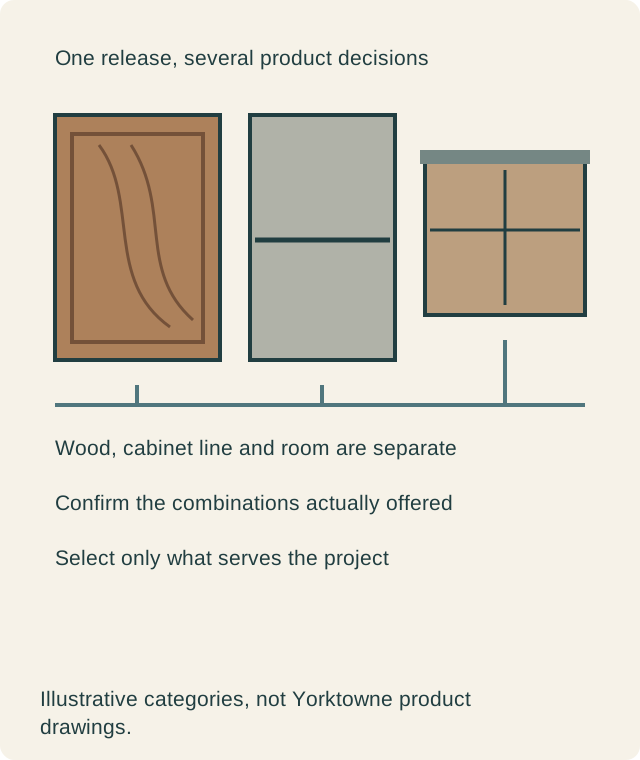
Walnut is a material option, not a complete finish description
If walnut is the reason to revisit the range, ask to see it on the intended door family with the actual finish. Include a representative exposed end and narrow companion front. The release identifies an added species; it does not establish that every profile, decorative component or surface treatment is offered in that species. Let the supplier confirm those combinations rather than completing a catalog in your imagination.
Consider where wood belongs in the room. A defined island accent and a full wall of wood make different use of the material. Compare each as an elevation beside the retained floor and countertop. An attractive walnut door alone cannot settle whether the project should change every visible cabinet face. The addition may solve a small, important part of the design without becoming the universal finish.
A new cabinet line deserves its own proposal
The announced frameless option creates a product-line question, not automatic permission to transfer an existing framed-cabinet drawing unchanged. Ask for the project in the proposed line, including available components and finished transitions. Review what changes in the actual offered cabinet group. The general differences between framed and frameless construction are already a separate comparison; here the issue is adopting this newly introduced option in this order.
A sample from another line can help explain appearance, but it does not fill an unconfirmed line item. Keep the drawing and quotation tied to the proposed product identity. If the project uses more than one line, show where they meet and how visible ends, trim and finishes are intended to relate. Sharing a brand name is useful context, not proof of every junction’s compatibility.
The vanity expansion opens a whole-home conversation
A floating vanity in the same release may appeal when the household is already planning both kitchen and bath work. Decide what should coordinate across those rooms: a wood family, a general color relationship or the degree of visual simplicity. Coordination does not require every cabinet to repeat the same door or the same material. Different rooms can have different jobs while remaining part of a deliberate home design.
Ask the supplier to confirm the actual vanity configuration and finish separately. The kitchen selection should not silently become the bathroom order, and the announced vanity should not be treated as a wall-support or plumbing specification. For a kitchen-only project, the vanity can remain outside the scope. There is no purchasing benefit in adding an unrelated renovation to make the release feel complete.
A hypothetical project adopts walnut and keeps its other decisions
Imagine a household whose kitchen layout and painted perimeter are already approved. Its remaining problem is that the island wood sample feels disconnected from a nearby living-room cabinet. The new walnut offering gives the designer another material to assess. A completed door-and-end sample produces the relationship the household wants, so it revises the island selection while retaining the rest of the kitchen palette.
The household also sees the new frameless and floating-vanity announcements. Neither answers an unresolved need in this project, so neither is added. This hypothetical decision uses the release’s substance without turning the entire release into a shopping list. The owner has a concrete reason for the revision and a clear boundary around the cabinets affected by it.
If the walnut trial had looked too dark against the retained floor, keeping the previously approved material would have been reasonable. Availability of a new species does not settle its visual fit. Likewise, if the desired island components could not be supplied together in the selected configuration, the material choice would remain incomplete until the supplier offered a coherent alternative.
Confirm orderability at the exact combination being considered
Request the current style, wood, finish and component combination for the actual project. Distinguish a sample that can be viewed, a catalog option and an item accepted on the supplier’s quotation. Those are different stages of the purchase. The dated announcement explains why the range deserves another look; the current order documentation establishes what this buyer can obtain.
Also ask what changes if a companion panel or decorative piece is unavailable in the preferred combination. A proposal using another accepted finish can be viable, but it needs to be visible in the design and price. Do not let a broad release summary conceal a substitution whose appearance has never been reviewed. Keep the revised cabinet package understandable without the press release beside it.
Make the release earn a specific revision
Retain the new completed sample, the affected cabinet identifiers and the revised proposal together. Record why the change improved the room: the wood relationship, an available cabinet configuration or a coordinated bathroom selection already within scope. A later reviewer should be able to understand the decision without being told that this was the newest collection.
The announcement has done useful work when it reveals an option that resolves a real design problem. The resulting order still needs its own confirmed components, finish and delivery arrangements. That is how a broad product introduction becomes a defined home project, while the many additions the household does not need can remain interesting possibilities for another job.
Sources & further reading
- Cabinetworks Group: Yorktowne Fall 2026 introduction, September 10, 2026