

Design & industry
Salice Exedra Light at SICAM 2026: specify the assisted movement and the supplied assembly
The new pocket-door system puts a defined smaller-front range, IN/OUT movement and kit-versus-customized supply into the same cabinet decision. US availability remains a separate confirmation.
Salice’s Exedra Light presentation makes a pocket-door cabinet decision more specific. Instead of asking only whether a front can disappear, a buyer can investigate a defined door range, choose the direction of assisted movement and decide how much of the mechanism arrives assembled. These are consequential choices for a cabinet shop preparing a complete unit. They also give a homeowner better questions than whether a showroom door feels smooth.
Salice’s announcement, published 2026-10-19, presents Exedra Light for door heights of 700–1600 mm and door weight up to 18 kg. These international limits do not confirm US availability.
Reading note: Salice returns to SICAM2026: Exedra Light.
The product page distinguishes OUT automatic extraction from IN automatic insertion. It lists assembly kits and customized, assembled versions made to customer dimensions and supplied ready to mount.
Reading note: Salice international: Exedra Light versions and documentation.
Start with the actual front within the new range
Treat the announced range as an initial screen. The selected front still needs the applicable width, thickness, weight and cabinet arrangement verified together. A door name or nominal cabinet size does not describe that complete combination. Ask the cabinet provider to identify the proposed front and the exact offered system before the room design depends on it.
This matters particularly when the design changes after a hardware demonstration. A different decorative panel or a revised front height can create a different specification question. Keep the mechanism review attached to the current door drawing. A sample that works with another front establishes how that sample moves; it does not settle the changed assembly.
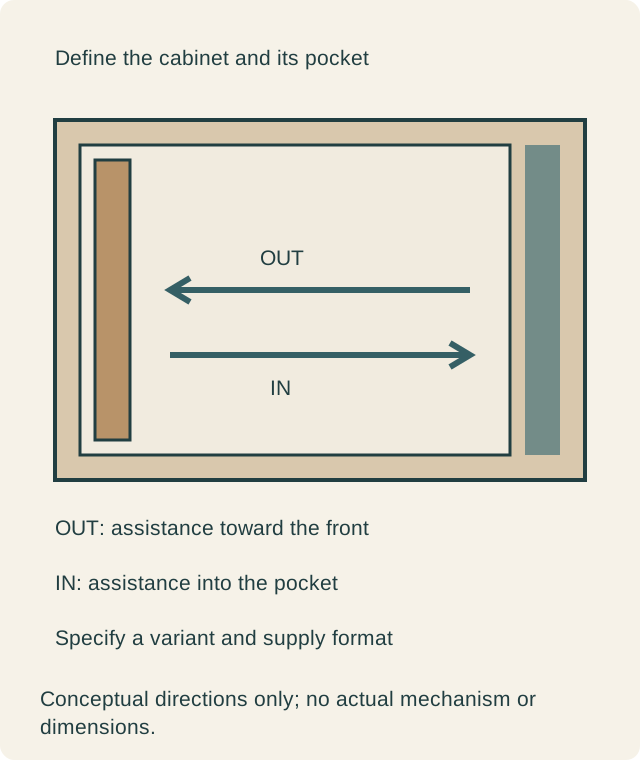
OUT and IN describe different assistance choices
The practical question is which part of the movement the household wants assisted. Ask to see the proposed version travel from its stored position to the usable front and back again. Observe where the user initiates movement, takes hold of the door and completes the operation. Write down the version shown rather than remembering only the product family.
Do not order as though the names describe settings the installer can freely exchange. The supplier should identify the actual offered variant and its compatible parts. If the preferred action changes during design, review the selected assembly again. That is more reliable than leaving the installer a vague instruction to make the door operate like the showroom example.
Choose the supplied assembly before assigning fabrication work
A kit and a customized assembled version place different work into the project sequence. The cabinet provider should explain which cutting, assembly, mounting and adjustment tasks remain with the shop for its proposed package. This is a division of actual work, not an assumed ranking of quality. Either route needs a cabinet designed for the selected configuration.
Ask who confirms the dimensions submitted for a customized assembly and when those dimensions become final. For a kit, ask who prepares it according to the applicable configuration documents. A homeowner need not manage the fabrication process, but the cabinet quote should have an accountable provider for the complete working result. An unassigned step can survive unnoticed until the parts arrive.
Review the pocket as part of the cabinet interior
The concealed front needs a place to go. Show that place on the actual cabinet plan beside the useful storage or work opening. Do not draw a full-width interior and add the pocket later as an invisible allowance. The finished unit must make sense with the door stored, moving and closed.
Also ask how the offered assembly will remain accessible for adjustment or service in the finished room. A decorative return or adjacent cabinet should not be accepted solely from the closed elevation if it interferes with the provider’s intended access. These are questions for the actual specified system, not instructions to improvise clearances from a conceptual drawing.
A hypothetical serving cabinet chooses the movement before the finish
Imagine a dining-area serving cabinet whose front is intended to stay retracted while guests use its contents. The household compares demonstrations of the offered variants and decides that assistance when returning the door into its pocket best suits its routine. The provider investigates the corresponding configuration, instead of ordering by the family name alone.
During the same review, the owners propose a heavier decorative front. The shop pauses that substitution until the complete front and system combination is checked. It then confirms the accepted front, the cabinet pocket and a customized assembled supply arrangement. The final color sample is approved against that defined assembly, rather than being allowed to change the mechanism requirements afterward.
This hypothetical result is not a recommendation that every serving cabinet should use IN or customized supply. Another buyer may prefer the other action, and a shop may have a well-established kit preparation process. The useful outcome is that the selected motion, front and fabrication responsibility agree. No part of the decision depends on claiming a universal best variant.
US projects need an offered product, not an international assumption
The cited announcement and product page belong to Salice’s international site. A US project should ask its provider whether the proposed configuration can actually be supplied for that project, with the applicable documentation and support. Keep that confirmation separate from the fact that the system appears in the SICAM presentation.
If the local provider offers a different pocket-door system, compare its actual motion and cabinet requirements on their own terms. Do not label it equivalent merely because the door disappears in both demonstrations. A substitute may still be suitable, but the room drawing and complete cabinet quote should be reviewed around the substitute actually offered.
Retain a configuration record that can survive revisions
The useful record identifies the front, the selected movement variant, the supply format and the provider responsible for the finished cabinet. Keep the accepted drawing and applicable product documents with it. If a finish, decorative panel or cabinet dimension changes, the record makes the affected questions visible before production.
Exedra Light’s release is therefore worth reviewing as a specific cabinet system introduction. Its buying significance lies in a more defined front and movement package, with an explicit choice about preparation. The purchase becomes concrete when those choices describe the assembly being offered and the household has seen the intended operation, with regional supply confirmed separately.
Sources & further reading
- Salice returns to SICAM2026: Exedra Light
- Salice international: Exedra Light versions and documentation