

Buying cabinets
Portable induction or permanent cooktop expansion: plan the whole extra cooking station
A portable induction unit can serve an occasional extra task only when its operating space, electrical provision, duty limits and storage all work. Compare that complete temporary station with a permanent cooktop expansion, not just the appliance prices.
Add a usable cooking station, not just an appliance
A portable induction unit is worth considering when an occasional extra cooking task fits the product's documented use and the kitchen has a suitable place to operate and store it. Expand the fixed cooking arrangement when the additional position is needed routinely, the portable candidate's limits do not fit the task, or its operating footprint consumes essential preparation space. A small purchase can still demand a substantial part of the working kitchen.
Keep the original problem specific. Does the main cooktop fail only during an occasional gathering, or is a regular meal short of a usable position every evening? A portable unit might make sense for the first situation while adding repetitive setup and clearing to the second. Neither choice should be judged solely by the fact that one appliance can go into a cabinet afterward.
The movable product has an operating limit
IKEA describes the named TILLREDA as movable and stowable between uses and identifies an included plug. Portability does not approve every countertop position or electrical supply.
Reading note: IKEA USA — TILLREDA portable induction cooktop, movable and stowable product architecture.
Read the intended task against the selected product before buying. A portable unit chosen for long, continuing cooking cannot be justified by saying that its power sounds adequate. If the task conflicts with the instructions, choose another documented product or a different kitchen arrangement. Do not convert a usage limit into a cooking recommendation or attempt to work around it with an improvised operating pattern.
The exact cookware also matters. Establish that the vessel is suitable for the candidate and that it sits as required, without using a brand or material name as proof. A portable position that only accommodates an unused small pan has not resolved the problem created by the household's regular large cookware.
Operating space is larger than the storage rectangle
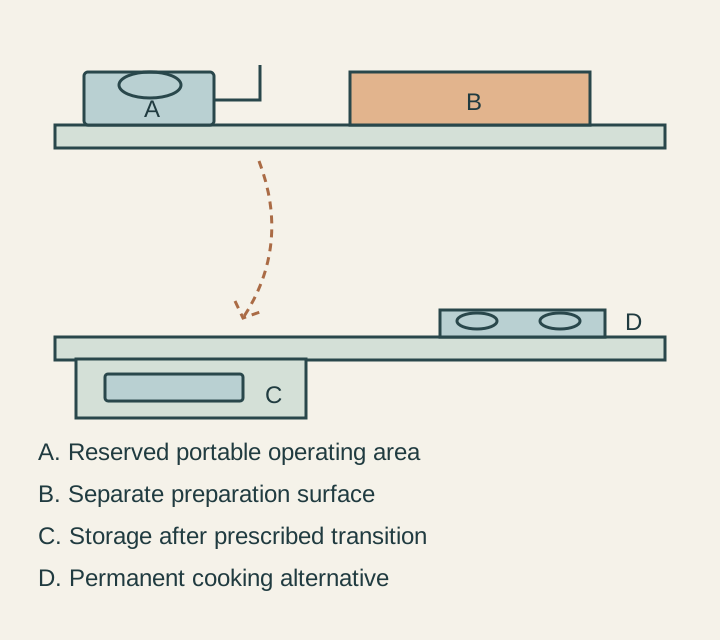
Mark the actual approved operating position before deciding where the unit will be stored. Include the appliance, cookware, handle, access to its controls and the relevant product requirements. The outline of the unplugged unit on a shelf is not an operating-space reservation. Keeping it in a cabinet between uses does not authorize using it inside that cabinet.
Review the location with the people who pass through the room. A temporary setup should not require someone to reach across the operating pan to use an ordinary cabinet or retrieve utensils. Show where ingredients and finished dishes wait. A position that works only after every other task stops is a limited arrangement, even if the appliance itself fits.
Keep preparation counter visible in the plan. If the portable unit sits on the only place normally used for chopping and arranging ingredients, the kitchen gains a cooking position while losing a different necessary function. Identify an acceptable replacement preparation place or reject that setup. Do not count the same surface as both continuously available preparation space and an occupied cooking station.
A plug does not settle the installation question
Have the selected location reviewed against the appliance's current electrical and operating instructions. Identify the actual supply to be used and resolve any required work before treating the portable option as ready. This guide does not size circuits, prescribe adapters or provide a wiring procedure. An outlet that is physically nearby is not a complete assessment of the proposed use.
Consider the cord's route during operation, not only how neatly it coils for storage. The approved arrangement must work with the room as it is used, including nearby appliances and traffic. An instruction conflict is not cured by making a cord less visible. Avoid basing the purchase on a temporary connection method that the product does not permit.
Ventilation and the surrounding surfaces also remain part of the project review. Portability does not turn cooking into a task that can take place anywhere an empty patch appears. Establish what the actual product and the proposed kitchen require, and include any resulting work in the comparison with the fixed alternative.
Plan the return to storage as part of ownership
Choose a storage home the user can reach and manage with the actual appliance. Allow for the cord in its permitted stored arrangement without forcing it into the space reserved for another object. If a cookware drawer must be emptied each time, identify where those contents go. Otherwise, the appliance has only acquired a theoretical storage location.
Follow the product's instructions for cooling, disconnecting, handling and storing. The fact that the cooking task is finished does not mean the unit can immediately disappear into a closed compartment. Keep an acceptable place for it during that transition. This guide gives no universal cooling interval and does not direct anyone to handle a hot appliance.
Try the setup and put-away routine with a suitable demonstration arrangement. The user needs to be willing to repeat it. If the unit remains on the counter because carrying it from storage is inconvenient, evaluate it as a persistent counter occupant. The promised clear surface is valuable only if the household actually regains it.
A permanent expansion buys a different arrangement
A fixed proposal reserves the cooking position in the finished kitchen. Compare the selected appliance, its opening and below-counter requirements, connection work, ventilation and the storage that remains. A larger nominal cooktop does not guarantee a useful additional pan position; examine the complete simultaneous cookware arrangement.
Price the full project alongside the portable station, including any work the latter needs. A portable appliance may involve less alteration in a particular home, but that is a project result, not a universal installation or price promise. Conversely, a fixed expansion that preserves working counter and removes a recurring daily setup task can justify a higher accepted cost.
An occasional task stays portable, with a real home
Consider a hypothetical household that is satisfied with its main cooking arrangement for ordinary meals. It occasionally needs another suitable position for a brief additional task. The owners investigate a portable candidate, confirm that their intended use falls within that product's documented restrictions and obtain an acceptable operating-location assessment. They do not choose it for prolonged continuous cooking.
The first proposed position occupies the normal preparation counter. That is rejected. An alternative position in the existing kitchen can be reserved during the task while a separate preparation area remains usable; its required supply, surrounding conditions and movement through the room are resolved. The intended pan fits the candidate, and the user can work without crossing another person's preparation route.
A nearby cabinet is then assigned the cooled, disconnected appliance and its stored cord. The owners remove an unused accessory from that cabinet permanently, rather than moving a group of daily dishes every time. They also retain the approved counter position during the post-use transition instead of promising immediate storage.
They choose the portable arrangement and keep the fixed cooktop. Their accepted quote includes the actual work needed for the portable station. A permanent expansion would change an otherwise satisfactory cabinet and countertop run without solving a frequent enough problem for this household. They accept the setup and put-away work because the extra task is occasional.
The same conclusion would not follow for a family that needs the extra position throughout everyday cooking or whose only suitable operating place consumes essential preparation counter. Compare the frequency, product limits and completed room, then choose. The named manufacturer example does not establish USA KITCHENS & TOPS inventory, installation services or a universal recommendation for that appliance.
Sources & further reading
- IKEA USA — TILLREDA portable induction cooktop, movable and stowable product architecture