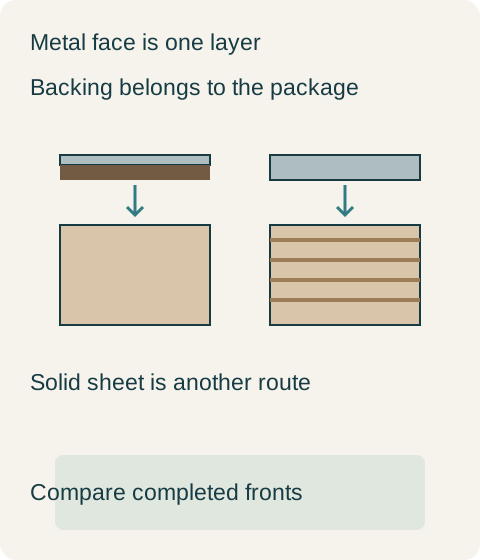
A real-metal cabinet face can be a metal laminate or a solid-metal facing, and those descriptions do not establish the same completed component. Neither means the whole door is solid metal. Compare the facing product, supporting board and fabrication together before accepting a substitution that promises a similar metallic appearance.
Real metal does not mean an interchangeable construction
Formica now presents the former DecoMetal collection as Homapal, including real metal laminates and solid metals. Its technical-team article distinguishes their backing recommendations: industrial particleboard or MDF for the described laminates, with MDF favored for mirror finishes to reduce telegraphing; hardwood-faced veneer-core plywood for the solid metals. These are product-line examples, not instructions for every metal sheet on the market.
The same technical guidance discusses vertical uses such as furniture and fixtures and does not recommend the described surfaces for heavily used horizontal applications such as kitchen countertops. Buying a metallic cabinet front does not qualify the same material for an adjacent work surface. Keep its intended application in the specification.
Ask whether the quoted item is a facing sheet, a bonded panel awaiting completion or a finished door. The edge, reverse, attachment preparation and accepted flatness still have to be supplied. A thin face can reveal irregularities in its backing; the supporting board is part of the appearance process, not simply an invisible cost that can be removed without consequence.
Diagram Conceptual face, backing and completed-front comparison. Layer thicknesses are exaggerated; this is not a fabrication detail, metal gauge or product sample.
Keep the metal laminate when a sheet substitution changes the backing
In a hypothetical order, a metal-laminate cabinet-front package on its specified MDF backing has an accepted finished sample. A proposed alternate supplies solid-metal facing while retaining the original backing and omitting the different fabrication package described for that product. The buyer rejects the alternate and retains the accepted laminate-front package. The decision preserves the desired metallic appearance with a documented construction, rather than treating real metal as proof that both quotations supply equivalent parts.
If solid-metal construction itself is the requirement, obtain and compare that complete package instead. The result may involve a different backing, edge treatment and fabrication allowance. It should be priced as such, rather than judged from the cost of the loose facing sheet or assumed to be a universal quality upgrade.
Check direction on the assembled front group
Formica’s technical advice also identifies directionality and calls for consistent orientation of the protective-film arrows to avoid unwanted color differences. This is relevant to the fabricated group of fronts, not only the isolated sheet. Confirm that the accepted finish direction is preserved where door and companion panels meet.
Keep the current facing identity and its applicable fabrication instructions with the approved panel section. The name change helps locate the material family; it is not evidence that every old and new item has identical specifications. A replacement or alternate should preserve the actual face, backing and completed-edge scope accepted for the cabinet.
Pure White
Cream White
Light Warm Gray
Gray
Navy
Black
Oak Tone
Dark Walnut Tone
Design study These finish studies are design references, not a list of currently orderable colors. Screens and lighting change the appearance; compare a physical sample before choosing.See all finish options →
A painted door, a wood-grain side and a plywood cabinet box can belong to the same cabinet. Here is how to read those parts, what the sample photos actually show, and which details to put on a quote.
The sample shows the door frame, a separate center panel, the face frame and the cabinet box. Each component has its own place in this Shaker construction.
Shaker construction: door frame, center panel, face frame and cabinet box. The cutaway helps locate these parts; confirm each material in the specifications for the selected cabinet.
01 / Door frame
The Shaker door has rails and stiles around a separate center panel. The frame and center panel are different components; confirm their materials in the specifications for the selected cabinet.
02 / Face frame
The face frame surrounds the opening at the front of the cabinet box and sits behind the doors. The face frame, door frame and cabinet box are separate parts.
03 / Cabinet box
The sample exposes the cabinet sides, interior surfaces and layered edges. The image does not establish the wood species or material specification of a selected cabinet.