

Design & industry
Merillat Basics 2026: laminate colors and matching end panels
The Basics refresh changes more than its color choices. Check which construction option includes matching ends, then compare the finished cabinet package for your actual exposed sides.
Merillat Basics’ refresh is worth examining as a cabinet package, rather than as a choice among new color chips. The important buying question is whether the refreshed finishes and construction option produce the complete visible result your layout needs. In particular, keep the matching-end provision attached to its stated upgrade. A headline about improved construction should not become an assumption that every quoted configuration contains every improvement.
Published 2026-07-17, Merillat’s release dates the refresh to 2026-07-13: Bluff, Charcoal and Olive laminates; matching ends with the all-plywood/dovetail upgrade; plus full-depth shelving and expanded wastebasket options.
Reading note: Cabinetworks Group: Merillat Basics refresh, July 17, 2026.
Color and construction change different parts of the purchase
The named laminate additions open a palette discussion. The upgraded construction package opens a component discussion. A buyer may want a new color without wanting a different cabinet package, or may care about the visible end treatment more than a new shade. Ask for the actual offered combinations before connecting those preferences into a single assumed product.
Start with the room you will keep. Put a finished sample beside the existing floor, chosen countertop and nearby wall. Decide whether the color works in that setting. Then look at the cabinet components included in the quote. A successful color comparison has not yet answered how the exposed side is supplied, and a complete end package cannot make an unsuitable color fit the room.
Keep the matching ends tied to the upgrade
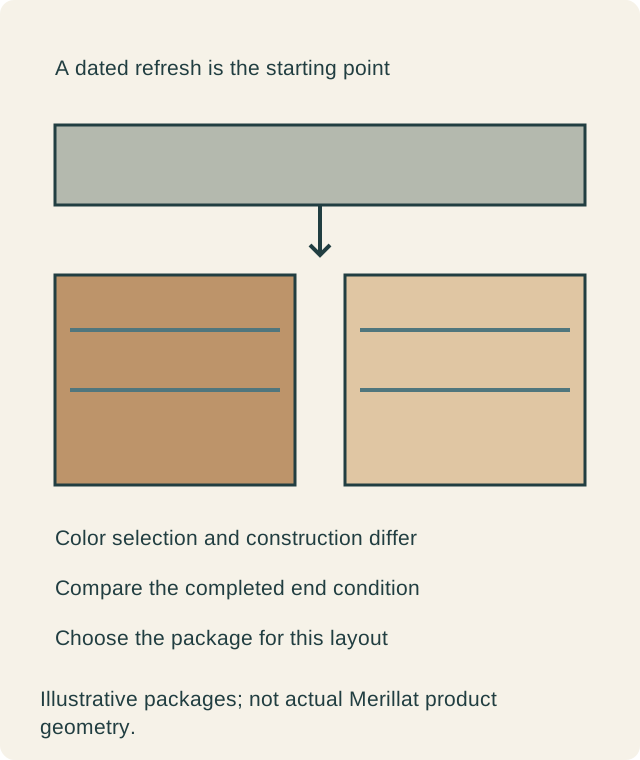
The release’s matching-end statement belongs to the all-plywood construction with dovetail drawers described there. Preserve that condition when requesting a quote. If another construction is offered, ask how its ends are completed rather than carrying the announcement’s wording into the order. The point is not to rank construction materials; it is to identify the package that actually includes the feature you are counting on.
Also clarify what the supplier means by the end in your proposed assembly. A cabinet side, an applied finished panel and a decorative furniture end can be different components. The release does not remove the need for the actual project detail. Match the quoted item to the drawing so the selected finish reaches the visible surface in the intended way.
Count exposed conditions from the actual layout
Mark the sides visible at a run termination, beside an appliance and toward a dining or living space. A kitchen enclosed by walls may have a different need from a peninsula facing an open room. Do not let a standard kitchen sketch stand in for this inventory. The comparison should follow the views the household will actually see.
Then look at how each end meets the floor, countertop and adjacent front. The finished color is one part of that junction; its outline and any visible attachment or edge are others. Request a representative assembly view or detail. The term matching should refer to the proposed completed condition, not merely a loose surface chip with a similar name.
Accessories must match the contents you will store
Treat the announced shelf and wastebasket expansions as options to inspect in the selected cabinet configuration. They are useful when they resolve a storage requirement. Do not count an accessory in the project simply because it appears in the release. Ask which cabinet it belongs to and see the offered arrangement with its actual usable access.
A shelf that extends farther into a cabinet may suit a particular storage plan, but the layout still needs a way to reach what sits at the back. A wastebasket arrangement should be compared with the containers and collection routine the household wants. These are design questions for the actual option; the announcement alone does not supply dimensions, container capacity or a universal storage improvement.
A hypothetical peninsula gives the end package a clear purpose
Imagine a kitchen with a peninsula side facing the family room. The owners like a completed sample in one of the refreshed laminate colors. They compare a quoted standard configuration with a separately identified upgraded configuration, including the intended exposed-end treatment in each. The latter presents the end as part of an acceptable coordinated package, so they select it after reviewing the complete price and detail.
The choice has a reason beyond the word plywood: the exposed side matters in this layout and the offered package resolves it. If the supplier instead presents an equally suitable defined end arrangement in the other configuration, the owners can compare that complete alternative. A component feature should earn its place through the project, rather than through a general material hierarchy.
The owners do not automatically add every announced accessory. Their current storage plan already fits the cooking equipment, and the proposed wastebasket option has not yet demonstrated a benefit for their collection routine. The hypothetical order adopts the color and package that solve the visible-end problem while leaving unrelated options out. It remains a complete kitchen choice, not an incomplete version of the refresh.
Confirm the current quote instead of importing an announcement schedule
The launch date explains when the manufacturer says the refreshed line began. It does not establish when a specific color, cabinet configuration or replacement can reach your home. Have the supplier confirm the current order and delivery arrangements for the selected combination. Keep that commitment distinct from a dated product announcement.
If a quoted item differs from the new release description, ask whether it is another configuration, an older specification or a project-specific alternative. Resolve that identity before approving the package. There may be a legitimate explanation, but the buyer should not have to guess which version is being offered. A new color name beside an old construction assumption is not a complete revision.
Make the refreshed package understandable on its own
Retain the selected finish sample, construction designation, drawer description, end detail and accessory list together. Show the affected cabinet locations on the drawing. A later installer or owner should be able to understand what was purchased without reconstructing the launch story from a news page.
The refresh becomes useful when it changes a defined part of the project: a palette that fits, an exposed end completed as intended, or an accessory that earns its cabinet space. Once those decisions are recorded in the actual order, the buyer can compare a complete cabinet offering rather than an appealing list of newly announced features.
Sources & further reading
- Cabinetworks Group: Merillat Basics refresh, July 17, 2026