

Design & industry
Medallion’s fall 2026 premiere: do the larger cabinet modules improve your layout?
The premiere introduces a frameless line and larger cabinet formats. Test whether a larger storage block solves the actual contents and elevation before redrawing the kitchen around it.
Medallion’s fall premiere deserves a new layout review when the existing plan is being forced into cabinet modules that do not suit the contents. Larger announced formats and a newly introduced line can offer another way to group storage. They do not automatically make a kitchen more useful. Before changing the order, compare the actual proposed cabinet interior, the elevation it creates and the complete product line needed to supply it.
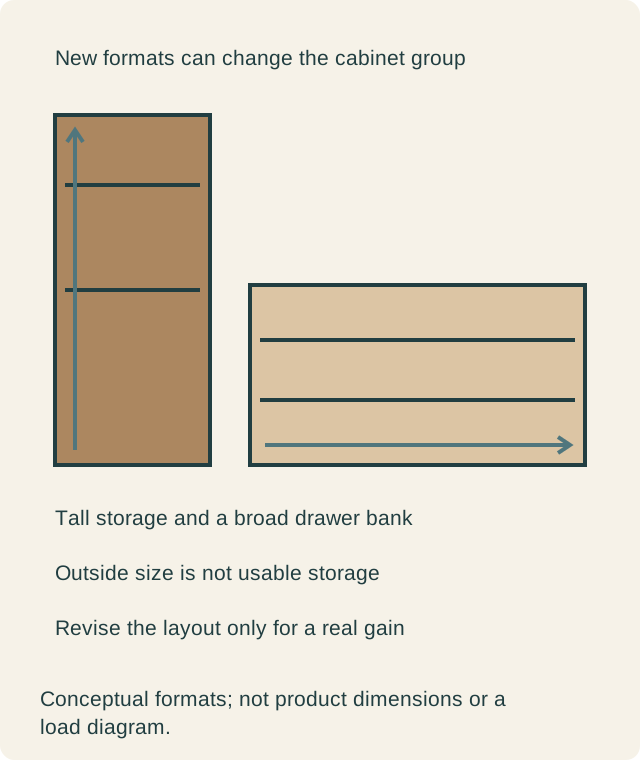
Medallion’s 2026-08-24 fall 2026 announcement adds a frameless line, a 120-inch tall cabinet and 48-inch wide drawer base, alongside walnut and finishes. These named formats do not establish usable interior dimensions.
Reading note: Cabinetworks Group: Medallion Fall 2026 portfolio premiere, August 24, 2026.
Decide what a larger module would actually solve
Begin with the item group that does not fit the present design. It might be broad serving pieces divided awkwardly between cabinets, or a tall storage composition broken by a cabinet transition the owner dislikes. Describe the problem before choosing a larger format. A bigger rectangle on the plan is only helpful if it changes that specific result.
Also consider whether the apparent problem belongs to the cabinet or its contents. Items that are rarely used may not justify altering the primary cooking run, and a broad cabinet is not automatically easier for more than one person to share. Compare a larger supported module with the current grouped arrangement. Keep the alternative that provides a real benefit without creating a different daily inconvenience.
Read the announced sizes as product descriptions
The release’s size descriptions identify additions worth asking about. They do not tell the buyer the drawer’s usable width, the clear opening of a tall cabinet, the spacing between shelves or the capacity of a complete loaded system. Obtain the specific configuration and construction information for the cabinet being quoted. An exterior dimension is a starting point for layout, not an inventory of what can be stored.
Bring the actual broad or awkward items to a permitted sample review where possible, or provide their dimensions to the designer. Ask for the intended loading and access arrangement rather than a photograph of an empty wide drawer. The complete cabinet includes the box, hardware and internal organization. A wider-looking front cannot resolve a conflict that remains inside the opening.
A tall block changes the whole elevation
Review the larger tall format alongside the ceiling, surrounding cabinets and door divisions. The desired result may be a more coherent vertical composition, but the product still needs an actual configuration in the selected line. Do not stretch a standard front in a rendering and assume the announced format uses that exact door segmentation. Ask for the supplied elevation.
At the upper part, decide what belongs in storage and how the household expects to access it. The release is not a reach or access recommendation. A visually attractive tall cabinet can still allocate space to items the household will use only occasionally. Compare that assignment with the original plan instead of crediting every added section as equally convenient everyday storage.
The frameless addition is a line-specific opportunity
If the new line is relevant, request the cabinet group within that line rather than combining an announced tall unit, a broad drawer and a finish into an assumed catalog offering. The release does not establish every cross-combination. The designer needs to confirm which actual components support the revised plan and how visible transitions are completed.
The general framed-versus-frameless question remains a separate decision. This release matters because it changes what can be investigated within Medallion’s portfolio. It should lead to a defined alternative drawing and quote. A collection name is not enough to show whether the cabinet that solved the layout problem belongs to the line and finish being purchased.
A hypothetical serving drawer earns the layout revision
Imagine an owner who keeps broad serving platters across several smaller storage positions. The first plan requires moving other objects to retrieve the platters. The designer investigates the newly announced broad drawer format and obtains its actual usable interior and intended system information. In the hypothetical proposal, the arrangement accommodates the serving group with an access pattern the owner prefers.
The owner compares the revised bank with the original cabinets, including the storage displaced and the appearance of the broader fronts. The larger module wins because it resolves retrieval without sacrificing an essential neighboring cabinet. Its demonstrated interior, not its advertised outside width alone, justifies the change. The example does not assign a capacity or claim that every platter collection fits that product.
The same owner does not adopt the tall format. The existing elevation already provides an acceptable balance between daily storage and occasional items, so the larger tall block has no clear task. A release can improve the project through a selected component without requiring every new format to be used. The final layout remains a deliberate set of choices.
Larger components need a complete fabrication and installation proposal
Have the responsible providers review the actual cabinet, finished piece arrangement and route into the room. A larger format may change handling or installation planning, but no universal delivery problem should be assumed from its name. Ask how the selected unit is supplied and assembled, and keep that answer tied to the particular order.
Coordinate the countertop and any neighboring appliance against the revised cabinet plan. The new module may move a joint, a panel or the boundary between work zones. These consequences belong in the updated design. Do not approve a broader drawer in isolation and leave the surrounding components on an earlier drawing that no longer represents the same kitchen.
Keep the reason for change visible in the order
Retain the original storage problem, the confirmed proposed interior and the revised cabinet identifiers together. Record the selected line and finish separately from the release’s broader additions. The named new sizes should remain product references, while the project drawing shows the actual supplied configuration and its intended role.
The premiere has practical value when it offers a module that improves a defined layout. If the confirmed interior does not solve the contents, or the needed combination is unavailable, keep the previous arrangement or review another complete alternative. New formats expand the investigation; the completed cabinet proposal decides whether the kitchen should change.
Sources & further reading
- Cabinetworks Group: Medallion Fall 2026 portfolio premiere, August 24, 2026