Lock the whole mirror cabinet or add an internal lockbox?
Choose which storage should require a key before choosing the lock. Compare a locked mirror door with a separate interior box, including shared shelf access, lost storage and who should hold each key.
Choose a cabinet with a lock on its main mirror door when the contents can sensibly share the same access rule. Choose an internal lockbox when ordinary bathroom supplies should remain available while a smaller group of belongings requires separate access. The latter preserves a shared cabinet, but the box and its opening take space away from ordinary shelving. Neither arrangement is automatically the better purchase.
This is a choice about the part of the cabinet that the lock controls. A closed mirror door hides everything from view; it does not necessarily restrict who can open it. A locked main door restricts access to the cabinet interior as a whole. An independently locked box creates another boundary inside the cabinet. Decide which boundary matches the household before choosing a finish or paying for an accessory.
Two documented structures, without an assumed pairing
Ketcham's Lockable Single Door Medicine Cabinet sheet describes a mirrored door with a front keyed lock. That places the lock on the main cabinet door, rather than on a smaller compartment inside it.
Its separate Lockable Storage Box sheet describes use alone or inside a medicine cabinet, with keyed-alike and keyed-different versions. These are documented product distinctions, not evidence that the box fits the particular mirrored cabinet above.
The examples identify two purchasing routes. They do not establish a combination to order from a photograph, and they do not describe USA KITCHENS & TOPS inventory. For an interior-box proposal, have the supplier identify the exact host cabinet, box and approved mounting arrangement. A brand name in common does not settle their fit.
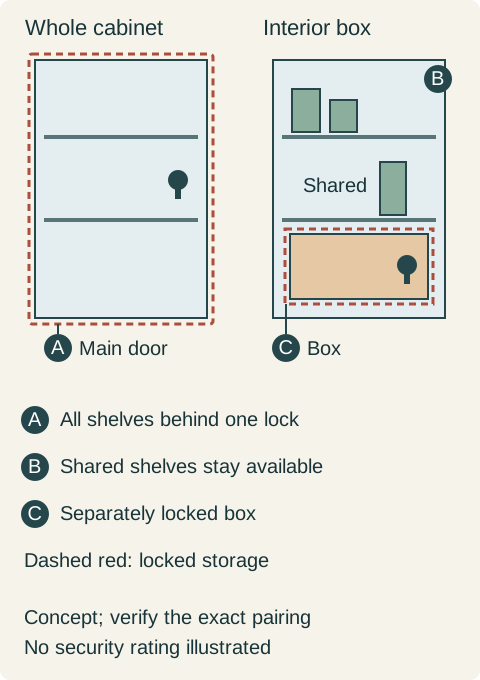
Teaching example Original concept diagram showing what the lock controls, not a product assembly. A locks the entire mirror-cabinet door, so all shelves sit behind that lock. B leaves the main cabinet available while C, the internal box, has its own lock. Red dashed boundaries show the locked storage area; green marks shared storage. Cabinet and box compatibility, mounting and security performance are not established by this drawing.
What happens when someone needs the toothpaste?
Imagine opening the cabinet for the ordinary things used throughout the day. With a locked main mirror door, those items share the unlocking step with the personal items. That can be entirely acceptable in an individual's bathroom, particularly when all the cabinet contents belong to that person. It is less useful when other household members repeatedly need access to only the ordinary shelf supplies.
Moving all shared items onto the countertop may technically solve that problem while undermining the reason for buying a storage mirror. Leaving the key in the door or leaving the cabinet unlocked also changes the access arrangement that motivated the purchase. Evaluate the cabinet in the way it will actually be used, rather than assuming people will maintain an inconvenient routine indefinitely.
With an interior box, opening the mirror door can expose ordinary shelves without opening the personal compartment. The person using the box has an additional door to operate and needs access to its lock while the main door is open. The purchase works only if that sequence is comfortable and the remaining shelves still accommodate the intended shared supplies.
A box consumes more than its closed outline
Review the usable interior with the box in its proposed position. Its body occupies space, its door needs room to open, and a hand must reach the lock and retrieve the contents. Shelf supports, cabinet hinges and any other installed accessories belong in that review. An empty cabinet's advertised exterior size does not describe this finished arrangement.
Do not treat a loose box resting on a shelf as equivalent to the manufacturer's installed arrangement. Ask how the proposed unit is intended to be mounted and whether the host cabinet permits it. This is a compatibility question for the actual products, not an invitation to drill a mirrored cabinet or invent a fixing method. If the pairing cannot be confirmed, compare a different supported package or a separate storage location.
Also examine what remains useful outside the box. A small personal compartment can be a poor trade if its placement removes the only shelf zone that accommodates everyday bottles. The goal is a cabinet that still works when both the restricted and ordinary areas are furnished, not the largest box that can be squeezed behind the mirror.
Same key and separate keys answer different needs
For several lockable compartments, decide whether the same person should open them all or whether different people need separate access. Keyed-alike options can support a shared key arrangement; keyed-different options provide a different key arrangement. Confirm what the manufacturer and supplier mean for the actual order, including any requested grouping of several units. Do not assume boxes bought at different times will arrive with the desired relationship.
Different locks also do not establish an entire household policy by themselves. Decide who receives the keys, who retains any spare and what should happen if a key is missing or ownership changes. Ask the supplier about the supported replacement route before purchase. A labeled personal shelf, a keyed compartment and a separately managed set of keys are different commitments.
Neither a product name nor a key establishes burglary resistance, child resistance or suitability for a particular regulated item. Assess any such requirement separately against documented performance and the item's own storage requirements. This comparison concerns access organization for ordinary personal belongings; it does not recommend where to store medicine or promise a security outcome.
A shared bathroom keeps most of the mirror cabinet usable
In a hypothetical household, the bathroom mirror cabinet holds shared grooming supplies and one adult's small personal items that the adult does not want freely handled. The family wants the countertop clear. The personal items are suitable for that room under their own care instructions, and the household is choosing an access arrangement rather than seeking a certified security enclosure.
The first proposal puts all shelves behind a keyed mirror door. It has a straightforward interior, but every person reaching for the shared supplies would need access to the same key. Giving everyone that key would defeat this household's intended distinction; moving the shared supplies out would sacrifice the storage function they wanted above the basin. They reject that proposal for this bathroom.
The second proposal combines an ordinary mirror cabinet with a supplier-confirmed internal lockbox. In the reviewed arrangement, the box opens without interfering with the cabinet door and the shared bottles still fit on the remaining shelves. The adult can operate both doors without clearing the basin area. The family accepts the smaller general storage capacity and selects this package, with the personal key and spare assigned deliberately.
They do not add another box simply for symmetry. If another adult later wants independently locked storage, that becomes a separate key and space decision; a matching-looking box keyed alike would not deliver independent access. For the present order, the family buys one confirmed cabinet-and-box assembly and keeps ordinary shelf access available.
The result would differ in a bathroom used only by the owner, with no shared supplies to retrieve. A locked main mirror door could then be the simpler useful arrangement. Choose the lock boundary that fits the room's users, and buy the complete interior that remains usable after that boundary is installed.
Pure White
Cream White
Light Warm Gray
Gray
Navy
Black
Oak Tone
Dark Walnut Tone
Design study These finish studies are design references, not a list of currently orderable colors. Screens and lighting change the appearance; compare a physical sample before choosing.See all finish options →
Give guests a clearly identifiable place for the items they are invited to use, and examine what becomes visible when that compartment opens. A separate divider inside a shared drawer may organize belongings without creating the privacy the household expects.
Allocate removable personal groups and an explicitly shared supply area within the existing cabinet, then test retrieval, cleaning and move-out together. An organizer is useful only if it preserves the cabinet's operation and can be managed as household membership changes.
Do not assume the bathroom is the right location. Establish each medicine's storage requirements and an appropriate access-controlled location before counting it as part of the vanity's inventory.
The sample shows the door frame, a separate center panel, the face frame and the cabinet box. Each component has its own place in this Shaker construction.
Shaker construction: door frame, center panel, face frame and cabinet box. The cutaway helps locate these parts; confirm each material in the specifications for the selected cabinet.
01 / Door frame
The Shaker door has rails and stiles around a separate center panel. The frame and center panel are different components; confirm their materials in the specifications for the selected cabinet.
02 / Face frame
The face frame surrounds the opening at the front of the cabinet box and sits behind the doors. The face frame, door frame and cabinet box are separate parts.
03 / Cabinet box
The sample exposes the cabinet sides, interior surfaces and layered edges. The image does not establish the wood species or material specification of a selected cabinet.