Should medicines be included in your vanity storage plan?
Do not assume the bathroom is the right location. Establish each medicine's storage requirements and an appropriate access-controlled location before counting it as part of the vanity's inventory.
The phrase medicine cabinet can make bathroom storage seem like an obvious assignment. Yet a cabinet's name, a closed door and convenient proximity to the sink do not establish appropriate conditions for the contents. Treat this as a location decision before comparing vanity drawers. The furniture plan should follow verified storage needs, rather than asking the household to adapt those needs to an attractive compartment.
Resolve location before measuring the group
MedlinePlus warns that bathroom heat and moisture can damage medicines and advises asking a pharmacist about specific storage instructions. That makes location a separate decision from whether containers fit inside a drawer.
Review the instructions for the actual products and obtain clarification from the pharmacist where needed. Do not turn a general bathroom layout article into a temperature specification or assume every item has identical requirements. Write down the resulting location constraints in terms useful for planning, and leave unresolved products out of a cabinet-capacity promise until their requirements are clear.
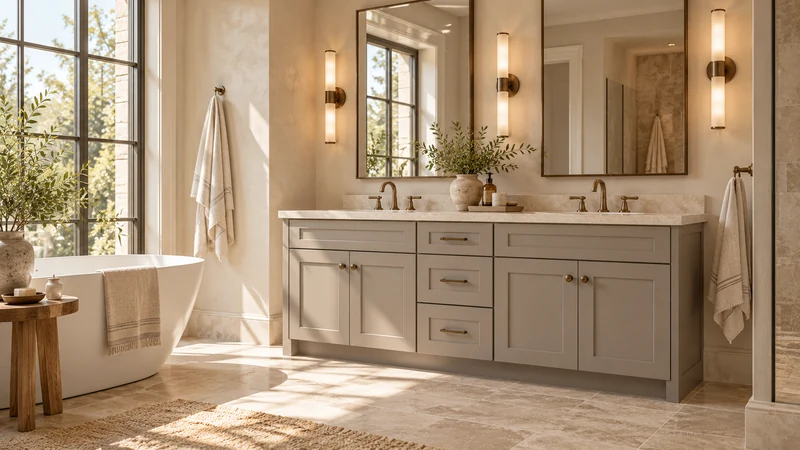
Design study This bathroom design study illustrates cabinet placement, not verified medicine-storage conditions. Choose medicine locations from product requirements before assigning vanity space.
Give an alternative location a complete assignment
If the appropriate location is outside the bathroom, identify a real place with adequate capacity and suitable access. A vague note saying elsewhere does not resolve the storage task. Check the selected containers in that location, including the space needed to see the labels and retrieve the intended item without emptying unrelated household storage.
Consider the people responsible for retrieving and returning the group. Coordinate the location with their established routine without changing medication use or timing to suit furniture. The planning question is whether they can reach and restore the approved storage arrangement, not whether a new cabinet layout can replace guidance from their health care professional.
Treat controlled access as a separate requirement
CPSC advises keeping medicines in original child-resistant containers, in a locked cabinet or box, out of children's reach. A concealed vanity drawer alone does not demonstrate that arrangement.
For the selected location, confirm what cabinet or container is actually being provided and how the responsible adult will operate it. Do not describe an ordinary vanity as secure merely because it has doors, or assume a separately purchased accessory is compatible before checking its requirements. Keep the physical storage proposal specific enough to evaluate, rather than relying on the appearance of concealment.
Preserve the information attached to the contents
If the arrangement includes a separate storage box, test the whole selected box in its destination, including opening and removal. The combined footprint of the medicine packages is not the space required by that complete assembly. Furniture fit must be checked around the provided container as well as its contents.
Plan around the actual labeled packages and any supplied protective packaging that the verified instructions require. Do not base the cabinet layout on replacing them with decorative matching jars. Allow the responsible user to identify the right package without using a furniture label as a substitute for the product's own information.
The cabinet planner can work with dimensions, the quantity of containers and the confirmed location requirements without needing a public list of personal medicine names. Keep the design record focused on the storage task. When the product collection changes, review the affected fit and location requirements instead of assuming the existing organizer remains suitable indefinitely.
Work through a vanity-selection example
Imagine a hypothetical remodel in which the buyer counts a group of medicine packages among the contents required to fit a new vanity. That assumption favors a larger drawer configuration. After reviewing the actual storage instructions and obtaining clarification, the household identifies an appropriate controlled-access location outside the bathroom and confirms that the packages fit there.
The vanity comparison now uses the remaining bathroom inventory. A smaller cabinet might serve that revised task, but the change is justified only because the alternative location was resolved. Simply removing the medicines from the inventory to make a preferred vanity fit would leave the household's overall storage problem unfinished.
Hand off a bounded furniture decision
Record what belongs in the vanity, what has another confirmed location and what still requires product-specific clarification. Review the arrangement with the people responsible for the contents so that ordinary replenishment does not gradually move the group back into an unverified bathroom position. The cabinet drawing should reflect the final assignment rather than an early assumption.
This decision concerns storage location, packaging fit and household access. Questions about using, changing or disposing of medicines belong with the applicable instructions and qualified health professionals, not with the choice of drawer organizer. Choose the vanity from the bathroom items it can appropriately serve, after the medicine-location question has been handled on its own terms.
Pure White
Cream White
Light Warm Gray
Gray
Navy
Black
Oak Tone
Dark Walnut Tone
Design study These finish studies are design references, not a list of currently orderable colors. Screens and lighting change the appearance; compare a physical sample before choosing.See all finish options →
Use the same household inventory in each confirmed interior, record what fits and remains accessible, and give every displaced item a named destination before declaring a cabinet sufficient.
Give small items a bounded, visible destination that allows easy retrieval and return, then check the spaces around and beneath that organizer where items have actually been lost.
Use them when repeated confusion has a clear cause, such as similar personal items or an unclear return location; choose labels and boundaries that match the household's actual sharing arrangement.
The sample shows the door frame, a separate center panel, the face frame and the cabinet box. Each component has its own place in this Shaker construction.
Shaker construction: door frame, center panel, face frame and cabinet box. The cutaway helps locate these parts; confirm each material in the specifications for the selected cabinet.
01 / Door frame
The Shaker door has rails and stiles around a separate center panel. The frame and center panel are different components; confirm their materials in the specifications for the selected cabinet.
02 / Face frame
The face frame surrounds the opening at the front of the cabinet box and sits behind the doors. The face frame, door frame and cabinet box are separate parts.
03 / Cabinet box
The sample exposes the cabinet sides, interior surfaces and layered edges. The image does not establish the wood species or material specification of a selected cabinet.