LEGRABOX vs. MERIVOBOX: comparing complete drawer systems
Both are Blum metal drawer systems, but their listed heights, finishes and high-side arrangements differ. Compare a complete kitchen schedule instead of accepting either family name as an interchangeable upgrade.
Choose a specified configuration, not a family-name upgrade
Choose LEGRABOX when its offered side heights, finishes and completed interior give you something the kitchen needs or you deliberately want. Choose MERIVOBOX when its available configurations satisfy the drawer schedule and its actual complete offer makes sense. Both names cover more than one drawer. Neither word alone identifies the sides, runners, bottom, rear, front attachment or organization you will receive.
This comparison uses Blum's published US ranges. It is not a statement that USA KITCHENS & TOPS stocks either system or that every listed option is available from a particular cabinet maker. Obtain the specific configuration offered for your project. An international photograph or a different maker's display is not a substitute for that scope.
The high drawer behind the front can be quite different
Blum's US LEGRABOX range lists F-height at 241 mm and includes carbon black among its finishes. These are product-range facts, not a clear interior height or a promise that every quoted drawer uses F sides.
The US MERIVOBOX range lists E-height at 192 mm and shows silk white and indium gray finishes. E is a system designation, not evidence that it matches a LEGRABOX side or an existing drawer opening.
Comparing those published nominal side heights gives 241 minus 192, or 49 mm. That calculation only identifies the difference between those listed side-height options. It does not give an extra 49 mm of usable storage, and it does not approve either drawer in a particular cabinet.
The drawer bottom's position, the obstruction above, the front and the actual installation still determine what can be stored and removed. Do not redraw the visible front divisions merely to capture a nominal height advantage. First determine whether the actual collection benefits from a higher containing side and whether the complete proposed assembly fits.
A low tray of utensils may receive no practical benefit from a taller side. A drawer assigned upright packets or a loose collection of lightweight containers may make the side construction more important. Demonstrate the intended arrangement using the real organizer and representative contents. The purchasing question is what the wall does for those contents, not which letter looks more advanced.
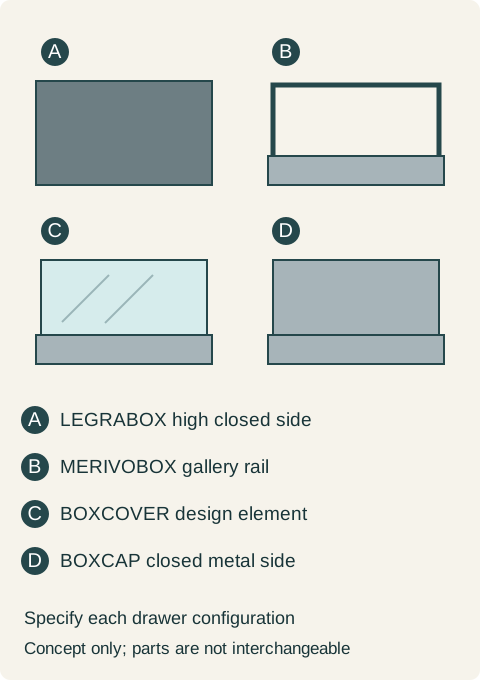
Teaching example Conceptual side arrangements, not manufactured profiles. A represents a continuous high side in a LEGRABOX proposal. B, C and D distinguish MERIVOBOX proposals with a gallery rail, BOXCOVER design element or BOXCAP closed metal side. These sketches explain containment and appearance; they do not show dimensions, part compatibility or a permitted retrofit.
A gallery rail is not a closed side
Blum distinguishes MERIVOBOX with a gallery rail, BOXCOVER with a design element, and BOXCAP with closed metal sides. Its system overview also identifies LEGRABOX's slim straight sides. These are different supplied constructions, not interchangeable descriptions.
Look through the open drawer from the side. A gallery arrangement leaves an opening beneath the rail. A closed-side proposal fills that region with a panel, while a design element adds another material and appearance to the assembly. Compare the configuration being offered rather than assigning every MERIVOBOX drawer the same open side.
A rail may suit broad cookware that is already organized. It may be a poor match for small loose packages that the owner expects a continuous wall to contain. A panel does not eliminate the need to organize the drawer, but it changes what can move sideways through the side region. Test the actual objects rather than treating a high decorative front as containment on every edge.
For a glass design element, decide whether seeing the contents from the side is desirable. A matched panel can be attractive when the drawer is open, but a kitchen owner may prefer a visually solid interior. Specify the design element and its supplied scope along with the fittings; the system name alone does not select the material.
Finish choices can settle the comparison without a strength claim
Compare the actual samples under the room's lighting, with the planned bottom, back and organizer present. A side finish is only part of the open drawer. Different gray names should not be treated as the same sample, and a dark side paired with a light bottom produces a different result from an entirely dark interior.
If the household specifically wants the dark option in the quoted LEGRABOX range, that can be a valid reason to choose it. The reason should remain appearance, unless there is separate evidence for a performance difference relevant to this installation. A darker finish does not establish greater strength, and a manufacturer's premium label does not specify additional useful storage.
Conversely, if the offered MERIVOBOX interior already looks right and holds the assigned collection, there may be no benefit in changing the whole schedule to obtain a feature the owners will not use. Compare the actual additional price, if any, rather than assuming a permanent price hierarchy between product families.
Keep the shallow and deep drawers in the same comparison
Request a schedule covering each drawer location. It should identify the side arrangement, nominal length, chosen runner configuration, opening behavior and fitted organization. Include inner drawers if they are part of the kitchen. A shallow sample does not represent the high-sided drawer used for packets, just as one tall drawer does not prove the utensil tray will fit.
Do not silently change motion features while comparing the systems. A handled soft-closing proposal and an assisted-opening proposal differ in more than their metal sides. Price and try the operating arrangement the household actually wants. Keep component ratings separate from the cabinet maker's documented allowance for the complete assembled drawer.
For an existing kitchen, a change of family needs a complete compatibility review. It is not permission to keep the old runners and snap on new sides. Front preparation, bottom and rear dimensions, accessories and cabinet attachments may need different parts or work. The quote must identify that work before the replacement is accepted.
A dark-interior kitchen chooses a particular LEGRABOX schedule
Consider a hypothetical kitchen whose owners want a consistent dark interior when the drawers open. They also want a continuous high side for the drawer holding upright pantry packets. Their initial comparison is a LEGRABOX proposal with closed high sides against a MERIVOBOX proposal using gallery rails.
The first correction is to obtain a MERIVOBOX closed-side alternative rather than compare it only in the open-rail configuration. With the actual contents and organizers present, both completed proposals provide usable storage. The owners do not declare the rail design defective or assume that one product family is inherently stronger.
They ultimately select the quoted LEGRABOX finish and the verified high-side arrangement for that pantry drawer. The rest of the schedule retains the appropriate shallow configurations for utensils instead of making every drawer tall. The selected interior, complete drawer operation and actual total price are acceptable together.
This choice pays for an appearance and a particular set of configurations. It does not pay for an assumed volume gain from the nominal side-height difference. The owners retain the approved packet arrangement and tray sizes, and the final order identifies the side and finish at each location. A later substitution described only as another Blum metal drawer would reopen those choices.
Compare finished drawers, then retain the configuration record
Ask who supplies and prepares the bottom, back, front and system components, who assembles them, and which organizers are included. Compare the same drawer schedule in the completed kitchen. A hardware carton price cannot be compared directly with a fitted drawer price.
Keep the offered system and configuration identities with the cabinet order, including any intentionally different side treatment within the kitchen. That record matters for replacements and avoids turning a carefully chosen interior into a generic allowance. The better system is the one whose actual configurations earn their place in this kitchen, not the one with the more persuasive family name.
Pure White
Cream White
Light Warm Gray
Gray
Navy
Black
Oak Tone
Dark Walnut Tone
Design study These finish studies are design references, not a list of currently orderable colors. Screens and lighting change the appearance; compare a physical sample before choosing.See all finish options →
A metal-sided drawer is a coordinated box system; a wood box can run on concealed metal hardware. Decide what should be visible, what must fit and which complete assembly the quote actually supplies.
Front proportions do not tell you the usable height inside. Group the actual objects, test their stored and removal positions, then compare the drawer combinations the selected cabinet system supports.
The sample shows the door frame, a separate center panel, the face frame and the cabinet box. Each component has its own place in this Shaker construction.
Shaker construction: door frame, center panel, face frame and cabinet box. The cutaway helps locate these parts; confirm each material in the specifications for the selected cabinet.
01 / Door frame
The Shaker door has rails and stiles around a separate center panel. The frame and center panel are different components; confirm their materials in the specifications for the selected cabinet.
02 / Face frame
The face frame surrounds the opening at the front of the cabinet box and sits behind the doors. The face frame, door frame and cabinet box are separate parts.
03 / Cabinet box
The sample exposes the cabinet sides, interior surfaces and layered edges. The image does not establish the wood species or material specification of a selected cabinet.