

Design & industry
KraftMaid’s new Lowe’s portfolio: compare the cabinet choices behind the series names
The new Professional, Designer and Luxury structure has separate rollout windows and different scopes. Start with the construction, door and finish combination the kitchen actually needs, rather than treating a series number as a complete specification.
KraftMaid’s new Lowe’s portfolio gives a buyer more than another list of door colors. It reorganizes the retail offer into collections with different selection scopes, while introducing construction and appearance choices that need to be evaluated as complete combinations. The useful starting point is the kitchen’s real requirement: whether a contained offer already provides the desired room, or whether a particular additional door, material or construction earns the broader selection.
The official schedule lists Professional 200 for September 2026, Designer 400 for January 2027, and Luxury 600 frameless for August 2026 with framed and inset for October 2026. These are announced rollout windows, not confirmed stock or delivery for a project.
Reading note: KraftMaid: new Lowe's lineup and rollout windows.
A streamlined collection can still be a complete answer
The Professional product page describes a streamlined door-finish offer with engineered-wood and plywood construction choices. It lists laminate interior and matching laminate end treatment, along with soft-close drawer and hinge features. Those specifics are more useful than assuming that a professional label describes only one box material.
Reading note: KraftMaid: Professional Collection construction.
For a kitchen with a straightforward configuration and an offered appearance the owners like, the narrower selection may be sufficient. It can make decisions easier by removing options the project never needed. The buyer should still compare the actual finished cabinet, including the exposed end and the selected construction, rather than treating a shorter catalog as an incomplete kitchen.
If an essential requirement is missing, name it. A preferred front profile, specific modification or interior arrangement is a concrete reason to look elsewhere in the portfolio. A general wish to move up a series is not yet a product requirement and does not explain what the additional scope improves.
The broader collection changes the available combinations
The Luxury overview describes a reworking of the Schuler offering and presents framed, frameless and inset choices with walnut among the species options. This is a range of construction and appearance possibilities, not evidence that every door, wood and cabinet configuration is available in every combination.
Reading note: KraftMaid: Luxury Collection construction and species.
The buyer can now ask for the desired complete front-and-box proposal within this retail offer. A walnut preference alone does not settle inset versus overlay, and a preferred door does not automatically settle the cabinet’s interior. View the combination that will actually be quoted, rather than assembling an imagined product from unrelated promotional examples.
New doors provide different amounts of detail
The new-door page identifies slim-frame Aletha, Huxford with a solid-wood reeded center, and inset Ozella, among other additions. It associates doors with particular constructions and materials. These are examples within the whole release, not interchangeable names for the same front.
Reading note: KraftMaid: new Luxury Collection doors.
If the attraction is texture, decide how much of it the room needs. A reeded accent can supply a focal point without repeating across every cabinet. If a restrained frame is the goal, inspect the small drawer fronts as well as a full door. A broad door photograph cannot establish how the selected family resolves all the shapes on the plan.
Keep the cabinet grouping visible while comparing. The most distinctive new sample may not be the most useful choice beside a patterned countertop or retained wood floor. The release broadens the design vocabulary; the household still chooses which elements should speak most clearly in its own room.
Inset is a construction proposal with its own finishing choices
The inset page describes optional beaded-frame and barrel-hinge treatments and several visible-end approaches. These belong to that inset proposal, rather than being features automatically included in every cabinet carrying the portfolio’s name.
Reading note: KraftMaid: inset construction and end treatments.
Choose the visible frame, hardware expression and end together. A buyer attracted to flush fronts may prefer a plain-looking composition, while another wants the added line of a beaded opening. Those are different finished rooms. The end at an open walkway should not be left as an afterthought once the front sample has been chosen.
Do not describe the construction as universally better storage. Bring the relevant household item or its footprint into the actual interior comparison. A visual preference for inset can be entirely sufficient if the cabinet meets its use, without inventing a general performance advantage over another construction.
A future collection should remain a future option
The Designer rollout is still ahead of the this article’s update. A buyer can treat the announced collection as a possibility to investigate, but should not have a current order depend on an unconfirmed future configuration. A broad future selection claim does not identify the exact cabinet that will eventually be offered for the project.
If timing makes that distinction important, compare the confirmed current proposal with the decision to wait. Keep the preferred future feature explicit. Waiting for an identified requirement can be rational; waiting merely because another number sits between other collections may not improve the eventual kitchen.
A hypothetical buyer keeps the contained offer
Imagine owners planning a simple kitchen who like an offered painted front and need no unusual modification. The broader collection’s walnut and textured doors attract them in the showroom, but neither addresses their original brief. The relevant Professional proposal includes the actual construction and visible-end treatment they accept.
In this hypothetical case, they keep the contained selection after comparing the complete cabinet. Their choice is not evidence that every broader option is unnecessary. It means this household did not identify an additional feature worth changing its design to obtain, and did not confuse collection hierarchy with a requirement.
Another buyer may specifically want an inset frame and a particular front available in the broader offer. That household should compare the corresponding complete proposal and its actual current supply. The reason to choose it is the desired construction and appearance, not a universal assumption about the highest series name.
Do not transfer an old order from the brand name alone
If the buyer is adding to an existing kitchen, use the original line and component identity as the starting point. A retail portfolio reorganization does not prove that an earlier door or end panel is unchanged under a new collection name. Ask for the actual proposed replacement or addition.
Likewise, do not treat construction changes as a door-only substitution. The selected frame, hardware and visible-end arrangement can belong to different complete proposals. Keep those relationships together so a revision does not preserve the attractive face while silently changing the cabinet behind it.
Close the comparison with a named combination
Record the actual collection, construction, door, wood or other front material, finish and end treatment. Confirm the applicable rollout and project supply separately. Avoid using the brand’s broad portfolio story as a promise that every desired combination is already available at the local store.
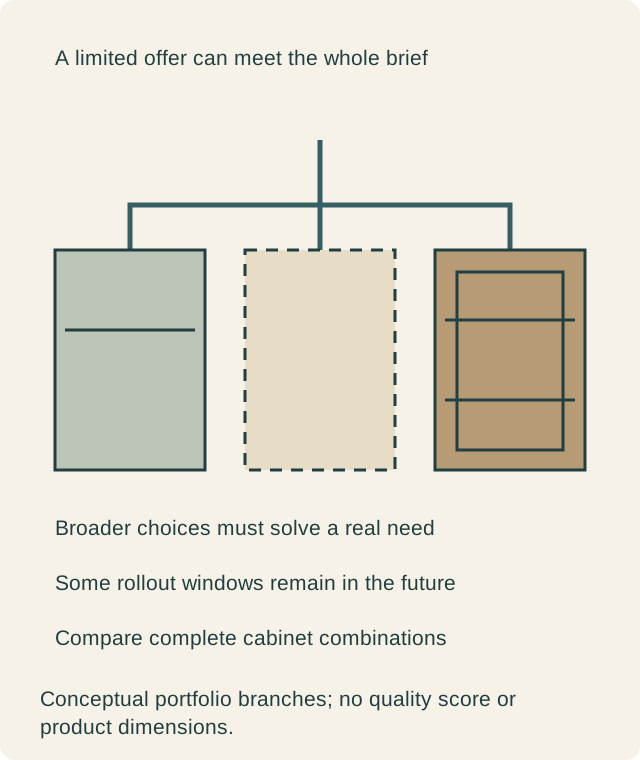
This release is useful when it lets the household locate the right scope of cabinet choice. A limited program can win by meeting the whole brief; a broader program can win by supplying a specific wanted result. Both decisions become reviewable when the series name leads to a complete cabinet proposal.
Sources & further reading
- KraftMaid: new Lowe's lineup and rollout windows
- KraftMaid: Professional Collection construction
- KraftMaid: Luxury Collection construction and species
- KraftMaid: new Luxury Collection doors
- KraftMaid: inset construction and end treatments