

Design & industry
KraftMaid VIP 2026: pocket cabinets and hood planning
The VIP release adds a Pocket Door Cabinet and expands decorative hoods. Evaluate the newly offered components in the actual dealer-line project before combining attractive launch images.
KraftMaid’s VIP introduction is most useful when it helps complete an actual cabinet project: a concealed bay that belongs in the daily routine, or a hood form that suits the surrounding elevation. Review the newly offered components as supplied products, rather than assembling a kitchen from independent launch photographs. A pocket cabinet, a decorative hood and a change in cabinet height solve different problems even when they arrive in the same introduction.
On 2026-07-30, KraftMaid announced independent-dealer VIP additions: a Pocket Door Cabinet, Bell Hood, refreshed Classic/Cove hoods, Reeded and Wide Bottom Rail Box Hoods, plus expanded cabinet heights. These identify the announced program, not detailed project specifications.
Reading note: Cabinetworks Group: KraftMaid Very Important Pieces introduction, July 30, 2026.
Start with the cabinet project already under consideration
If a KraftMaid proposal is on the shortlist, ask which newly introduced components would change that proposal and why. A designer should be able to identify the relevant cabinet group, not merely point to a release image. The new pocket cabinet may address an unresolved storage bay, while another project may need only a different hood silhouette.
Keep the intended sales channel and line clear. The announcement identifies the independent-dealer introduction. Do not assume a similarly named product in another channel carries the same configuration or options. The useful next step is an identified proposal from the intended supplier, with the new components shown in context. The press release itself is not that proposal.
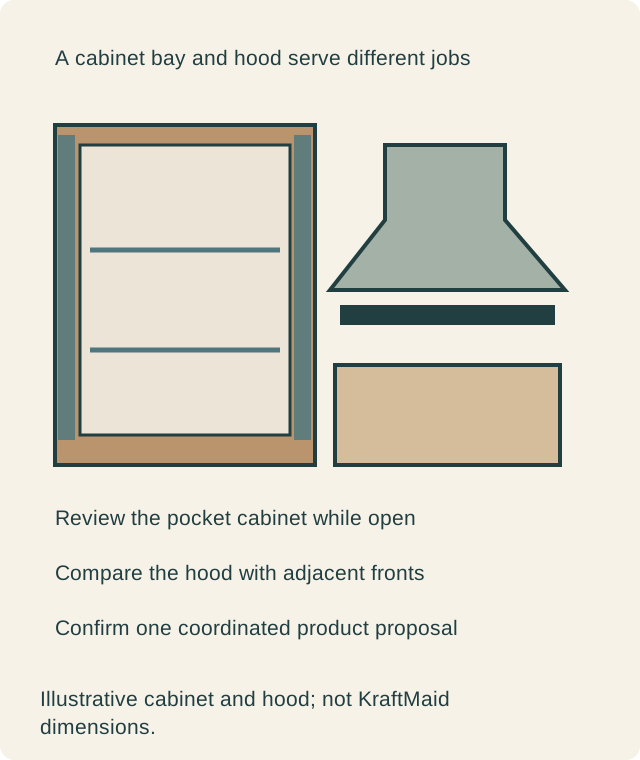
Review the Pocket Door Cabinet as a complete offered unit
Ask for the actual cabinet configuration with its open, parked and closed states. The name does not reveal the useful interior, the construction allocated to the doors or how a shelf or drawer can be reached. Compare the offered cabinet with the storage and work routine it is supposed to replace. An attractive closed face answers only part of the purchasing question.
The broader choice between hiding an entire kitchen wall and concealing a limited bay remains a separate design question. Here, the release gives the buyer a specific integrated cabinet to investigate within the brand’s program. Establish whether that unit supplies the intended bay without improvising a separate enclosure around an already finished cabinet. Confirm the actual offered assembly before comparing its price.
The open condition deserves equal time
Walk through an ordinary use period with the proposed configuration. Decide what stays in the bay, what comes out and whether the doors remain parked for a while. The usefulness of concealment depends on that sequence. A storage area that closes neatly for a photograph can still be inconvenient if it needs to be reopened for every small item throughout the day.
If equipment is part of the intended bay, have the responsible provider coordinate its actual installation and operating requirements with the selected cabinet. A furniture introduction does not by itself specify the appliance arrangement. The project can also use the cabinet for a dry serving or display function, where the value comes from closing away a group rather than adding equipment. Name the intended role instead of letting an inspirational picture determine it silently.
Treat the hood additions as forms with a technical assembly
The newly announced hood shapes provide design alternatives worth comparing on the elevation. Look at their width relationship to neighboring fronts, the visible lower outline and their meeting with upper cabinets or ceiling. A sculptural hood can be the room’s focal point; a quieter form may better support a strong island or backsplash. The release broadens the visual discussion without deciding which composition suits the house.
Then identify what the actual hood proposal includes and how it works with the selected ventilation equipment. A decorative name is not a complete blower, insert or service-access specification. Keep the finished outer form and its technical assembly in the same project review. Do not carry the appearance of one pictured hood into a quote for a different supplied construction.
A hypothetical project chooses the cabinet and declines a new focal hood
Imagine a kitchen where the owners want to close away occasional serving pieces beside the dining area. The newly offered pocket cabinet is investigated as a complete unit, and its confirmed open arrangement suits the collection. The owners select it after comparing the closed elevation and the actual retrieval sequence. Their purchase has a defined purpose within the new program.
The owners also review a more expressive hood silhouette from the release. Beside their already patterned backsplash, it produces more visual competition than they want. They keep the quieter coordinated hood proposal instead. The hypothetical project uses a substantive new cabinet offering without treating all VIP additions as a mandatory matching set.
Another household might do the reverse: retain ordinary storage fronts while selecting a new hood as the principal focal form. These are different ways to use the introduction. The buyer should be able to explain the improvement in the room, rather than counting how many new pieces entered the order. An unchanged component can be the right companion to a newly selected one.
Check the surrounding cabinet heights on the revised drawing
If the proposed height options change the elevation, update the actual cabinet list and its relationship to the hood and pocket bay. Do not let an earlier drawing remain the basis for the surrounding trim while the central units have changed. A coordinated appearance depends on the complete offered combination, not on assuming that new options automatically share every old dimension.
Ask the designer to identify any companion pieces that changed because of the revision. Their finish and visible edge treatment belong in the quote as well. The release should lead to a coherent new version of the project, with any additions or omissions apparent, rather than a mixture of old cabinet assumptions and new feature names.
Close the decision with the components actually being purchased
Retain the confirmed cabinet configuration, opening-state information, hood assembly description and revised elevation together. Keep finish samples and the supplier’s current order arrangements with that set. An announcement date establishes the context of the product news; it does not establish when this particular package reaches the home.
The VIP introduction earns its place when a new offered component resolves a specific layout or appearance problem. The complete proposal still decides the purchase. That gives the buyer a room that can be reviewed and ordered, instead of a collection of attractive forms whose relationships were never confirmed.
Sources & further reading
- Cabinetworks Group: KraftMaid Very Important Pieces introduction, July 30, 2026