

Bath & laundry planning
KOHLER x Studio McGee Claude: a coordinated suite or selected pieces?
Use the Claude collection as a way to coordinate a bathroom, then decide which of its actual assemblies the project needs. A shared design language can simplify visual choices, but it does not make the vanity, mirror and other fixtures one interchangeable installation. Buy the complete suite when the selected components all serve the room; select individual pieces when retaining another suitable component produces a better finished project.
Use the Claude collection as a way to coordinate a bathroom, then decide which of its actual assemblies the project needs. A shared design language can simplify visual choices, but it does not make the vanity, mirror and other fixtures one interchangeable installation. Buy the complete suite when the selected components all serve the room; select individual pieces when retaining another suitable component produces a better finished project.
Identify the collection and the vanity package separately
Kohler's May announcement presents Claude as a coordinated bathroom suite. Its vanity package includes a Carrara quartz top, matching backsplash, Dune undermount sink and Malin hardware.
Reading note: Kohler: Claude collection announcement.
That package boundary is useful because it identifies part of the upper-and-lower assembly before the owner selects surrounding products. Keep the exact vanity configuration with its current documents. Do not substitute a preferred sink or top from another collection picture while continuing to describe the result as the same package.
The wider suite is another level of choice. A product family can coordinate several independent fixtures without placing every one in the vanity order. Prepare the room schedule from the items actually selected, with clear identities for retained components as well as new ones.
Decide which relationships should be fixed together
Start at the basin and dry preparation position. Try the actual daily grooming group on the proposed upper arrangement, then review the resulting cabinet interior. A coordinated appearance has practical value only when people can use the assembly and store the things that belong there.
Next place the intended mirror and lighting in the same elevation. Test the useful reflection from the ordinary positions, and have the appropriate project parties review the installation interfaces. A mirror's relationship to the vanity is not determined solely by carrying the same collection name.
Give the supplied backsplash a project-specific role
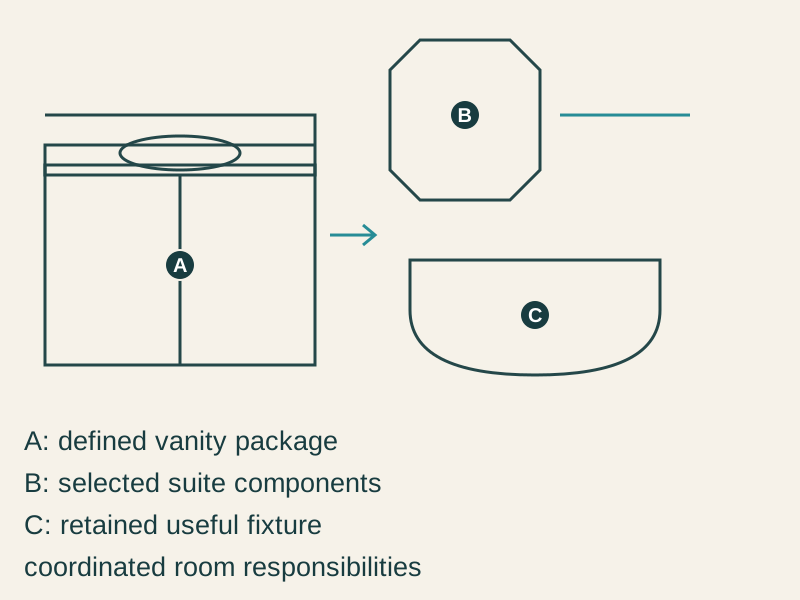
- A
- A: defined vanity package
- B
- B: selected suite components
- C
- C: retained useful fixture
Include the proposed upper assembly and surrounding wall finish together. Determine how the selected backsplash and adjacent wall treatment meet, including returns and any known fixture positions. The buyer needs a completed edge and wall proposal, not an assumption that the matching piece resolves every site condition.
If the room calls for another wall treatment, ask the supplier and installer how that changes the actual order and installation. Do not remove a package component on paper and immediately credit its cost as a saving. The change needs its real scope, suitability and commercial terms confirmed.
Keep the other fixtures accountable to their tasks
For each new piece elsewhere in the suite, identify the existing task and what improvement is wanted. A fixture that already works and has an acceptable appearance may be worth retaining. Replacing it solely to complete a named room composition can add work without improving the owner's routine.
Conversely, a newly configured room can benefit from a coordinated selection when its components each have a clear function and their installation is planned together. The goal is neither to buy every piece nor to mix brands for its own sake. The owner should be able to explain why each selected assembly belongs.
Follow a selective-purchase example
Imagine a renovation where the owner wants the Claude vanity arrangement but the existing separate bathing fixture remains suitable and is not part of the planned work. The proposed vanity can serve the daily kit and the wall plan can accommodate its selected upper components. This is a hypothetical purchase comparison.
The team compares a broader replacement scheme with a selective one. The selective scheme keeps the existing fixture and finishes its relationship to the new vanity through a reviewed room palette and wall elevation. The owner's chosen mirror is evaluated at the actual viewing positions rather than copied automatically from the display.
The owner chooses the selective order because it produces the desired grooming area without adding an unrelated replacement job. Another project starting with an empty room may choose more of the suite. Neither result follows merely from the word collection; both need the same complete room review.
Separate visual coordination from delivery responsibility
Confirm what the actual vanity offer includes and what remains separately selected or supplied. Identify installation, connections and wall preparation in the project scope. A coordinated product family does not establish that every purchase arrives together or that one installer takes responsibility for all interfaces.
Assign someone to reconcile revisions across the schedule. If the vanity configuration changes, the basin relationship, mirror and wall treatment may need another review. If only a separate fixture changes, determine which room relationships really change instead of reopening every selection without reason.
Preserve a useful basis for future replacement
Keep the vanity model, upper package, hardware, retained products and final room drawing together. Record the purpose of each selection, including any component intentionally kept from the existing bathroom. Later substitutions can then be assessed by fit, use and appearance rather than by a vague instruction to match the suite.
The Claude announcement offers a real coordinated selection framework. The purchase succeeds when that framework is translated into the assemblies this particular room needs, with usable storage, a practical grooming surface and clear installation responsibilities. Choose the whole composition only where all its parts earn their place; otherwise make the selective combination just as complete.
Sources & further reading
- Kohler: Claude collection announcement