Frameless glass cabinet doors need a different hinge plan
Removing the wood frame changes more than the view. Compare the glass attachment, visible fittings and completed-door scope before approving a frameless front.
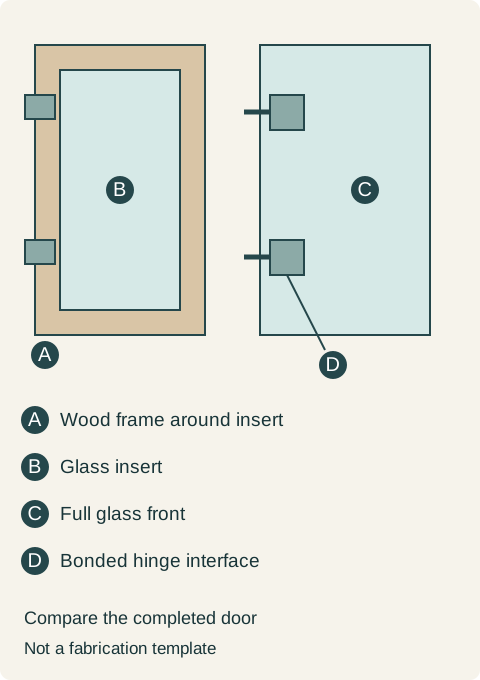
A wood-framed glass door and a frameless glass door can look similar in a small catalog photo. They are different purchases. In the framed version, the hinge connects to the door frame and the glass is retained within it. Removing that frame changes the attachment that carries the moving front. The old hinge detail should not be carried into the new order without a new design.
Identify what is holding the hinge
Start with a rear view of the proposed door. Is the hinge fixed into wood, attached to a metal frame, clamped around a glass edge or connected to a plate bonded to the glass? Those descriptions are not interchangeable. A supplier should identify the actual arrangement rather than call all of them glass-door hardware.
Blum’s CRISTALLO technical sheet provides one example: an adhesion plate attaches to a suitable glass or mirror front without glass drilling. It recommends an experienced glass manufacturer for the bonding work and directs adhesive selection to the glass or front supplier.
That example explains why “no drilling” does not mean “no preparation.” It does not approve a particular door in another cabinet line. The glass, bonded interface, hinge and cabinet-side fixing have to be specified together. A generic glue product added to an ordinary wood-door hinge is not the assembly described by that sheet.
Compare the visible hardware before choosing clear glass
On a clear front, the attachment may be visible from outside or through the cabinet. Ask for the front, rear and open-door views of the finished combination. An opaque drawing can hide a plate that becomes obvious in clear glass. The finish of the hinge and plate may matter as much as the cabinet handle finish.
Also review what the glass reveals behind it: shelf edges, the cabinet interior and the space around the attachment. Switching from a wood frame to clear glass exposes areas that the frame previously covered. A dark hinge can be intentional, but it should be part of the approved appearance, not discovered after delivery.
The handle needs its own attachment plan. A hinge that needs no glass drilling says nothing about the pull. Confirm whether the selected grip requires fabrication in the glass or uses another specified fixing. Have that work included in the completed-door order rather than leaving an installer to improvise a mounting detail.
Teaching example Conceptual comparison: a framed insert sits within a separate door frame, while a frameless glass front needs its own hinge attachment. The small plate represents a bonded interface, not its size, adhesive thickness or installation position.
A wider front changes the purchase even if the height stays the same
Suppose a hypothetical clear panel changes from 24 by 36 inches to 30 by 36 inches. Its area rises from 864 to 1080 square inches, an increase of 25 percent. For the same uniform glass and thickness, the glass-only weight rises by the same proportion. That does not calculate the completed door weight, which includes its fittings.
The additional width also changes the location of the panel’s center of mass relative to the hinge edge. It is therefore not enough to copy a hinge quantity from the narrower door or divide a claimed weight rating by the number of fittings. The selected system’s door-size, material and attachment requirements still control the arrangement.
In this hypothetical order, the buyer declines the wider panel until the door supplier provides a complete compatible assembly. The approved narrower front stays in the cabinet schedule. If the wider design is later accepted with documented hardware, it becomes a revised door item; it is not treated as a harmless glass-size substitution.
Order a working door rather than a sheet and a bag of hinges
Compare quotes at the same completion stage. A cut glass panel may exclude edge finishing, the hinge attachment, the handle preparation and the installation check. Another quote may include a completed front with the attachment already prepared. Their material descriptions alone do not explain that difference.
Identify who supplies the glass, completes the hinge interface and checks the door on the actual cabinet. Keep the finished dimensions, hardware model, handed position and accepted appearance together. If several doors look alike, assign each to its opening so a later installer does not have to infer the intended arrangement from loose parts.
Before accepting the result, check normal opening and closing, clearance at neighboring fronts and access to the shelf contents. Visible damage or a questionable attachment needs assessment by the responsible supplier; tightening harder or adding adhesive is not an acceptance check. Keep the fitting records with the cabinet documents so future service addresses the actual system.
Pure White
Cream White
Light Warm Gray
Gray
Navy
Black
Oak Tone
Dark Walnut Tone
Design study These finish studies are design references, not a list of currently orderable colors. Screens and lighting change the appearance; compare a physical sample before choosing.See all finish options →
The sample shows the door frame, a separate center panel, the face frame and the cabinet box. Each component has its own place in this Shaker construction.
Shaker construction: door frame, center panel, face frame and cabinet box. The cutaway helps locate these parts; confirm each material in the specifications for the selected cabinet.
01 / Door frame
The Shaker door has rails and stiles around a separate center panel. The frame and center panel are different components; confirm their materials in the specifications for the selected cabinet.
02 / Face frame
The face frame surrounds the opening at the front of the cabinet box and sits behind the doors. The face frame, door frame and cabinet box are separate parts.
03 / Cabinet box
The sample exposes the cabinet sides, interior surfaces and layered edges. The image does not establish the wood species or material specification of a selected cabinet.