

Construction & materials
Private-label cabinets vs. manufacturer brands: what to check
Private-label cabinetry can put the dealer’s name on the product without making the dealer its manufacturer. Decide what the series promises and how its physical specification remains identifiable when suppliers or options change.
A cabinet dealer choosing an own-label series is choosing what customers will associate with its name. The name may organize a coherent selection and keep the showroom’s offer recognizable. It does not, by itself, make the dealer the cabinet manufacturer or make every product sold under that series physically interchangeable. Before adopting the format, decide what the collection stands for and how its actual construction will remain traceable.
Trail Cabinet gives a concrete manufacturer example: its dealer page offers custom branding on drawer boxes, including a dealer logo. That establishes an available branding format, not a universal arrangement for every private-label cabinet line.
Reading note: Trail Cabinet: dealer private-label drawer-box branding.
U.S. Cabinet Depot also explicitly discusses dealer private labeling in its public marketing policies. These examples verify that the model exists; they do not establish any particular dealer’s supply agreement or participation.
Reading note: U.S. Cabinet Depot: Marketing Policies, private labeling.
Decide which relationship the showroom wants customers to recognize
With a manufacturer-named line, the product’s public identity remains attached to that manufacturer. The dealer can focus its own story on design, selection and the services it actually supplies. With an own-label series, the dealer’s collection becomes the name customers are likely to remember when asking for another room or a later replacement.
That difference affects the work behind the offer. An own series needs a clear, repeatable meaning: perhaps a defined construction family, a deliberately limited selection or a particular level of customization. A new collection name is less useful if it covers whichever unrelated cabinet happens to be available this month without explaining the changes.
Do not assume one format is inherently more trustworthy or more profitable. A manufacturer brand can have a poorly explained local offer, while an own-label line can be carefully documented. Compare the actual product and the dealer’s ability to maintain its description, rather than assigning quality from the logo alone.
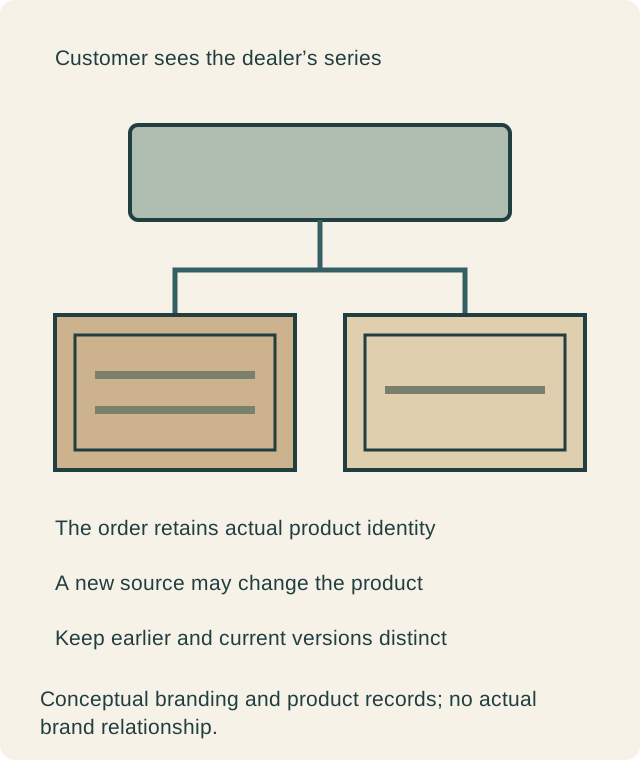
A name should describe something stable enough to sell again
Write the collection’s practical boundaries before designing the showroom label. If its promise is a particular cabinet construction, identify which components define that construction. If the promise is a selected range of appearances, say what can vary behind them. The buyer-facing explanation and the internal product schedule should tell compatible stories.
A collection can evolve, but the dealer should know when a revision changes its meaning. Moving to another drawer system, changing the door material or narrowing available modifications may matter even if the public name stays. Keeping a stable name is a branding choice; keeping the previous specification recoverable is a product-management task.
The visible logo does not explain who makes each part
A branded drawer box can be a useful reminder of the showroom that supplied the kitchen. It is not a complete description of the cabinet. The door, box, finish, drawer hardware and accessories may need separate identification in the installed-product record, regardless of which logo is most visible.
Customers should receive a plain explanation of the dealer’s actual role. If the dealer selects and supplies a line made elsewhere, describe that accurately. If it performs additional fabrication, identify that scope. The purpose is a clear product offer, not a tour of every internal commercial arrangement or an unsupported suggestion that the showroom owns a factory.
Supplier flexibility creates a decision, not automatic continuity
An own label can make the public collection name independent of a particular supplier name. That may be useful, but it does not make a supplier change invisible at the product level. A similar-looking replacement line may have different front proportions, edge treatments, drawer clearances or accessory choices.
Before carrying the name forward, compare the previous and proposed specifications. Decide which differences are acceptable within the series and which require a revised version or a different collection. A new sample door should replace an old display deliberately. The old sample and its order history still matter for customers who bought the earlier product.
A hypothetical collection changes its source
Imagine a dealer selling a restrained painted cabinet collection under an invented showroom name. Its original product uses one door profile and drawer system. A later source offers a close-looking color but a different inner profile and drawer-box arrangement. The dealer likes the new offer and wants to retain the collection name.
In this hypothetical decision, the name remains, but the showroom creates a distinct current specification and keeps the earlier one with completed project records. Existing customers asking for an additional cabinet are told that the current collection has changed. The dealer compares the actual proposed addition beside their installed kitchen instead of treating the shared name as evidence of a match.
Another dealer may decide that this amount of change undermines the original collection promise and introduce a new name. Both approaches can be coherent. The weak approach is to reuse the name while losing the ability to explain which physical product a customer received.
Price comparisons need the actual cabinet proposal
An own-label quotation and a manufacturer-branded quotation may not use comparable public names. Compare their doors, cabinet construction, finish, drawer system, dimensions, modifications and included finishing parts. The series label should not become a substitute for those details or an invitation to compare only a headline cabinet price.
The same principle works inside the dealer’s showroom. If two own collections differ, staff should be able to explain the relevant differences in the offered products. A ladder of names such as basic and premium does little if the actual distinction is a particular material, hardware package or modification scope that remains unstated.
Service should retain the earlier product’s identity
When a customer returns, search the completed order rather than the current display alone. The record should identify the series as sold and the actual supplier product and options behind that sale. A collection brochure updated later cannot reconstruct a discontinued door or finish by itself.
Keep a usable route for asking about the delivered components, including who handles the inquiry now. Do not promise perpetual matching or supply merely because the dealer controls the collection name. The useful commitment is an identifiable product history and a clear explanation of what a current replacement proposal would change.
Choose the format the business can maintain
A dealer already equipped to manage versions, samples and product explanations may find an own-label series useful. A business that wants the manufacturer’s identity to remain central can keep that name prominent and distinguish its own work through the service it actually performs. Neither requires pretending that branding changes the physical cabinet.
The decision is ready when staff can answer what the series means, what product it currently contains and how an earlier customer’s kitchen will be identified later. That makes the name a useful part of the offer instead of an obstacle between the customer’s remembered collection and the cabinet actually installed.
Sources & further reading
- Trail Cabinet: dealer private-label drawer-box branding
- U.S. Cabinet Depot: Marketing Policies, private labeling