Compact laminate is a different component proposal, not just a thinner laminate finish
Compare the complete section and fabrication scope when substituting compact laminate for a faced wood-based board. A matching decor does not make the parts interchangeable.
A compact-laminate alternate should be reviewed as a different component construction. It is not simply the original decorative laminate made thinner or a wood-based board with its core removed. Compare the whole section, edge appearance, supported application and fabrication detail before accepting the substitution. The same decorative name can conceal a substantial change in what the fabricator must make.
The material itself forms the structural panel
Formica’s technical team describes Formica Compact as a structural decorative laminate with decorative faces on both sides and a black core. It also provides its own fabrication and joining guidance. That named product example establishes a construction difference; it does not establish an unrestricted load capacity.
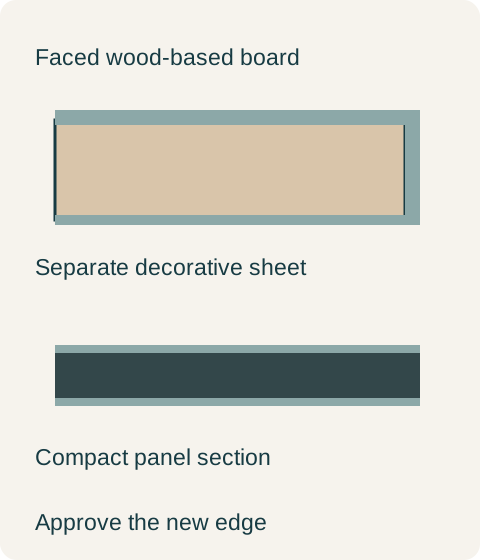
In a conventional faced board, the decorative surface is bonded to a separate supporting board. In a compact panel, the component section is the compact material itself. The distinction changes the drawing that must be approved. An exposed dark core may be an intentional part of the selected edge appearance, while the exposed core of a different faced board may call for a separate edge finish. Judge the actual specified edge, not the word laminate.
A thinner visual section can alter interfaces with neighboring parts. Keeping the outer outline does not keep every reference face in the same position. Identify which face must align with adjacent components and which dimensions change. A decor match cannot answer those geometry questions, and an overall photograph may conceal them until assembly.
Teaching example Conceptual section comparison, not to scale. A faced board and a compact panel require their own finished-component details; no span, load or fastening dimensions are supplied.
Compare the finished thin-edge component, not the raw sheet
Suppose a hypothetical buyer wants a thin, dark exposed edge on a furniture panel. The original offer uses a faced wood-based board with applied edging; the alternate offers a compact panel with the desired finished core edge. The buyer selects the compact alternate only as a revised component package: the approved section, finished edge and matching fabrication/connection details are all included. The original board’s shop detail is superseded. This achieves the chosen appearance without pretending the material is a drop-in replacement.
In that hypothetical decision, a competing offer that supplies only a raw compact sheet is compared separately. It may omit cutting, edge finishing and the revised component details included in the selected package. The lower amount on such an offer would not demonstrate a cheaper finished part. A meaningful comparison brings both offers to the same delivered state and intended function.
Structural does not mean unlimited unsupported use
A structural-panel description does not authorize any span, point load or support arrangement. The chosen thickness, geometry and application must follow the applicable product and fabrication information. This is especially important when a thin edge encourages a visually unsupported design. Keep a material description separate from verification of the completed assembly; the latter must address the actual component.
Likewise, do not carry over a familiar wood-board joint without checking the new material. The compact product’s joining and machining instructions exist because its fabrication behavior is part of the specification. A purchasing drawing can identify the required finished outcome and responsible fabricator without becoming a field machining recipe. Unresolved details should be priced and completed within that fabrication package.
At acceptance, compare the revised component with its own approved section and edge sample. A deliberate dark core is not an unfinished-edge defect when it was the selected appearance. Conversely, a dark line alone cannot identify compact laminate or prove the stated product. The material record, finished edge and component drawing should agree.
This comparison is useful when the desired thin section or exposed core changes the result. If the project simply needs the original faced-board appearance and function, there is no reason to assume compact is a necessary upgrade. Choose the construction that demonstrates the required completed component, and make any substitution visible in both the drawing and the quote.
Pure White
Cream White
Light Warm Gray
Gray
Navy
Black
Oak Tone
Dark Walnut Tone
Design study These finish studies are design references, not a list of currently orderable colors. Screens and lighting change the appearance; compare a physical sample before choosing.See all finish options →
A painted door, a wood-grain side and a plywood cabinet box can belong to the same cabinet. Here is how to read those parts, what the sample photos actually show, and which details to put on a quote.
The sample shows the door frame, a separate center panel, the face frame and the cabinet box. Each component has its own place in this Shaker construction.
Shaker construction: door frame, center panel, face frame and cabinet box. The cutaway helps locate these parts; confirm each material in the specifications for the selected cabinet.
01 / Door frame
The Shaker door has rails and stiles around a separate center panel. The frame and center panel are different components; confirm their materials in the specifications for the selected cabinet.
02 / Face frame
The face frame surrounds the opening at the front of the cabinet box and sits behind the doors. The face frame, door frame and cabinet box are separate parts.
03 / Cabinet box
The sample exposes the cabinet sides, interior surfaces and layered edges. The image does not establish the wood species or material specification of a selected cabinet.