Evaluate a cabinet pull from the side and in use before ordering it throughout a project. Projection describes how far the hardware stands away from the front, while the usable space behind its grip and the shape of its ends answer different questions. Test the actual sample at a representative height and orientation to judge hand clearance, nearby contact and whether clothing catches during ordinary movement.
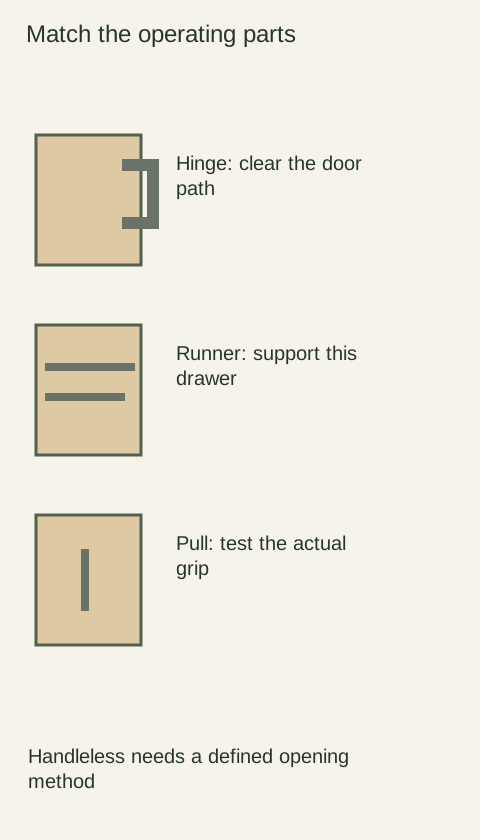
Diagram A concept diagram helps distinguish hardware types. Grip clearance and end contact must be checked on the selected physical pull.
Read the side-view dimensions correctly
Hardware Resources lists projection and clearance separately in its dimensional guide, alongside overall length and mounting-center spacing. That separation matters: a thick gripping bar can have substantial outward projection without leaving equally generous room behind it. Use the selected model’s drawing to identify which dimension is being quoted.
Do not compare products from a single unlabeled depth measurement. Establish the mounting surface, the outermost point and the space available where fingers will enter. A front-facing photo may make a slim and a deep pull look almost identical. Side and underside views show the relationship more clearly, but a physical sample is still needed to judge the intended user’s grip.
Mount the sample before judging comfort
Ask for a suitable display or sample board that reproduces the planned orientation and approximate use height. Hold the pull naturally, draw the hand away and repeat the motion without looking closely at the hardware. Notice whether knuckles rub the surface, fingertips have to pinch a narrow edge or a decorative return interrupts the grip.
Include the people who will use the cabinetry regularly. Hand size, preferred grip and rings can change what feels convenient. If gloves are part of the intended task, include those in the demonstration. This is a personal fit check, not an accessibility certification or a basis for assigning a universal minimum clearance from an informal trial.
Observe exposed ends during normal movement
Some bar pulls extend past their mounting posts, leaving ends that can interact with loose sleeves, pockets or an apron. Examine the end shape and the approach direction. A smooth-looking finish does not tell you whether the geometry will catch a fabric loop that passes behind the end.
On a securely mounted sample, reproduce ordinary reaching and passing movements slowly, keeping clothing free to move. If fabric catches, stop and note the point of contact rather than repeatedly tugging it through. A negative result in a brief test is useful, but it cannot promise that every garment and movement will remain snag-free. Compare the actual alternatives in the same way.
A shallow pull is not automatically the better choice
Imagine selecting hardware for a frequently used cabinet beside a place where the owner works in an apron. An open-ended bar feels comfortable but catches the apron loop in a realistic sample check. A very shallow alternative avoids that contact yet requires an awkward fingertip pinch to open the door.
The useful comparison includes another profile that brings the ends back toward the surface while preserving a comfortable grip. Test that sample rather than choosing only the smallest projection number. The example illustrates a tradeoff between the body’s passing path and the hand’s working space; it does not establish that all open-ended bars are unsuitable or all returned-end pulls are effortless to use.
Confirm the installed interaction before multiplying the order
Check whether the selected pull contacts neighboring fronts or another handle during the intended opening motion. Include any backing plate in the sample configuration because it can change the mounting relationship. Review the position with the installer before drilling new fronts. A dimensional drawing is valuable, but it cannot represent an unrecorded change in mounting location.
Save the exact model, size, finish and mounting orientation of the accepted sample. Record the reason for the choice in ordinary terms, such as comfortable grip and no observed apron contact in the representative trial. Avoid a blanket “snag-proof” promise. A different size within the same collection may have another grip or end relationship, so confirm the variants before placing the full hardware order.
Pure White
Cream White
Light Warm Gray
Gray
Navy
Black
Oak Tone
Dark Walnut Tone
Design study These finish studies are design references, not a list of currently orderable colors. Screens and lighting change the appearance; compare a physical sample before choosing.See all finish options →
A painted door, a wood-grain side and a plywood cabinet box can belong to the same cabinet. Here is how to read those parts, what the sample photos actually show, and which details to put on a quote.
The sample shows the door frame, a separate center panel, the face frame and the cabinet box. Each component has its own place in this Shaker construction.
Shaker construction: door frame, center panel, face frame and cabinet box. The cutaway helps locate these parts; confirm each material in the specifications for the selected cabinet.
01 / Door frame
The Shaker door has rails and stiles around a separate center panel. The frame and center panel are different components; confirm their materials in the specifications for the selected cabinet.
02 / Face frame
The face frame surrounds the opening at the front of the cabinet box and sits behind the doors. The face frame, door frame and cabinet box are separate parts.
03 / Cabinet box
The sample exposes the cabinet sides, interior surfaces and layered edges. The image does not establish the wood species or material specification of a selected cabinet.