

Buying cabinets
Warming drawer or an additional oven: what does the meal actually need?
Separate food that is still cooking from dishes waiting to be served, then buy the supported equipment that resolves the real overlap without leaving the cabinet plan incomplete.
Buy the capability that is missing at the busy moment
Choose a warming drawer when the repeated bottleneck is an accepted warming or serving task that its documented functions can perform. Choose another oven when a genuine cooking task needs a separate supported cavity at the same time as the main oven. Keep neither addition if the household’s preferred meal already works with the accepted equipment and sequence.
The distinction starts with the meal timeline. At the point of conflict, is the dish still being cooked, or has that work finished and the household wants a particular serving arrangement? A vague request to keep dinner moving can lead to buying the wrong appliance and surrendering a useful cabinet without solving the problem.
Do not compare labels as interchangeable functions
Wolf distinguishes its dedicated warming drawer from Keep Warm functions on other appliances and notes that those functions vary by model. A shared warm label is not a complete capability comparison.
Reading note: Wolf — Keep Warm Feature, differences among warming drawer and other appliances.
List the exact functions the shortlisted drawer supports and match the intended tasks to its instructions. Do the same for the extra oven, including any warming function the buyer wants to use. This guide does not assign a universal cooking or holding method to either category.
If a desired preparation lies outside the candidate’s documented use, do not make it the purchase justification. Compare equipment expressly supporting the task or retain the existing arrangement. The issue is not whether a function sounds close; it is whether the actual offered appliance performs the accepted job.
Find the overlap the second appliance must absorb
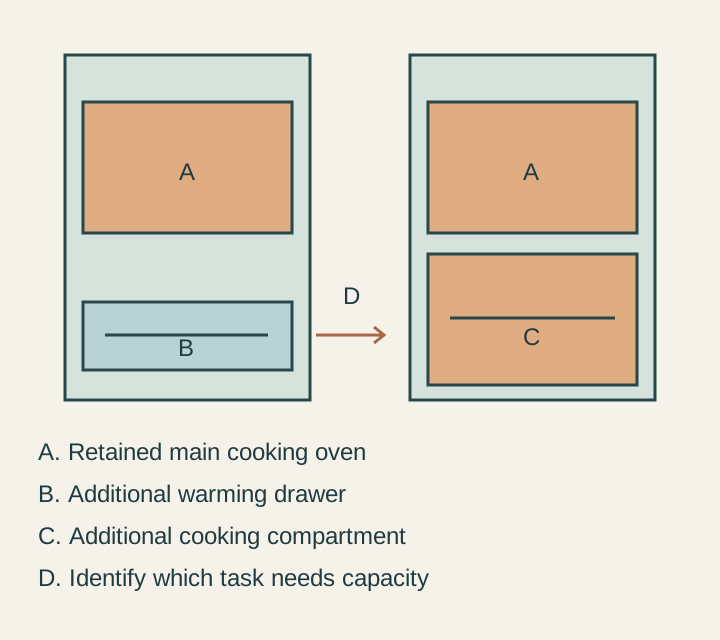
Follow a representative meal through preparation, cooking, finishing and serving. Identify when the main oven becomes unavailable for the next task. Distinguish a true simultaneous need from a sequence the household could change without abandoning the meal it values.
A second oven can provide another cooking location but may leave the serving queue unchanged. A warming drawer can serve an appropriate finished-dish task while doing nothing for a baking batch still waiting for its own cooking conditions. The household must decide which of those conflicts actually occurs.
Do not enlarge the everyday brief merely because entertaining sometimes feels rushed. A special meal can justify an appliance if the owner values it enough. Describe that occasion honestly, including how often the equipment will serve other accepted work rather than inventing daily demand.
Use the actual vessels and serving group
Check dishes, lids, rims and handles in each candidate. If the proposal involves several items together, test that group in the arrangement the instructions support. A wide drawer front does not establish a tall interior, and a total oven volume does not show which serving pieces fit.
Verify vessel suitability separately from physical fit using the relevant appliance and dish guidance. This purchase comparison gives no food-temperature, holding-time or reheating recipe. Those operating details must follow the actual products and intended food handling.
Rehearse removal with cool, empty representations and the intended user. Follow the dish to its real destination with the appliance open. A second compartment whose position is inconvenient for the assigned load cannot be counted as practical capacity merely because it exists.
Show the cabinet each alternative buys
Draw the complete supported appliance combination. Identify whether the drawer uses a base location, belongs within an oven tower or occupies another permitted position. Do not stack appliances as arbitrary rectangles or assume any warming drawer can sit under any oven.
Then show the alternative with the additional cooking oven. Include support, connections, required spaces and usable storage remaining. The two proposals may claim different height or width; compare actual elevations rather than assuming the same cabinet order works for both.
Assign displaced trays, utensils and serving pieces real homes. A new warming drawer that removes the serving-piece cabinet can create extra trips precisely when the meal is busiest. Include that inventory movement in the task trial.
Keep a destination available at serving time
The surface receiving the dish is part of both purchases. Mark the ingredients and completed dishes already there, as well as other people’s positions. A nearby island is not an automatically empty landing.
If the main goal is setting serving dishes near the dining side, compare a suitable location there with an aligned appliance tower. If the goal is another cooking batch, test its approach and transfer to the working counter. Short visual alignment is not a substitute for the actual task route.
Compare the full price of equipment, cabinet work, supported accessories, connections, counter changes and finish restoration. Avoid an assumed energy saving or a hypothetical future resale benefit as a way to justify a poorly matched task.
Distinguish the serving group from the next cooking batch
If the purchase is motivated by serving pieces, identify the actual supported task rather than combining empty tableware, finished food and unfinished preparations into one warm category. A candidate may be appropriate for one documented use while the household has imagined several others. Keep only the uses established for that exact appliance in the capacity comparison.
Consider when the assigned serving group returns to ordinary storage. Buying a drawer for an occasional meal may still be a good preference, but the kitchen needs a workable home for its everyday items on every other day. Do not count the appliance interior as general cabinet storage unless its instructions expressly support the proposed use.
If the complete extra oven is selected instead, repeat the group's route at the installed position. Its rack and access arrangement may differ from the main oven. The household is buying another usable working location, not merely a second rectangle on the elevation.
A household buys cooking capacity instead
Imagine a hypothetical family whose recurring meal needs a baked side dish while the main oven remains occupied by another accepted cooking task. The second dish is not ready for serving yet. A warming-drawer proposal looks compact in the tower, but its documented functions do not serve this preparation.
The household tests an additional oven arrangement. Both vessels fit their assigned cavities; the users accept the working positions. The cabinet plan reassigns the displaced baking trays to a nearby tested compartment and preserves the landing surface.
They buy the additional oven at its complete installed scope. Another household whose main conflict is a supported finished-dish serving task may choose the warming drawer and keep more valuable cabinet space elsewhere. Approve the exact task, vessels, equipment combination and displaced inventory together. The useful addition is the one that takes over real work at the moment the kitchen needs it.
Sources & further reading
- Wolf — Keep Warm Feature, differences among warming drawer and other appliances