

Bath & laundry planning
Open grid drain or a stopper: should the bathroom basin hold water?
Choose a non-closing drain when the intended basin use does not require retaining water and the selected complete assembly is suitable for the basin. Choose a closing drain when the household needs that basin to hold water and can operate the selected stopper conveniently. Decide this function before choosing a matching finish: a decorative cover does not reveal whether the drain can close.
Choose a non-closing drain when the intended basin use does not require retaining water and the selected complete assembly is suitable for the basin. Choose a closing drain when the household needs that basin to hold water and can operate the selected stopper conveniently. Decide this function before choosing a matching finish: a decorative cover does not reveal whether the drain can close.
Describe what people do at this basin
Ask whether the owner ever deliberately fills the basin for an appropriate household task. Distinguish that action from washing under running water. If water retention is part of the accepted routine, a drain intended to remain open does not supply the same function even if the top looks more elegant.
Danco describes the cited grid drain as non-closing. That is a functional difference from a drain with an operable stopper.
Reading note: Danco: non-closing grid drain.
Use the actual product description rather than inferring function from a circular cap or grid-like appearance. Product names and mechanisms vary. Identify what this candidate does, then compare it with the basin's brief; do not buy a visual match first and discover the missing function afterward.
Decide where the closing control belongs
For a stopper operated at the drain, test reaching and operating it in the actual bowl. For a design controlled elsewhere, show the control and its full movement with the faucet, wall and mirror. The choice is meaningful when the user can start and release the retained water through the intended mechanism.
Include the complete required linkage or control parts in the cabinet review. A visible stopper may look unchanged while the operating arrangement beneath the deck differs. Keep those parts clear of assigned drawers and accessible according to the selected installation. A closing function should not be promised before the actual assembly is coordinated.
Check compatibility as a separate decision
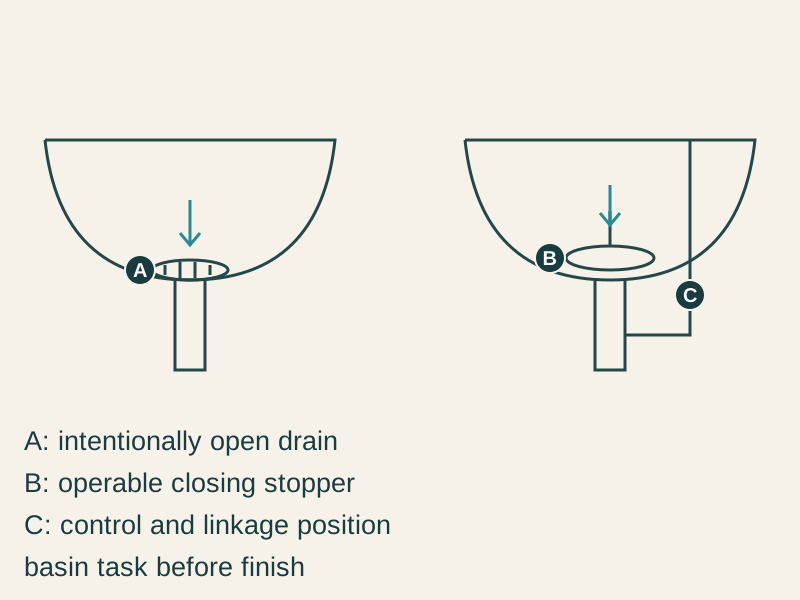
- A
- A: intentionally open drain
- B
- B: operable closing stopper
- C
- C: control and linkage position
After choosing the required function, confirm the actual drain with the basin's current product information and the relevant supplier or installer. The basin's overflow arrangement, mounting and connection requirements still matter. Selecting an open drain does not bypass that review, and selecting a stopper does not establish it.
Keep any drain supplied with the faucet identified. It may provide the function desired, but it still needs to be checked with the chosen bowl. Conversely, declining an included part does not mean that a visually similar separate purchase completes the assembly. Name the final components and who confirms the combination.
Try use and ordinary care together
Demonstrate the chosen opening and closing action where applicable, then identify how the selected product is attended to according to its instructions. The person doing ordinary care needs to understand the actual mechanism rather than force a decorative face that was never meant to move.
Compare access with the basin, faucet and cabinet in place. An easy demonstration on a loose countertop sample can omit the wall or drawer below that changes the task. Review the complete installed relationship while leaving actual installation work to the responsible project parties.
Follow a functional choice
Imagine a household that wants the new basin to retain water for cleaning immersible grooming tools according to their care directions. The initial faucet package includes a stopper, but the owner prefers the appearance of a separately selected grid drain. This is a hypothetical purchasing example.
The grid candidate is identified as non-closing, so it does not meet that part of the brief. The team confirms a compatible closing assembly, checks the actual control motion and reviews its underside with the vanity. The owner chooses it while keeping the preferred finish among the verified options.
If the household had no retention task and preferred the identified open configuration, that could be a different valid purchase after the same compatibility review. The conclusion follows from the requested basin function, not a general hierarchy of sophisticated and ordinary drain styles.
Avoid inventing performance from the function
An open drain's non-closing design does not establish a particular flow capacity or guarantee that the basin cannot overflow. A stopper's presence likewise does not define how quickly the basin empties. Where a project needs a particular performance answer, obtain it for the actual complete components rather than deriving it from the word open or pop-up.
Do not add a separate improvised plug to the open proposal on the assumption that this makes it equivalent. If the owner wants another accessory, that combination needs its own applicable confirmation. The simpler purchasing route is to choose an intended closing assembly when closing is part of the brief.
Preserve the function through substitutions
Record whether the basin must retain water, the selected drain and control, and the confirmed pairing with the basin. Include whether the final part comes with another purchase or is ordered separately. A late finish substitution should not quietly remove the function that justified the selection.
Choose the open grid when the identified non-closing behavior suits the basin's job. Choose a stopper when water retention is needed and its operation works in the completed vanity. The useful decision is a basin that performs the owner's intended task, with the drain's appearance selected inside that functional boundary.
Sources & further reading
- Danco: non-closing grid drain