Can a vanity support a routine completed with one hand?
Test the whole sequence with the intended user, including where each object rests while the hand opens, retrieves, uses and returns another item. A cabinet that opens with one hand can still leave the routine unfinished.
The limiting step may occur after the product is out of the drawer. The user holds a pouch but needs the same hand to clear a space, open another compartment or close the cabinet. Planning a usable landing and a sensible sequence can matter as much as the choice of front. Start with an actual ordinary task instead of assuming that a single hardware feature answers the question.
Define the intended use without guessing at ability
Identify which hand the person intends to use and the task they want to complete. Keep the user's preferred position and any usual assistance explicit. If this relates to an injury, disability or changing needs, use appropriate professional guidance rather than asking the person to imitate a limitation or try an uncomfortable movement for a demonstration.
Choose the real items involved, including their ordinary packaging and organizer. A trial with an empty bottle or an already opened pouch skips work that may matter. Keep questions about opening a particular product separate from the cabinet selection, while recognizing that both affect whether the complete task succeeds.
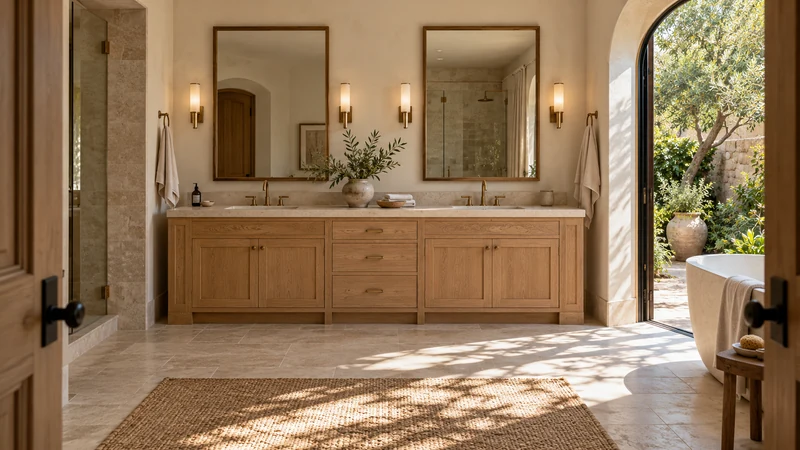
Design study The oak study shows a basin, adjacent top and several closed storage fronts. It can support a discussion of possible landing locations, but it does not demonstrate a one-handed routine.
Trace what the hand is doing at each transition
Begin before opening the cabinet. Note whether the hand is empty, holding a personal item or already engaged in the task. Follow the sequence through opening, reaching, lifting and placing. When the next action needs an empty hand, identify the exact place where the current object can rest.
Do the same in reverse. A storage arrangement may allow easy retrieval but require holding the organizer while opening the compartment for its return. That is an unresolved transition. Record it directly instead of treating the end of product use as the end of the bathroom routine.
Give the working objects a real landing
Use a full-size layout or appropriate display to represent the usable preparation surface beside the selected basin and controls. Include the objects that normally remain there. A surface that looks spacious when bare may not accommodate the pouch in its open state along with the item just removed from it.
Check that the landing remains available while the chosen door or drawer is open and while the person stands or sits in the intended position. Do not count a basin rim, an open drawer or an improvised attachment as a stable work support without appropriate product-specific confirmation. The layout trial evaluates positions; it is not a load-bearing construction.
Check how the front behaves during the task
Observe whether the front stays in the expected position without the user holding it. Include its path when opening and closing, the standing or seated position, and the access needed for retrieval. If the routine depends on leaving a drawer extended, examine the resulting room route as well as the item inside it.
Ask the supplier about the specific front and mechanism if behavior is uncertain. Avoid solving the trial with an improvised prop that would not belong to the installed arrangement. A different compartment or a changed sequence may be more useful than a proposal that requires the hand to keep a door in place.
Compare a sequence, not a display pose
For example, a user lifts a grooming pouch from a drawer and then wants to close the front. The planned landing is occupied by everyday containers, so the pouch remains in the hand. The drawer itself operates comfortably; the obstacle is the missing intermediate resting place.
Try a revised arrangement that reserves a usable landing, then repeat retrieval, placement, opening the pouch, putting items back and returning it to storage. If the pouch closure still requires an action the user cannot perform as intended, keep that limitation visible. More clear surface does not automatically resolve packaging or personal-care actions.
Include the organizer inside the cabinet
Follow any inner tray, lid or stacked box as part of the sequence. A freely moving outer drawer does not resolve a lid that must be held while its contents are removed. Test whether the intended object can be reached and returned without temporarily stacking unrelated items on the reserved landing. If changing the organizer eliminates that extra transition, repeat with the new arrangement before changing the cabinet itself.
Turn the observed result into selection criteria
Record the tested hand, user position, product group, landing location and front behavior. Note which items must stay off that landing for the routine to work. In a shared bathroom, agree how the available space will be restored after another person uses it.
Select cabinetry that supports the demonstrated sequence, and recheck any substitution that changes the landing or opening path. The result should explain how the person proceeds from start to reset, where assistance remains necessary and which product questions still need answers. It should not promise independent use merely because the drawer can be pulled with one hand.
Pure White
Cream White
Light Warm Gray
Gray
Navy
Black
Oak Tone
Dark Walnut Tone
Design study These finish studies are design references, not a list of currently orderable colors. Screens and lighting change the appearance; compare a physical sample before choosing.See all finish options →
Compare the complete opening, retrieval and closing action with the intended user and a representative loaded cabinet; the appearance of a pull cannot establish how the finished assembly will work for that person.
Build the arrangement around the user's own method of finding, identifying and returning ordinary items, then test it in the actual viewing and lighting conditions. Consistent locations and a readable organization system matter more than a cabinet color chosen from a photograph.
Compare full-size representations of the finished cabinet, top, basin and faucet while the actual users perform their intended standing tasks, and keep the rest of the assembly consistent when evaluating a height change.
The sample shows the door frame, a separate center panel, the face frame and the cabinet box. Each component has its own place in this Shaker construction.
Shaker construction: door frame, center panel, face frame and cabinet box. The cutaway helps locate these parts; confirm each material in the specifications for the selected cabinet.
01 / Door frame
The Shaker door has rails and stiles around a separate center panel. The frame and center panel are different components; confirm their materials in the specifications for the selected cabinet.
02 / Face frame
The face frame surrounds the opening at the front of the cabinet box and sits behind the doors. The face frame, door frame and cabinet box are separate parts.
03 / Cabinet box
The sample exposes the cabinet sides, interior surfaces and layered edges. The image does not establish the wood species or material specification of a selected cabinet.