Should a powered vanity drawer stay on when it closes?
Decide whether the drawer is for supervised grooming or for charging while closed. A position interlock can deliberately remove power on closing, so an outlet-equipped drawer may not perform both jobs.
Choose the powered drawer from the required operating state. A grooming drawer that loses power when it closes may be exactly what the owner wants for the selected tools, yet unsuitable for a toothbrush charging overnight inside it. Ask what the complete outlet-and-switch combination does before choosing the vanity interior. The presence of a receptacle does not answer that question.
Separate temperature protection from drawer-position control
Docking Drawer distinguishes the thermal interlock in its Blade outlets from an additional Safety Interlock Outlet with a Blade Switch. The additional combination removes power as the drawer starts closing. That is a functional difference the cabinet buyer can evaluate without designing an electrical circuit.
A temperature-dependent shutoff and a position-dependent shutoff respond to different conditions. Do not assume that every drawer outlet switches off when shut, or that a drawer which switches off can continue charging a connected device. Obtain the behavior for the exact selected configuration, including any optional switch; a photograph of the receptacle face will not identify it.
Write the two jobs separately
For a styling station, describe where the tool is used, how the drawer sits during use, and the appliance's required unplugging, cooling and storage sequence. An interlock does not replace those instructions or establish that a hot tool can be put away. The organizer also needs room for the complete stored tool and cord without occupying the outlet or moving cable mechanism.
For a charging station, identify which device needs charging and when. Check its own instructions for the proposed location. If charging must continue with the drawer closed, the equipment schedule must explicitly provide that behavior in a suitable approved arrangement. Leaving a drawer open to defeat the conflict is a different daily routine and may obstruct the basin user or room passage.
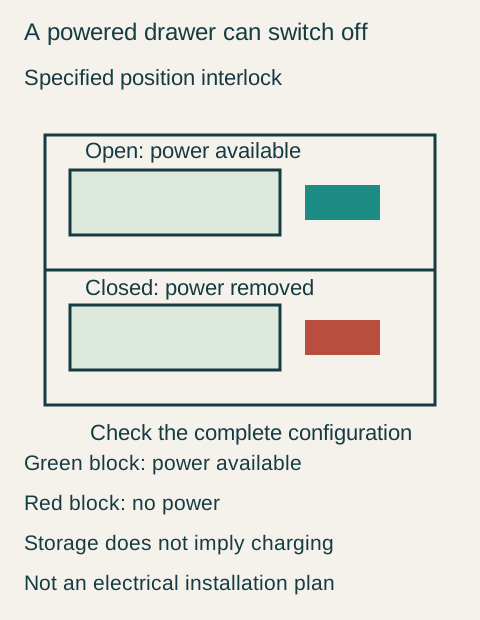
Teaching example Conceptual operating states for a drawer fitted with the specified position interlock: the upper open-drawer state has power available; the lower closed-drawer state has power removed. Green and red blocks indicate power state, not wiring. This is a product-selection diagram, not a circuit or installation drawing.
Compare a vanity that promises both jobs
Consider a hypothetical household choosing a drawer bank beside a basin. The proposed upper drawer contains styling tools, a shaver charger and a toothbrush base. The owner expects to close everything after grooming and find the devices charged the next morning. The selected outlet package includes the position switch, so that expectation fails even though every object fits.
The revised selection keeps the position-switched styling drawer but removes overnight charging from its brief. The household already has a dry charging position outside this drawer, suitable under the actual device instructions, and accepts using it. The shaver and toothbrush bases are allocated there before the organizer is sized; the styling drawer is checked with only its intended tools. The owner chooses this configuration because automatic power removal on closing matters more than consolidating all devices.
If the owner required concealed overnight charging instead, this exact package would be rejected. A separate purpose-designed charging compartment would need its own product and electrical review. Merely omitting a switch without checking the resulting assembly is not a completed alternative.
Buy the usable interior, not just an outlet option
The outlet body, cable-management hardware and power connection consume cabinet space. Have the supplier show their relationship to the basin, drawer sides, slides and rear structure through full travel. The device's installation manual and the electrical professional determine the actual requirements; this is not space that should be promised simultaneously to an organizer.
Specify the drawer's job and closed-state behavior alongside the selected components. At the final demonstration, the owner should see the intended operating states and be able to complete the appliance's ordinary routine. The purchase is useful when both the storage layout and the power behavior match that routine.
Pure White
Cream White
Light Warm Gray
Gray
Navy
Black
Oak Tone
Dark Walnut Tone
Design study These finish studies are design references, not a list of currently orderable colors. Screens and lighting change the appearance; compare a physical sample before choosing.See all finish options →
Plan a place for the complete, ready-to-store tool and its accessories, while following the appliance instructions for use, cooling and care before it enters the cabinet.
Give the active routine a stable, appropriate home and keep unopened replacements in a separate cabinet reserve, rather than trying to hide every item in the same container.
Review the selected cabinet, top, basin, faucet and connection components as a single proposed installation. Confirm their identities, check each interface and resolve the remaining conditions before relying on the combination. Separate product approvals do not by themselves establish that the assembly works together in the measured bathroom.
The sample shows the door frame, a separate center panel, the face frame and the cabinet box. Each component has its own place in this Shaker construction.
Shaker construction: door frame, center panel, face frame and cabinet box. The cutaway helps locate these parts; confirm each material in the specifications for the selected cabinet.
01 / Door frame
The Shaker door has rails and stiles around a separate center panel. The frame and center panel are different components; confirm their materials in the specifications for the selected cabinet.
02 / Face frame
The face frame surrounds the opening at the front of the cabinet box and sits behind the doors. The face frame, door frame and cabinet box are separate parts.
03 / Cabinet box
The sample exposes the cabinet sides, interior surfaces and layered edges. The image does not establish the wood species or material specification of a selected cabinet.