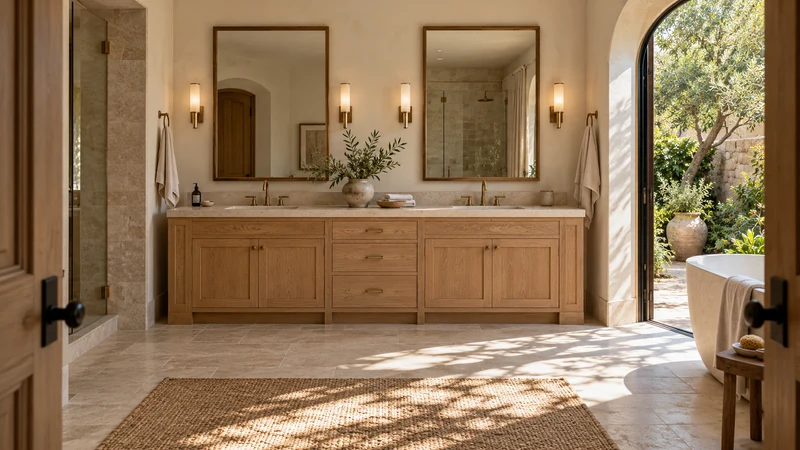
A guest-suite vanity should leave usable space for the visitor’s belongings, not only display the host’s supplies. For a stay lasting several days, an open toiletry bag, personal bottles and a recognizable drawer can matter more than a large decorative arrangement. Test the vanity with the things a visitor carries from a suitcase. Keep the bathroom’s basic functions available while those belongings are in use.
Try an open toiletry bag on the counter
Place a representative bag on the proposed landing area and open it fully. Fold-out sections, handles and a tall bottle may occupy much more room than the closed bag. Check whether the guest can reach the faucet and basin without moving everything first. A narrow strip behind the basin can look like spare countertop while being awkward to reach and unsuitable for the way the bag opens.
In the pictured design, a vase occupies the center of the double vanity. It contributes to the room’s appearance, but that central area is also worth evaluating as temporary personal-item space. Removing the vase is a useful layout trial, not proof that any particular bag fits. The image has no measurements; test the actual counter and sink outlines before assigning that space.
Design study The center vase marks a visible styling choice. For guest use, compare that arrangement with a clear landing area and an available drawer; fit must be checked on the actual vanity.
The goal is not to keep every surface empty. A visitor should be able to unpack the daily set without balancing it on the basin edge or taking over the whole countertop. Keep the items needed for handwashing usable while the bag is open. This trial often reveals whether a wider clear landing area is more valuable than another small decorative recess.
Offer a temporary home without requiring a full unpack
Some guests prefer keeping everything in their own bag. Others will use a drawer for the duration of the visit. Provide a clear option rather than a rigid organizer designed around the host’s bottle collection. A removable tray or uncomplicated drawer area can accept several shapes and is easier to check when the guest leaves.
Choose the position from the real cabinet interior. A drawer front under a basin may conceal a false front or a reduced space, so do not promise it as personal storage until the selected drawing confirms what opens. The central drawers shown in the design suggest a possible category of storage, not a guaranteed capacity or depth.
Keep the visitor’s temporary storage distinct from household overflow. If the drawer is already full of unrelated belongings, calling it a guest drawer does not make it available. Before arrival, create the actual usable space and make its purpose apparent. That is different from stocking shared soap or spare towels; it is room for what the visitor brings.
Test a visit with more than one person
Imagine a pair of guests staying for several nights. One keeps a bag on the landing area, while the other uses a removable tray in a drawer. Check whether either person can wash hands while the other retrieves items. If the counter becomes completely occupied, compare sharing the drawer differently or using an appropriate nearby surface in the suite rather than automatically adding another basin.
Follow the route from suitcase or dresser to the vanity. A visitor carrying a small kit should not need to put it on the floor to open several doors. Consider the reverse trip when packing to leave. A visible, removable grouping can reduce forgotten items without requiring the guest to learn the household’s entire storage system.
Plan the reset as part of the cabinet choice
After departure, the personal-item area should be straightforward to empty, inspect and clean according to the selected finish’s care instructions. Avoid permanent, narrow compartments that only suit one collection of travel bottles. Keep the visitor area adaptable as the type and length of visits change.
Bring the open-bag test, a proposed temporary drawer and the shared-use sequence to vanity selection. Do not size the cabinet solely from a staged photo or the number of amenities the host wants to display. A welcoming guest vanity gives visitors a place to use their own things while leaving the sink and the room easy to share.
Pure White
Cream White
Light Warm Gray
Gray
Navy
Black
Oak Tone
Dark Walnut Tone
Design study These finish studies are design references, not a list of currently orderable colors. Screens and lighting change the appearance; compare a physical sample before choosing.See all finish options →
A basement vanity order needs more than the finished room width. Document the route downstairs, fixed services and the conditions behind the proposed cabinet.
The sample shows the door frame, a separate center panel, the face frame and the cabinet box. Each component has its own place in this Shaker construction.
Shaker construction: door frame, center panel, face frame and cabinet box. The cutaway helps locate these parts; confirm each material in the specifications for the selected cabinet.
01 / Door frame
The Shaker door has rails and stiles around a separate center panel. The frame and center panel are different components; confirm their materials in the specifications for the selected cabinet.
02 / Face frame
The face frame surrounds the opening at the front of the cabinet box and sits behind the doors. The face frame, door frame and cabinet box are separate parts.
03 / Cabinet box
The sample exposes the cabinet sides, interior surfaces and layered edges. The image does not establish the wood species or material specification of a selected cabinet.